
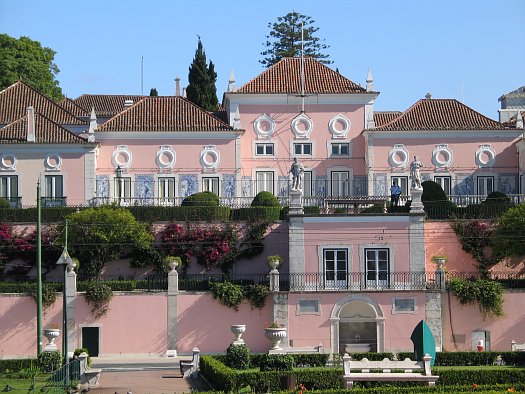
Photo: Kent Wang · CC BY 4.0 · Wikimedia Commons
Palace of Ajuda is a building in Lisbon, Lisbon District, Portugal. Court moved to Ajuda hill after the 1755 earthquake. The free Lokali audio guide runs 7 minutes.
✓ Published October 2026 · how we write these guides
Visitor facts
| Lokali audio guide | 7 min · free |
|---|---|
| Type | Palace |
| Location | Lisbon, Portugal |
| Coordinates | 38.7075, -9.1978 |
| Official website | palacioajuda.pt |
| Languages | 50+, in the Lokali app |
The story
Stand for a moment in the open square before the palace and listen. The wind comes up from the river below, and the gravel shifts under your feet. In front of you is a long wall of pale stone, very regular and very calm. The lines are straight, the windows repeat in steady rows, and the light falls flat across the facade. This is the Palace of Ajuda, on a hilltop in western Lisbon, above the district of Belém.
To understand why a palace stands here at all, we need to go back to one terrible morning. In 1755, a great earthquake struck Lisbon. It was followed by fire and by waves from the river. Much of the city fell, including the old royal palace beside the water. The king and his family survived, but they were badly shaken. Many accounts say the king would no longer sleep under a heavy stone roof.
So the court moved up here, to the high ground of Ajuda. The ground felt safer, and the air was cleaner. But the first royal home on this hill was not made of stone. It was made largely of wood, and Lisbon people called it the Real Barraca, which means something like the royal shed or royal hut. For decades, the Portuguese monarchy lived in this improvised wooden palace. Then, in 1794, a fire destroyed it.
After the fire, work began on a permanent palace in stone. The first designs followed the late Baroque style — the rich, curving style of the eighteenth century. Soon, however, the plans changed. New architects took over, and they turned the building toward Neoclassicism. That style looks back to ancient Greece and Rome, with columns, clean geometry, and a sense of order. What you see in front of you is the result: a building that values balance more than decoration.
Here is the first surprise. For most of its life, this palace was unfinished. In 1807, French armies invaded Portugal, and the royal court sailed to Brazil. They stayed there for years. Work on the palace slowed and stalled. Money was short, and politics were unstable. The grand original plan was never fully built. For around two centuries, one side of the building simply stopped, like a sentence without its last words.
The palace finally came alive as a true royal home in the second half of the nineteenth century. King Luís the First and his wife, Queen Maria Pia, made it their main residence. Maria Pia was an Italian princess from the House of Savoy, and she had strong taste in interiors. Under this couple, the rooms filled with silk, gilded furniture, porcelain, paintings, and heavy curtains. Much of what visitors see inside today reflects their era.
Walk inside, and the mood changes completely. The outside is cool and restrained. The inside is warm, layered, and full of objects. You move from formal state rooms to more private spaces, and the ceilings are often painted. There are chandeliers, mirrors, and inlaid floors. Look down as often as you look up. The floors and the ceilings often tell you as much about the room as the furniture does.
One room that many visitors remember is a room dedicated to porcelain from Saxony, in Germany. Saxon porcelain was one of the great luxury products of Europe, and royal families displayed it as a sign of status. Other rooms show the ceremonial side of the monarchy, such as the throne room, where official audiences took place. Then there are the smaller rooms, where the family actually lived, read, and received friends.
The story of the palace as a royal home did not last long. In 1910, a revolution ended the Portuguese monarchy, and the royal family went into exile. The palace closed its doors. Its contents stayed largely in place, which is unusual. That is the second surprise. Because so much was left behind, the interiors today give a rare picture of how a nineteenth century royal household arranged its daily life. Decades later, the building reopened as a museum.
Now for the newest chapter. Early in the 2020s, the long unfinished west wing was finally completed. Look for the difference between the old stone and the new construction. The new wing does not copy the old facade exactly. It closes the building in a modern way. Inside it is the Royal Treasure Museum, which displays crown jewels, royal regalia, and precious objects of the Portuguese monarchy. It usually requires its own ticket, separate from the palace rooms.
After the palace, consider a short walk to the Ajuda Botanical Garden, which sits just nearby. It was created in the eighteenth century and is considered the oldest botanical garden in Portugal. It was planned as a royal garden for study and for pleasure. Its terraces of clipped hedges step down the hill, and on clear days you can see toward the river. It is a quiet counterpoint to the formal rooms you have just walked through.
The neighbourhood of Ajuda itself is worth a slow look. It is residential and calm, and it feels far from the crowds of central Lisbon. You may hear trams, buses climbing the hill, and conversations from small cafés. Below the hill lies Belém, with its monastery and its riverside monuments. Many visitors come up here after Belém, and the contrast is part of the pleasure. Down there are the great voyages. Up here is the private life of a later monarchy.
Before you leave, turn back once more toward the facade. Notice how long and even it is, and how the light moves across the stone as clouds pass. Think of the wooden palace that once stood on this hill, and the fire that ended it. Think of the decades when this building stood half finished, waiting. Now it is complete at last. As you walk away, listen again for the wind from the river — the same wind that the court felt here, more than two centuries ago.
Key facts
What to look for
Practical tips
Common questions
Is there a free audio guide to Palace of Ajuda?
Yes — the Lokali app narrates Palace of Ajuda free of charge in 50+ languages. The guide runs about 7 minutes, covers the history, what to look for on site and practical tips, and works offline once downloaded.
Where is Palace of Ajuda?
Palace of Ajuda is in Lisbon, Portugal, at 38.7075, -9.1978. Tap the map link on this page for directions from where you are.
What is Palace of Ajuda known for?
Court moved to Ajuda hill after the 1755 earthquake. The earlier wooden royal palace burned down in 1794.
What should you look for at Palace of Ajuda?
Contrast between old stone and the modern west wing. Painted ceilings above the formal state rooms. Inlaid wooden floors that change from room to room.
What should you know before visiting Palace of Ajuda?
Plan extra time for the Royal Treasure Museum wing. Royal Treasure Museum usually needs a separate ticket.
On the map
Opens directions to Palace of Ajuda from your location.
More to see in Lisbon


Hear Palace of Ajuda in your language
The full story, narrated, in 50+ languages. Download it before you go and it plays offline, at your own pace, with no ticket and no tour group.