
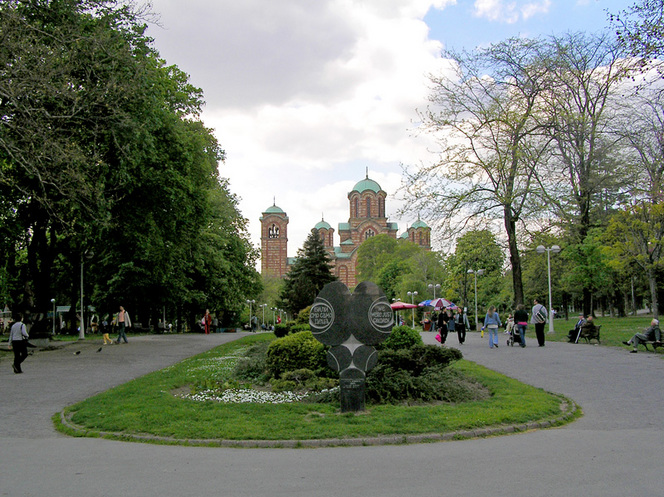
Photo: Museum_of_Nikola_Tesla,_Belgrade,_Serbia.JPG: Rburg87 derivative work: Begoon · CC BY-SA 3.0 · Wikimedia Commons
Nikola Tesla Museum is a museum in Serbia. Tesla was born in 1856 in Smiljan, Austrian Empire. The free Lokali audio guide runs 7 minutes.
✓ Published October 2026 · how we write these guides
Visitor facts
| Lokali audio guide | 7 min · free |
|---|---|
| Type | Museum |
| Location | Belgrade, Serbia |
| Coordinates | 44.8051, 20.4707 |
| Official website | nikolateslamuseum.org |
| Languages | 50+, in the Lokali app |
The story
The street outside is quiet and leafy. Linden trees line the pavement, and old embassy villas stand back behind iron railings. Then you step through a modest doorway, and the air feels different. Somewhere inside, a coil begins to hum. A faint smell of ozone drifts through the room, the sharp, clean smell of air after a lightning storm. This is the Nikola Tesla Museum, and it is one of the few places on earth where a visitor can hold electricity in an open hand.
You are standing in Vračar, one of Belgrade's older central neighbourhoods, on a street known for diplomatic residences and grand family homes. The museum does not live in a purpose-built hall. It lives in a private villa from the late 1920s, a period when Belgrade was growing fast as the capital of the new Kingdom of Yugoslavia. The house was designed as a home, and you can still feel that. The rooms are human in scale, with tall windows and polished stairs. It feels less like a museum and more like visiting someone's study.
The man at the centre of it all was born in 1856, in the village of Smiljan. Today that village lies in Croatia. At the time, it belonged to the Austrian Empire. Tesla was an ethnic Serb, and his father was a Serbian Orthodox priest. He studied engineering in Graz and worked in Budapest and Paris. Then, in his late twenties, he sailed to New York. That journey shaped the rest of his life. He arrived with very little money, but with a head full of ideas about rotating magnetic fields.
Those ideas changed the modern world. Tesla developed the alternating current induction motor, and he worked on a practical system for alternating current power. This is the kind of electricity that still flows through the sockets in the walls around you. He also experimented with high-frequency currents, wireless lighting, radio, and remote control. Some of his projects worked brilliantly. Others were decades ahead of the technology available to build them. He was famous, admired, and often in debt — all at the same time.
Tesla died in New York in January 1943, alone in a hotel room. He was eighty-six years old. His papers, notebooks, and belongings did not stay in America. His nephew, Sava Kosanović, was a Yugoslav diplomat. He arranged for the estate to be shipped to Belgrade in the early 1950s. The Yugoslav government then created this museum to hold it. So the objects around you made a long journey across the Atlantic, to a city that Tesla himself visited only briefly.
That visit is worth remembering. In 1892, Tesla came to Belgrade for a short stay. By then he was already celebrated in Europe and America. Crowds came out to greet him, and he was received by the young king. He spoke to students and told them he was proud to be a son of this people. For a city that was then small and still finding its place in Europe, it was a moment of great pride. That sense of ownership has never really faded here.
Now, the part most visitors remember. The guided tour usually includes live demonstrations. A guide switches on a large Tesla coil, and violet sparks leap through the air with a loud, crackling snap. Then comes the surprise. Visitors are often handed a long fluorescent tube. With no wire and no plug, the tube begins to glow in your hand, powered by the field around the coil. It is a simple trick of physics, but it still makes adults laugh like children.
Beyond the sparks, look closely at the models of induction motors and generators. Some show the famous principle of the rotating magnetic field. In one well-known demonstration, a metal egg spins upright on a plate, pushed by invisible magnetic forces. Tesla used a similar display to explain his ideas to audiences who had never seen anything like it. Watching the egg turn, you understand in seconds what pages of equations try to describe. That gift for showmanship was part of Tesla's genius.
Here is something many visitors miss. The real treasure of this museum is mostly out of sight. The archive holds a vast collection of Tesla's original papers — letters, drawings, notebooks, patents, and photographs. Scholars from around the world come to study them. In 2003, UNESCO added the archive to its Memory of the World Register. That register protects documents of global importance. So the quiet filing cabinets behind these walls matter as much as the humming coil in the front room.
The display cases also show Tesla the man, not only Tesla the inventor. You may see his clothing, his gloves, his hat, and personal items from his New York years. He was known for being tall, thin, and very carefully dressed. He also had strong habits and fixations, and many stories about them circulate. Some are well documented. Others grew over time into legend. Treat the more colourful tales with a little caution, and enjoy the real objects in front of you.
And then there is the most moving room in the house. In a quiet space, under soft light, stands a golden sphere. Inside it are Tesla's ashes. They were brought to Belgrade in the 1950s, after his cremation in New York. It is often said that the sphere was chosen because it was Tesla's favourite shape. Whatever the reason, the effect is calm and strangely personal. People tend to lower their voices here, even without being asked.
The urn has also caused debate. For years, some voices in Serbia, including figures in the Orthodox Church, have argued that the ashes should rest in a religious setting, such as the great Church of Saint Sava nearby. Others believe they belong here, beside his life's work. The discussion has come and gone in public life. It shows how much Tesla still means to people in this country. He is a scientist, a symbol, and a family member all at once.
When you leave, you will see Tesla's name again and again across this city. The airport carries it. His face has appeared on Serbian banknotes. The international unit of magnetic flux density is called the tesla, named in his honour. As you step back onto the leafy street, listen for a moment. The trams, the traffic lights, the phone in your pocket... all of them run on ideas that passed through the mind of the man whose ashes rest just behind you.
Key facts
What to look for
Practical tips
Common questions
Is there a free audio guide to Nikola Tesla Museum?
Yes — the Lokali app narrates Nikola Tesla Museum free of charge in 50+ languages. The guide runs about 7 minutes, covers the history, what to look for on site and practical tips, and works offline once downloaded.
Where is Nikola Tesla Museum?
Nikola Tesla Museum is near Belgrade, Serbia, at 44.8051, 20.4707. Tap the map link on this page for directions from where you are.
What is Nikola Tesla Museum known for?
Tesla was born in 1856 in Smiljan, Austrian Empire. His estate reached Belgrade through his nephew Sava Kosanović.
What should you look for at Nikola Tesla Museum?
The golden sphere holding Tesla's ashes in a quiet room. Violet sparks leaping from the large Tesla coil. A metal egg spinning upright on a magnetic plate.
What should you know before visiting Nikola Tesla Museum?
Join the guided tour to see the live coil demonstrations. Volunteer to hold the tube when the guide asks.
When is the best time to visit Nikola Tesla Museum?
Arrive early, as the small rooms fill up quickly.
On the map
Opens directions to Nikola Tesla Museum from your location.
More to see in Belgrade


Hear Nikola Tesla Museum in your language
The full story, narrated, in 50+ languages. Download it before you go and it plays offline, at your own pace, with no ticket and no tour group.