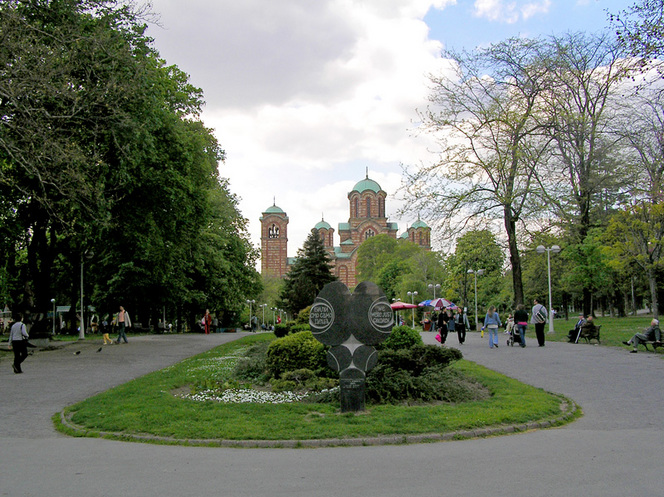
Photo: LukaP at en.wikipedia · CC BY-SA 3.0 · Wikimedia Commons
Tašmajdan Park is a public park and the surrounding urban neighborhood of Belgrade, Serbia. Tašmajdan comes from Turkish words meaning stone ground. The free Lokali audio guide runs 6 minutes.
✓ Published October 2026 · how we write these guides
Visitor facts
| Lokali audio guide | 6 min · free |
|---|---|
| Type | Park |
| Location | Belgrade, Serbia |
| Coordinates | 44.8092, 20.4708 |
| Languages | 50+, in the Lokali app |
The story
Listen for a moment. Beyond the traffic on the boulevard, the park has a softer sound. You may hear gravel under shoes, pigeons on a stone ledge, and children's voices near the benches. Under the plane trees, the light falls in patches and moves when the wind shifts the leaves. It feels like an ordinary city park, a green pause in central Belgrade. But the ground beneath your feet is not quite solid in the way you might expect.
Start with the name. Tašmajdan comes from Turkish, and it means, roughly, stone ground or stone quarry. That is the first surprise. This park sits on top of an old quarry. For centuries, people cut pale limestone out of this hill. It was a practical stone, easy to work and close to the city. When you walk here, you walk across the roof of an old excavation.
The quarrying may go back to Roman times, when Belgrade was a frontier town called Singidunum, on the edge of the empire. Later builders used the same stone through the Ottoman centuries, the long period when Belgrade was a Turkish-ruled city. Stone from under this park went into walls, houses, and foundations across town. In a quiet way, parts of old Belgrade came out of the ground where you are standing now.
All that cutting left something behind — a network of caves and tunnels below the surface. You cannot see it from the paths, and most visitors never think about it. During the Second World War, the occupying German army used these underground spaces as a shelter and command area. Later, Belgraders also knew the caves as places to hide from bombing. The park above stayed green while the space below held fear and waiting.
The land had another role, too. For a long period, this area held one of the city's main cemeteries. Gravestones stood where lawns and benches are today. As Belgrade grew in the nineteenth century, the city opened a large new cemetery further out, and burials here came to an end. Over time, the old graveyard gave way to a public garden. So this is a place of stone, of the dead, and now of everyday city life.
Now turn toward the largest building at the park's edge. That is the Church of Saint Mark. You will notice its colours first — bands of yellow and red, made with stone and brick in alternating rows. This striped style comes from Serbian medieval churches, which followed Byzantine models. Byzantine here means the art of the eastern Christian empire centred on Constantinople. The church was built between the two world wars, but it looks back many centuries.
The church is very large, and its interior feels high and cool. Inside, it holds the tomb of Tsar Dušan, the fourteenth-century ruler who led medieval Serbia at its greatest size. His remains were brought here in the twentieth century. For many Serbs, this gives the church a special weight. A visit inside is quiet, and a few minutes standing near the tomb connects this modern park to the medieval Serbian kingdom.
Behind Saint Mark's, look for a much smaller church with onion-shaped domes. This is the Russian Church of the Holy Trinity. It was built by Russian emigrants who came to Belgrade after the Russian Revolution and Civil War. Many of them settled in the city in the 1920s. The White Army general Pyotr Wrangel is buried inside. Most people walk past without noticing it, so it is worth a short detour around the back.
On the other side of the park, the mood changes. Here you can see the building of Radio Television of Serbia, the state broadcaster. In April 1999, during the NATO bombing of Yugoslavia, a missile struck this building at night. Sixteen employees died, most of them technical staff working the shift. For Belgraders, this is one of the most painful memories of that spring.
Near the building stands a small memorial with one word cut into it, Zašto, which means why. It names the people who were killed. The question has no answer written below it. Nearby, a separate monument remembers children killed during the bombing across the country. Families still leave flowers and candles here on anniversaries. If you see fresh flowers, you will understand that this history is not distant for the people who live here.
Tašmajdan is also part of daily sports life in Belgrade. On the slope of the old quarry is a sports centre with swimming pools, and an outdoor pool fills with people in the hot summer months. Close by is a large indoor arena used for basketball and concerts. On match nights, the streets around the park fill with fans, scarves, and noise. It is a strange and very Belgrade mix — memorials, churches, and cheering crowds within a few hundred metres.
On a normal afternoon, though, the park belongs to locals. Retirees sit and talk on the benches. Students cut across the paths between lectures, because the university faculties are not far away. Parents push strollers under the trees, and dogs pull their owners toward the grass. This park sits between the old centre and the busy boulevard, so many people pass through it rather than stopping. Take a moment to stop anyway.
Before you leave, stand still and look around once more. Look at the striped walls of Saint Mark's, the green domes of the small Russian church, and the plain broadcaster building. Remember the empty tunnels under the grass and the old graves that once stood here. Then listen again — the gravel, the birds, the traffic in the distance. The ground under you is hollow in places, but the life on top of it is steady. That is Tašmajdan.
Key facts
What to look for
Practical tips
Common questions
Is there a free audio guide to Tašmajdan Park?
Yes — the Lokali app narrates Tašmajdan Park free of charge in 50+ languages. The guide runs about 6 minutes, covers the history, what to look for on site and practical tips, and works offline once downloaded.
Where is Tašmajdan Park?
Tašmajdan Park is in Belgrade, Serbia, at 44.8092, 20.4708. Tap the map link on this page for directions from where you are.
What is Tašmajdan Park known for?
Tašmajdan comes from Turkish words meaning stone ground. Limestone was quarried here, possibly since Roman times.
What should you look for at Tašmajdan Park?
Alternating yellow and red stripes on Saint Mark's walls. Onion-shaped domes of the Russian Holy Trinity Church. The memorial carved with the single word Zašto.
What should you know before visiting Tašmajdan Park?
Walk behind Saint Mark's to find the small Russian church. Dress modestly if you plan to enter the churches.
When is the best time to visit Tašmajdan Park?
Check event schedules, as arena match nights bring heavy crowds.
On the map
Opens directions to Tašmajdan Park from your location.
More to see in Belgrade


Hear Tašmajdan Park in your language
The full story, narrated, in 50+ languages. Download it before you go and it plays offline, at your own pace, with no ticket and no tour group.