
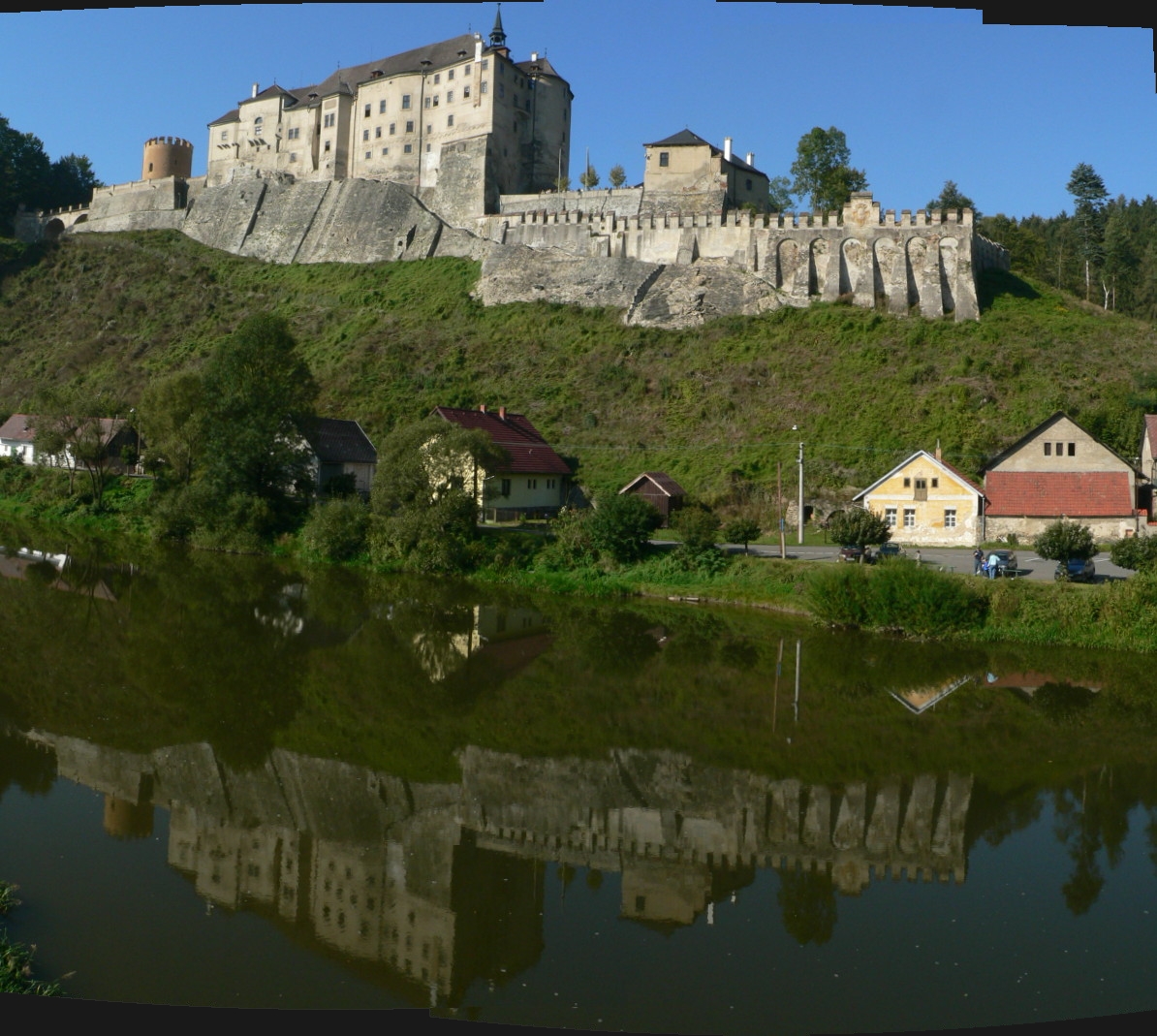
Photo: Marek Prokop from Říčany, Czech Republic · CC BY 2.0 · Wikimedia Commons
Konopiště Castle is a château located in the Czech Republic. Founded as a Gothic fortress in the late thirteenth century. The free Lokali audio guide runs 8 minutes.
✓ Published October 2026 · how we write these guides
Visitor facts
| Lokali audio guide | 8 min · free |
|---|---|
| Type | Castle |
| Location | Benešov, Czechia |
| Coordinates | 49.7794, 14.6567 |
| Official website | zamek-konopiste.cz |
| Languages | 50+, in the Lokali app |
The story
Listen for a moment. Gravel shifts under your shoes, and somewhere in the park a pheasant calls from the long grass. Ahead, pale walls and round towers rise from a wooded ridge. The air smells of damp earth, cut lawn and old timber. This is Konopiště Castle, in the green country of Central Bohemia, a short distance from the town of Benešov and less than an hour south of Prague. It looks calm today. But this house belonged to one of the most consequential men of the early twentieth century.
The story begins long before him. Konopiště was founded as a Gothic fortress in the late thirteenth century. Its builder is linked to the Benešov family, a powerful noble line in medieval Bohemia. The original plan followed a French model. It was a compact rectangle with round towers at the corners, designed for defence rather than comfort. As you walk around the walls, look at the thickness of the stone and the shape of the towers. That medieval skeleton still holds the whole building together.
Over the centuries, the castle passed through many noble hands. Each owner changed it to fit the fashion and the needs of the age. Sieges and wars left their marks. In the eighteenth century, the castle received a softer baroque character. The moat lost its military purpose. Gardens, gates and decorative statues gave the approach a more welcoming face. A fortress slowly became a country residence. Much of what you see is this blend of medieval structure and later polish.
Then, in 1887, a new owner arrived. He was Archduke Franz Ferdinand of Austria-Este, heir to the throne of the Habsburg Empire. He bought Konopiště and transformed it into his private home. The work was extensive. Modern heating, electricity, plumbing and even a lift were installed. The interiors were reshaped in a romantic historical style. For the archduke, this was not a palace for state ceremony. It was a retreat — a place where he could live away from the rigid court in Vienna.
That retreat mattered for a personal reason. Franz Ferdinand married Countess Sophie Chotek, a Czech noblewoman. The imperial court judged her rank too low for a future emperor. The marriage was allowed only on strict terms. Their children could never inherit the throne, and Sophie was often excluded at court events. At Konopiště, those rules mattered less. Here the couple raised their three children in a warm family atmosphere. Many visitors are surprised to find such an intimate home behind such a formal name.
Now comes the detail that stops most people in the corridors. Franz Ferdinand was an obsessive hunter. He kept careful records of every animal he shot. Across his lifetime, the total is usually given at close to 300,000 animals. A large part of his trophy collection still hangs at Konopiště. Antlers, horns and mounted heads line the walls in long rows, from floor to ceiling. The effect is overwhelming. Some visitors find it fascinating. Others find it deeply uncomfortable. Both reactions are part of the experience here.
The archduke collected more than trophies. His other great passion was Saint George, the Christian soldier-saint who, according to legend, killed a dragon. Franz Ferdinand gathered paintings, statues, carvings and small objects showing the saint. The result is one of the largest collections devoted to Saint George anywhere. Seeing the same dragon story repeated in so many styles and centuries is a strange pleasure. Look closely at the dragons. Some are fierce, some are almost comic, and a few look strangely sad.
The castle also holds a remarkable collection of arms and armour. Much of it came to Franz Ferdinand through his inheritance from the House of Este, an old Italian ducal family. That is where the "Este" in his title comes from. Swords, shields, helmets and firearms fill the rooms, many of them decorated with fine engraving. They show weapons not only as tools of war, but also as objects of status and art. Notice how much effort went into decorating things designed to kill.
Outside, the archduke shaped the landscape as carefully as the house. He was a passionate gardener. The large park around the castle mixes open lawns, ponds, woodland paths and garden statues. The rose garden near the greenhouses was one of his personal projects, and it is still a place to slow down in summer. The park is wide, so the noise of tour groups quickly fades. Within a few minutes you can hear only wind in the trees and water birds on the ponds.
In June 1914, Konopiště received an important guest. The German emperor, Wilhelm the Second, visited the archduke here and walked in these gardens. Only a short time later, Franz Ferdinand and Sophie travelled to Sarajevo. There, on 28 June 1914, both were shot and killed. Their deaths set off the chain of events that led to the First World War. Because of the timing, rumours spread about a secret plan made at Konopiště. Historians generally treat that story as speculation, not documented fact.
After the war, the empire collapsed and the new state of Czechoslovakia took ownership of the castle. The archduke's sons were not allowed to keep it. During the Second World War, the German occupiers used the estate, and some of its collections were moved. After the war, many items returned, and the castle eventually opened to the public as a state property. Today it is cared for as a national heritage site. The rooms remain arranged much as the family knew them.
A few practical thoughts as you explore. The interiors are shown on guided tours, and there are usually several different routes. One focuses on the main residential rooms. Another covers the family's private apartments or the collections. If you have time, choose more than one, because each shows a different side of the house. Inside, the rooms can feel cool even in summer. Outside, the park paths are long and partly uneven, so comfortable shoes make a real difference.
Before you leave, walk back toward the moat and the entrance bridge. Look for the bears. For many years, bears have been kept in the castle moat, following an old tradition at some Bohemian castles. Their presence feels odd and old-fashioned, and it often starts a conversation about how we treat animals today. In a house so full of hunting trophies, that conversation feels especially fitting. It is one more layer in a place where beauty and unease sit side by side.
Now stand still for a moment and look up at the towers again. The Gothic stone, the baroque gate and the archduke's comfortable windows all belong to one building. Think of the family who once ran across these lawns, and of the journey that ended their story. As you walk away through the park, listen to the gravel again. The castle stays behind you, quiet among the trees, holding more history than its calm walls suggest.
Key facts
What to look for
Practical tips
Common questions
Is there a free audio guide to Konopiště Castle?
Yes — the Lokali app narrates Konopiště Castle free of charge in 50+ languages. The guide runs about 8 minutes, covers the history, what to look for on site and practical tips, and works offline once downloaded.
Where is Konopiště Castle?
Konopiště Castle is near Benešov, Czechia, at 49.7794, 14.6567. Tap the map link on this page for directions from where you are.
What is Konopiště Castle known for?
Founded as a Gothic fortress in the late thirteenth century. Archduke Franz Ferdinand bought the castle in 1887.
What should you look for at Konopiště Castle?
Round corner towers from the original French-style medieval plan. Walls of antlers and horns lining the long corridors. Dragons with very different expressions in the Saint George collection.
What should you know before visiting Konopiště Castle?
Book a guided tour route in advance during summer weekends. Choose two tour routes to see different sides of the castle.
When is the best time to visit Konopiště Castle?
Visit the rose garden in early summer for the best blooms.
On the map
Opens directions to Konopiště Castle from your location.
More to see near Konopiště Castle


Hear Konopiště Castle in your language
The full story, narrated, in 50+ languages. Download it before you go and it plays offline, at your own pace, with no ticket and no tour group.