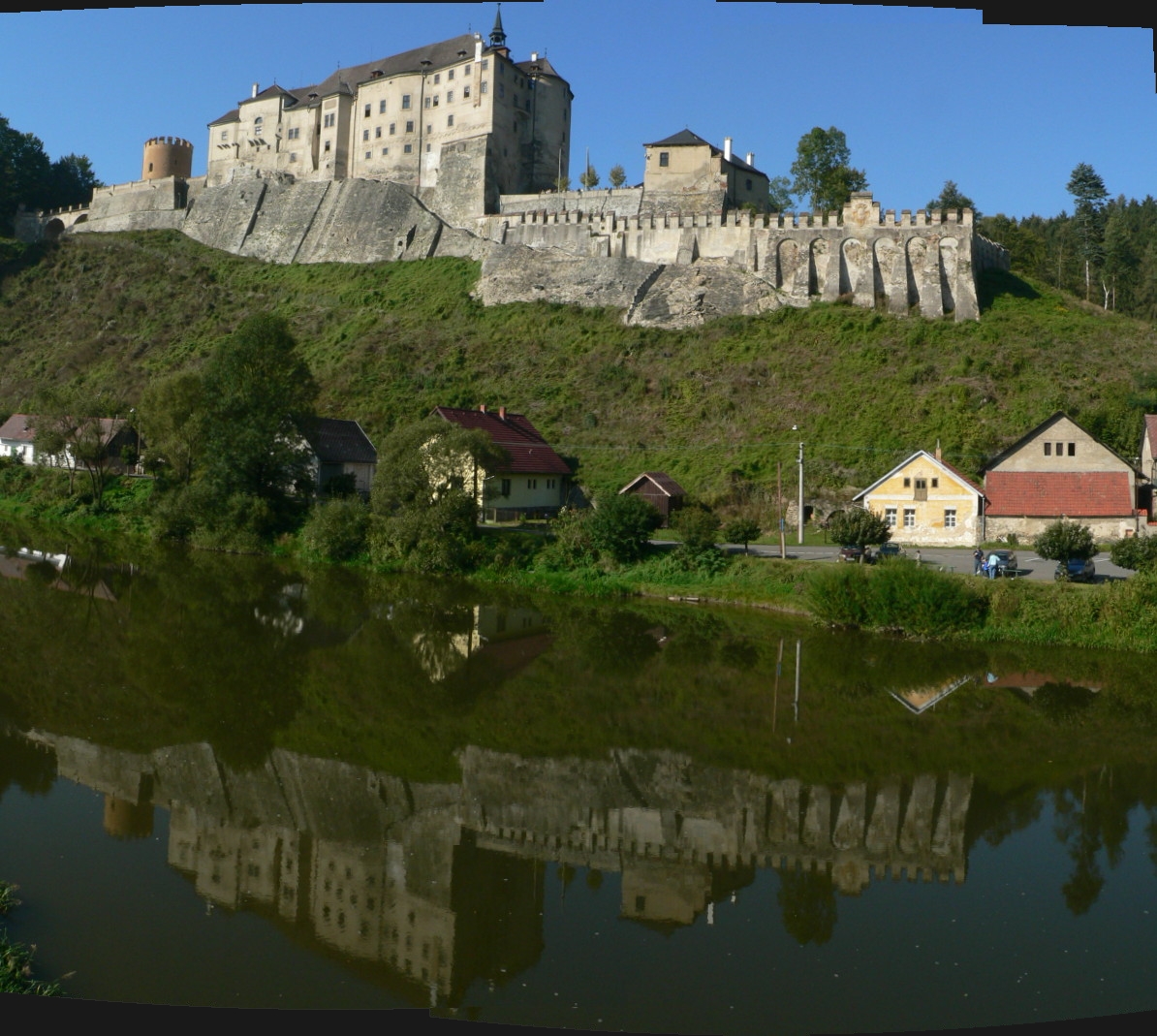
Photo: Petr Kalivoda · CC BY-SA 3.0 · Wikimedia Commons
Český Šternberk Castle is a 13th c. Bohemian castle. It is in Český Šternberk, Czechia. Founded around 1241 by Zdeslav of Divišov. The free Lokali audio guide runs 6 minutes.
✓ Published October 2026 · how we write these guides
Visitor facts
| Lokali audio guide | 6 min · free |
|---|---|
| Type | Castle |
| Location | Český Šternberk, Czechia |
| Coordinates | 49.8089, 14.9264 |
| Official website | hradceskysternberk.cz |
| Languages | 50+, in the Lokali app |
The story
Listen first to the river. Far below the castle walls, the Sázava runs green and quiet through its wooded valley. Its sound comes up the rock face in soft waves. The air here often smells of damp moss and old stone, and on a still morning you can hear a train winding along the riverbank. Look up, and the castle is right there. It is a long pale body of walls and roofs, laid along a narrow ridge as if it grew from the rock.
This is Český Šternberk Castle, in the heart of Central Bohemia, the historic western region of the Czech Republic. Its story begins in the thirteenth century. Historical records link its founding to a nobleman named Zdeslav of Divišov, around the year 1241. He chose a ridge that drops steeply on almost every side. That was a sound choice for defence, because an enemy had very few ways to approach the walls.
Zdeslav also took a new name for his family, and that name holds the first surprise. In German, Stern means star and Berg means mountain. So Sternberg, or Šternberk in Czech, means simply star mountain. The family emblem is an eight-pointed star. You will see it again and again inside — on doors, on paintings, carved into wood and stone. The castle, the village below and the family all share one name.
Here is the second surprise, and many visitors only learn it at the end of the tour. The Sternberg family still owns this castle today. For most of nearly eight centuries, it stayed in the hands of one lineage. Very few castles in Central Europe can claim that. Wars, sales and revolutions broke the line in most other places. Here the line was bent many times, but it was never fully broken.
It came close, though. The castle saw sieges and damage during the turbulent wars of the fifteenth century. It suffered again during the Thirty Years' War, the long religious conflict that tore through Central Europe in the seventeenth century. Each time, the family repaired what had fallen. Look at the outer walls as you walk around them. The stone shows its age in the patches, in changes of texture, and in the layers of work from different centuries.
The twentieth century brought the hardest break. After the Communist government took power in Czechoslovakia, the state confiscated the castle in 1949, along with countless other aristocratic properties. The family lost their home. The castle became state property and opened as a museum. For four decades, strangers walked through rooms where the Sternbergs had lived for generations, and the family could not call the building their own.
Then came 1989 and the Velvet Revolution, the peaceful end of Communist rule. In the early 1990s, new laws allowed many families to reclaim property that the regime had taken. The Sternbergs recovered their castle. Today the family still lives in part of the building, and the rest is open to visitors. When you walk the halls, you are walking through a museum — but also through somebody's home.
From outside, the castle looks Gothic and severe. It sits high, it is long and narrow, and its walls are built for defence. Inside, the mood changes. In the seventeenth century, the family rebuilt many interiors in the Baroque style, the ornate taste of that era. Ceilings fill with white stucco — sculpted plaster shaped into garlands, shells and figures. The rooms feel lighter and warmer than the rugged exterior suggests.
Pay attention to the walls of the corridors and rooms. The castle holds a large collection of copper engravings, many of them from the period of the Thirty Years' War. They show battles, sieges and towns, often in fine, crowded detail. Stand close to one and you can see tiny soldiers, smoke and fortifications drawn with a hard, precise line. Together, these prints form a kind of picture history of a war that shaped this whole region.
You will also see hunting trophies, family portraits, carved furniture and rooms full of porcelain and weapons. The portraits matter here more than in most castles. These faces are not anonymous nobles bought at auction. They are ancestors of the people who still live upstairs. Look for the eight-pointed star in the corners of frames and on coats of arms. It ties every generation in these rooms to the founder on the ridge.
Now step to a window, or out onto a terrace, and look down. The valley falls away sharply beneath you. The river bends around the base of the rock, and the red roofs of the village gather along its banks. Across the water, the forested hills roll away in shades of green. From this height, you understand why a medieval lord chose this exact spot. He could see anyone coming from a long way off.
The railway in the valley has its own small story. The line follows the twists of the Sázava, crossing and recrossing the landscape. Czech travellers love it for weekend trips, and the station lies just below the castle. Many visitors arrive the old way — by train from the Prague direction, then on foot up the hill. It is a slow approach, and it lets the castle grow larger with every step.
So take a moment before you leave. Feel the stone under your hand, cool even on a warm day. Listen again for the river and perhaps for the next train in the valley. Look once more at the star above a doorway. People have lived behind these walls for nearly eight hundred years, and some of them still do. As you walk back down the hill, turn around once. The castle will still be there, long and pale on its ridge, watching the valley as it always has.
Key facts
What to look for
Practical tips
Common questions
Is there a free audio guide to Český Šternberk Castle?
Yes — the Lokali app narrates Český Šternberk Castle free of charge in 50+ languages. The guide runs about 6 minutes, covers the history, what to look for on site and practical tips, and works offline once downloaded.
Where is Český Šternberk Castle?
Český Šternberk Castle is in Český Šternberk, Czechia, at 49.8089, 14.9264. Tap the map link on this page for directions from where you are.
What is Český Šternberk Castle known for?
Founded around 1241 by Zdeslav of Divišov. Šternberk means star mountain in German origin.
What should you look for at Český Šternberk Castle?
Eight-pointed star carved above doors and frames. White Baroque stucco garlands on the ceilings. Thirty Years' War copper engravings along corridors.
What should you know before visiting Český Šternberk Castle?
Take the scenic Sázava valley train to the village station. Wear sturdy shoes for the steep walk up.
On the map
Opens directions to Český Šternberk Castle from your location.
More to see near Český Šternberk Castle


Hear Český Šternberk Castle in your language
The full story, narrated, in 50+ languages. Download it before you go and it plays offline, at your own pace, with no ticket and no tour group.