
Kaiser Wilhelm Memorial Church
52.5047° N · 13.3353° E · Church
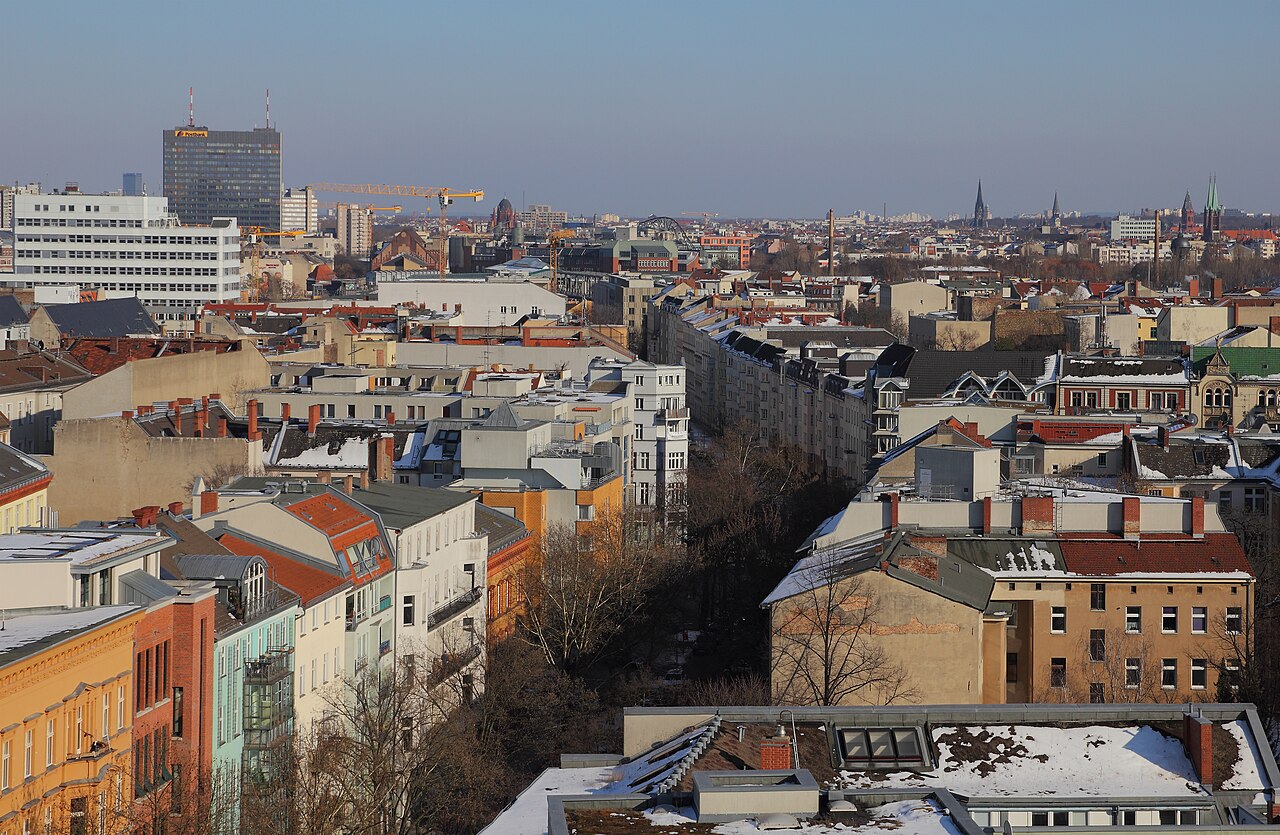
Photo: nl:User:GerardM · CC BY-SA 3.0 · Wikimedia Commons
Kaiser Wilhelm Memorial Church is a church in Berlin. Built in the 1890s to honour Kaiser Wilhelm the First. The free Lokali audio guide runs 6 minutes.
✓ Published October 2026 · how we write these guides
Visitor facts
| Lokali audio guide | 6 min · free |
|---|---|
| Type | Church |
| Location | Berlin, Germany |
| Coordinates | 52.5047, 13.3353 |
| Official website | gedaechtniskirche-berlin.de |
| Languages | 50+, in the Lokali app |
The story
Stand still for a moment on Breitscheidplatz and listen. Buses hiss to a stop. Shoppers drift toward the Kurfürstendamm. Above all of it rises a dark, broken tower, its top torn open against the sky. Next to it stands something completely different: a flat-roofed octagon of concrete and deep blue glass. Two buildings, two moods, one site. This is the Kaiser Wilhelm Memorial Church, and few places in Berlin tell the story of the city's twentieth century so directly.
Begin with the old tower, because it came first. In the late nineteenth century, Kaiser Wilhelm the Second ordered a grand church here in memory of his grandfather, Wilhelm the First. The older Wilhelm was the first emperor of a unified Germany. The architect was Franz Schwechten, and the church was completed in the 1890s. At that time, this corner was still on the western edge of the growing city. A monument like this was meant to show that the new imperial capital was moving west.
Schwechten chose a Neo-Romanesque style. Romanesque is the heavy, round-arched style of European churches from around the eleventh and twelfth centuries. The choice was deliberate. It linked the young German Empire to the medieval Holy Roman Empire, as if to say this power was ancient, not new. Look at the stone of the tower. You can still see round arches, small decorative columns, and thick walls built to look as if they would last forever.
They did not. In November 1943, during an Allied air raid on Berlin, the church was badly hit. Fire and bombs destroyed most of the building, and the main spire lost its upper section. What you see now is mostly the stump of the west tower. Walk around it slowly. The edges of the broken stone are still rough. Scorch marks and cracks remain in the walls. Nobody tidied them away.
Here is the first surprise. After the war, the ruin was very nearly demolished. The architect chosen to build a new church, Egon Eiermann, originally planned to remove the old tower altogether. Berliners objected strongly. Many people wanted the ruin kept as a warning against war. The protest worked. The plan changed, and the broken tower stayed, now framed by Eiermann's new buildings rather than replaced by them.
Berliners have a sharp sense of humour, and they gave the site nicknames. The ruined tower is often called the hollow tooth, because of its jagged, decayed top. The tall new bell tower and the low octagonal church beside it have their own joke. Locals call them the lipstick and the powder compact. Once you hear it, it is hard to see them any other way. Look up at the new tower now and judge for yourself.
Eiermann's new church was built around 1960, and from the outside it looks almost austere. A grid of concrete holds thousands of small glass blocks. In daylight, from the square, the walls look dark, almost grey. That is part of the design. The real effect only happens when you step inside. If the doors are open, go in now and let your eyes adjust for a few seconds.
Inside, the light turns blue. Deep, saturated blue glass surrounds you on every side, broken by small points of red, gold, and green. The glass was made by the French artist Gabriel Loire in his workshop in Chartres, a town famous for its medieval stained-glass cathedral. The walls are double, with a gap between them. This helps to keep out the noise of the city. Notice how quiet it becomes, only a few steps from the traffic.
Above the altar hangs a large golden figure of Christ, arms spread, seeming to float against the blue. Look for a smaller, quieter object too. In the church you can find a copy of a charcoal drawing known as the Stalingrad Madonna. A German army doctor named Kurt Reuber drew it during the Battle of Stalingrad, at Christmas in 1942, on the back of a Soviet map. He did not survive captivity. The drawing did, and it became a symbol of longing for peace.
Now go back to the old tower. Its base holds a memorial hall, and this is the second surprise. Many visitors walk past without going in. Inside, rich mosaics from the original church still cover the ceiling and walls, glittering with gold. One mosaic shows members of the Hohenzollern family, the royal dynasty of Prussia, walking in procession. Photographs and exhibits show the church before the bombing, so you can compare the grand original with the ruin around you.
The hall also holds signs of reconciliation. A cross made from old medieval nails came from Coventry in England. Coventry's own cathedral was destroyed by German bombing in 1940. The Cross of Nails is a gift shared among churches that work for peace between former enemies. Here, in the ruin of a German imperial church, it carries a quiet message: the destruction went in both directions, and so can the healing.
The square outside has its own recent history. Each winter, a Christmas market fills Breitscheidplatz with wooden stalls, warm wine, and the smell of roasted almonds. In December 2016, a terrorist drove a truck into that market, and people were killed. Today a memorial marks the place. Look down near the church steps. A golden crack runs across the ground, and the names of the victims are written on the steps. Many people walk over it without noticing.
Take a final moment before you leave. Behind you is the Kurfürstendamm, the long avenue of shops and cafés. Around you are glass office towers and the constant movement of West Berlin. In the middle stands the hollow tooth, still broken, still kept. As you walk away, turn back once. Watch how the dark tower and the blue glass sit side by side... the old wound and the quiet answer, in the same frame.
Key facts
What to look for
Practical tips
Common questions
Is there a free audio guide to Kaiser Wilhelm Memorial Church?
Yes — the Lokali app narrates Kaiser Wilhelm Memorial Church free of charge in 50+ languages. The guide runs about 6 minutes, covers the history, what to look for on site and practical tips, and works offline once downloaded.
Where is Kaiser Wilhelm Memorial Church?
Kaiser Wilhelm Memorial Church is in Berlin, Germany, at 52.5047, 13.3353. Tap the map link on this page for directions from where you are.
What is Kaiser Wilhelm Memorial Church known for?
Built in the 1890s to honour Kaiser Wilhelm the First. Original architect was Franz Schwechten, Neo-Romanesque style.
What should you look for at Kaiser Wilhelm Memorial Church?
Jagged broken top of the old west tower. Golden mosaics of the Hohenzollern family in procession. Charcoal Stalingrad Madonna drawing on a Soviet map.
What should you know before visiting Kaiser Wilhelm Memorial Church?
Step inside the new octagon to see the blue glass. Visit the memorial hall in the old tower's base.
On the map
Opens directions to Kaiser Wilhelm Memorial Church from your location.
More to see in Berlin



Hear Kaiser Wilhelm Memorial Church in your language
The full story, narrated, in 50+ languages. Download it before you go and it plays offline, at your own pace, with no ticket and no tour group.