
Memorial to Homosexuals Persecuted Under Nazism
52.5133° N · 13.3761° E · Monument
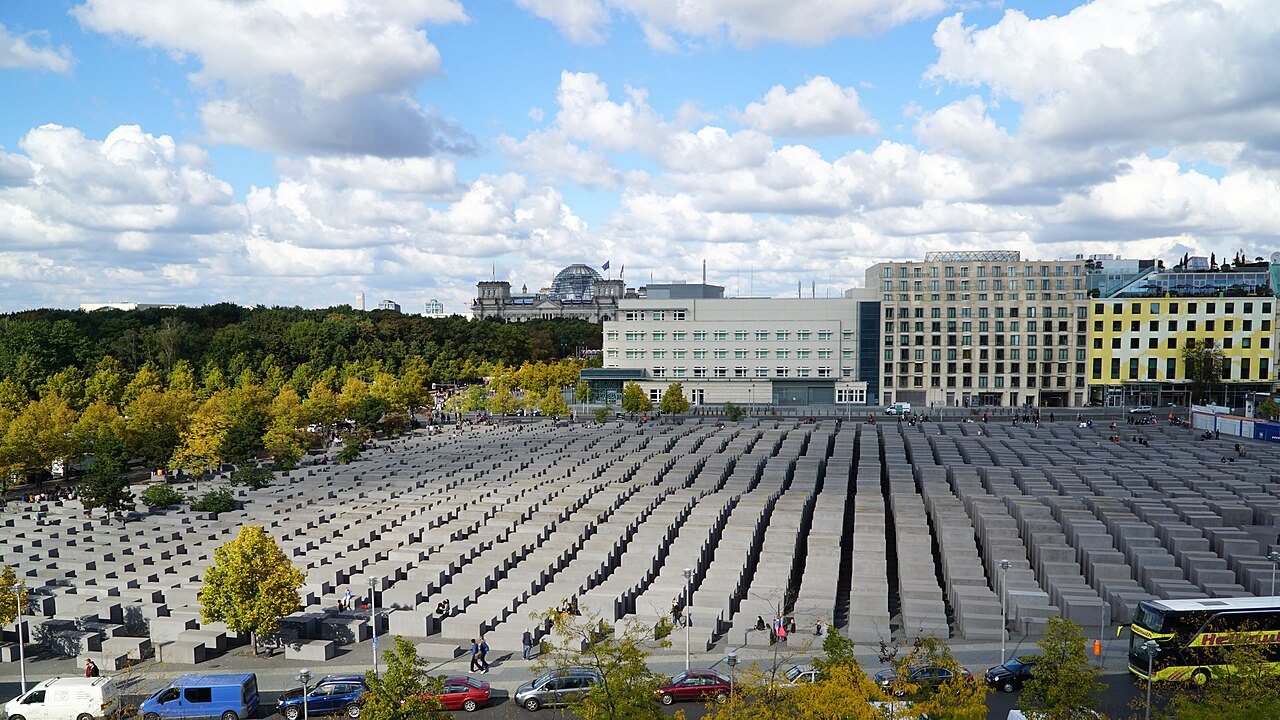
Photo: Times · CC BY-SA 3.0 · Wikimedia Commons
Memorial to Homosexuals Persecuted Under Nazism is a memorial in Berlin, Germany. Designed by artist duo Michael Elmgreen and Ingar Dragset. The free Lokali audio guide runs 7 minutes.
✓ Published October 2026 · how we write these guides
Visitor facts
| Lokali audio guide | 7 min · free |
|---|---|
| Type | Monument |
| Location | Berlin, Germany |
| Coordinates | 52.5133, 13.3761 |
| Languages | 50+, in the Lokali app |
The story
Listen for a moment. Behind you, the trees of the Tiergarten move in the wind. In front of you, traffic hums along Ebertstraße. And between those two sounds stands a block of grey concrete, plain and silent, leaning very slightly forward. It has no name carved across its face and no heroic figure. It does not ask for your attention. If you walked past quickly, you might take it for a utility structure. But step closer, and you will see that this block has a window.
You are standing at the Memorial to Homosexuals Persecuted Under Nazism. It sits at the eastern edge of the Tiergarten, Berlin's great central park, in the district of Mitte. It was unveiled in 2008. The memorial honours the gay men who were arrested, imprisoned, and killed under the Nazi regime. It also remembers lesbian women, who faced persecution in different and often less recorded ways. For many decades, these victims had almost no public place of remembrance in Germany.
Look across the road, toward the field of grey stone blocks. That is the Memorial to the Murdered Jews of Europe, designed by the American architect Peter Eisenman. The connection is deliberate. The artists who made this memorial, the Danish and Norwegian duo Michael Elmgreen and Ingar Dragset, shaped their block to echo those stelae. It looks as if one stone has stepped away from the field and come to rest here, among the trees. It is related, but it stands apart.
Now walk up to the window. It is small, set at roughly eye level, and you may need to lean in. Inside, a short film plays on a loop. When the memorial opened, the film showed two men kissing. It is an ordinary, tender gesture. Under the Nazis, a gesture like this could lead to arrest. Here is the first quiet surprise of this place. The memorial's most powerful image is not suffering. It is affection, the very thing that was criminalised.
The legal tool behind that persecution had a number: Paragraph 175. This section of the German criminal code made sexual acts between men a crime. It existed long before Hitler, from the time of the German Empire in the late nineteenth century. In 1935, the Nazi government widened it sharply. After that change, even a glance, a letter, or a touch could be treated as evidence. The police built special units and kept lists of suspected men.
The numbers are estimates, and historians still debate them. Around one hundred thousand men were arrested under the Nazi regime. Roughly half of them were convicted. Several thousand were sent to concentration camps. There, they were forced to wear a pink triangle on their uniforms, a badge that marked them as homosexual prisoners. Many of them died from hunger, from violence, or from forced labour. Some were used in brutal medical experiments.
And here is the second surprise, the one that many visitors do not expect. When the war ended in 1945, the persecution did not end. West Germany kept Paragraph 175 in its harsher Nazi-era form until 1969. Some men who had survived the camps were sent back to prison. The law was reformed step by step, and it was only removed completely in 1994. For decades, survivors stayed silent, because speaking out could still be dangerous.
That long silence explains why this memorial came so late. Gay rights groups campaigned for years for a place of remembrance. In 2003, the German parliament, the Bundestag, voted to build one. A design competition followed, and the concrete block of Elmgreen and Dragset was chosen. In 2002, the German state had formally overturned the Nazi-era convictions. Convictions from after the war were only overturned much later, in 2017. Many of the men affected did not live to see it.
The memorial was not free of debate, even after it opened. Some critics argued that the original film showed only men. They said it left out women, whose persecution, though not written into Paragraph 175, was still real. Lesbian women could be labelled as asocial and sent to camps under that category. In response, it was agreed that the film inside would change over time. Later versions have shown women as well as men. So the image you see today may differ from what earlier visitors saw.
Take a step back now and look at the block itself. The concrete is smooth but not polished. You may notice small marks, stains, and patches from weather. The block tilts, just a little, which makes it feel unstable when you look at it for a while. Near the memorial, you will also find an information panel. It explains the history in German and English. It is worth reading slowly, because it gives voice to people the official record once tried to erase.
This memorial has also been attacked. On several occasions, people have vandalised it, including damage to the viewing window. Each time, it has been repaired. That is a sobering detail to keep in mind as you stand here. Remembrance is not finished business. The block in front of you is not only about the past. It is also a statement about the present, placed in the heart of the capital.
Notice, too, how this spot feels compared to the field of stelae across the road. Over there, the ground rises and falls, and voices echo between the blocks. Here, there is just one block, a few trees, and a gravel path. People come alone or in pairs. Some leave flowers at the base, or small notes. On certain days, especially around remembrance dates and Berlin's summer Pride events, you may see more tributes than usual.
Before you leave, look through the window one more time. Watch the film for a full minute, longer than feels comfortable. Then turn around and look at the people walking past in the park, holding hands, laughing, talking on their phones. That simple freedom, so normal in this city today, was once a crime on this very ground. As you walk back toward the trees or the traffic, carry that contrast with you. The grey block will stay behind you, quiet, leaning forward, still watching the path.
Key facts
What to look for
Practical tips
Common questions
Is there a free audio guide to Memorial to Homosexuals Persecuted Under Nazism?
Yes — the Lokali app narrates Memorial to Homosexuals Persecuted Under Nazism free of charge in 50+ languages. The guide runs about 7 minutes, covers the history, what to look for on site and practical tips, and works offline once downloaded.
Where is Memorial to Homosexuals Persecuted Under Nazism?
Memorial to Homosexuals Persecuted Under Nazism is in Berlin, Germany, at 52.5133, 13.3761. Tap the map link on this page for directions from where you are.
What is Memorial to Homosexuals Persecuted Under Nazism known for?
Designed by artist duo Michael Elmgreen and Ingar Dragset. Unveiled in 2008 at the edge of the Tiergarten.
What should you look for at Memorial to Homosexuals Persecuted Under Nazism?
The small viewing window set into the concrete face. The slight forward tilt of the grey block. Weathering marks and repaired patches on the concrete.
What should you know before visiting Memorial to Homosexuals Persecuted Under Nazism?
Watch the full film loop through the window, not just seconds. Visit the Jewish memorial across Ebertstraße to compare designs.
When is the best time to visit Memorial to Homosexuals Persecuted Under Nazism?
Come early morning for a quiet, reflective visit.
On the map
Opens directions to Memorial to Homosexuals Persecuted Under Nazism from your location.
More to see in Berlin


Hear Memorial to Homosexuals Persecuted Under Nazism in your language
The full story, narrated, in 50+ languages. Download it before you go and it plays offline, at your own pace, with no ticket and no tour group.