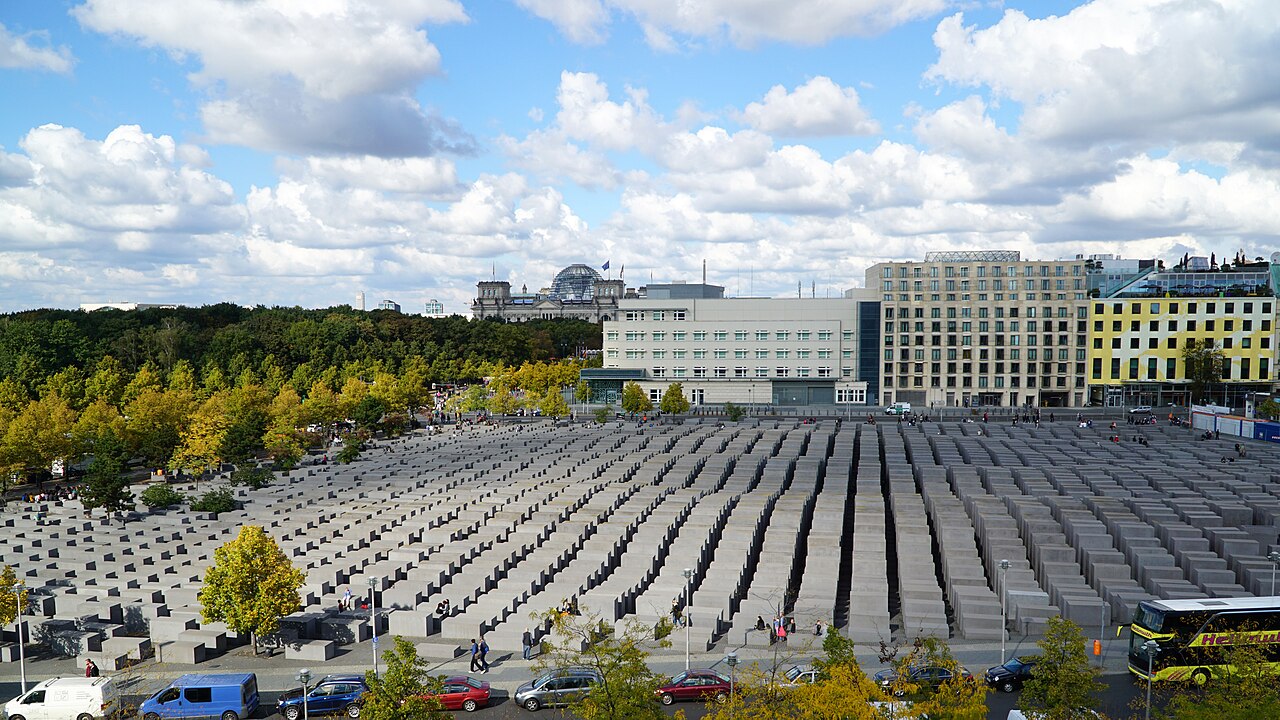
Memorial to the Murdered Jews of Europe
52.5137° N · 13.3789° E · Monument
Memorial to the Murdered Jews of Europe is a 19,000-square-metre field of 2,711 concrete slabs of varying heights, designed by Peter Eisenman. It is in Berlin, Germany. Most visitors spend 1–1.5 hours here. The free Lokali audio guide runs 5 minutes.
✓ Verified August 2026 · how we write these guides
Visitor facts
| Time needed | 1–1.5 hours |
|---|---|
| Lokali audio guide | 5 min · free |
| Type | Monument |
| Best for | History |
| Location | Berlin, Germany |
| Coordinates | 52.5137, 13.3789 |
| Languages | 45, in the Lokali app |
The story
Near the heart of the city, a vast field of grey concrete blocks stretches across a gentle slope, row upon row, rising and falling, silent among the surrounding streets. This is the Memorial to the Murdered Jews of Europe, Germany's central monument to the millions of Jewish people killed in the Holocaust.
The memorial was opened in the mid-2000s, after long national debate, as an act of remembrance and responsibility, placed deliberately at the centre of the reunited capital, close to the seat of government and the great gate.
It takes the form of thousands of plain concrete blocks of differing heights, set in a grid on uneven ground, so that as you walk in among them the floor dips and the blocks rise above your head, and the noise of the city falls away.
The design is abstract and without explanation by intent, offering no obvious symbolism, so that visitors are left with their own response: a sense of disorientation, isolation, and unease as the rows close around them.
Walking into the field, the ground sinks and the grey blocks grow taller until you are alone among them, the streets and other people glimpsed only in flashes down the long rows, an experience meant to be felt rather than read.
Beneath the field lies an information centre, a quiet underground space that gives the human detail the abstract field withholds: the names, faces, and stories of victims and families, drawn from across Europe.
That centre grounds the memorial in real lives, with letters, photographs, and records that turn the unimaginable scale of the crime into individual people, and it is an essential, sobering part of a visit.
The memorial is open at all hours and free, and you walk freely among the blocks, though it is a place of remembrance and asks for quiet, respectful behaviour rather than play or spectacle.
It sits a short walk from the great gate and the parliament, in the historic and political heart of the city, a deliberate placing that ties the nation's remembrance to its centre of power and public life.
Visiting asks something of you: to walk in slowly, to go down into the information centre, and to give the place the seriousness it was built for, rather than treating it as a backdrop.
Walk into the silent field until the grey blocks rise over you and the city disappears, then descend to read the names below, and the memorial does its quiet, difficult work. When you step back out into the streets, the ordinary life of the city carries the weight of what you have just stood among.
Key facts
What to look for
Practical tips
Common questions
How long do you need at Memorial to the Murdered Jews of Europe?
Plan 1–1.5 hours. That is the time most visitors spend at Memorial to the Murdered Jews of Europe. The free Lokali audio guide adds about 5 minutes of narration you can listen to as you walk, so it fits inside your visit rather than adding to it.
Is there a free audio guide to Memorial to the Murdered Jews of Europe?
Yes — the Lokali app narrates Memorial to the Murdered Jews of Europe free of charge in 50+ languages. It covers the history, what to look for on site and practical tips, and it works offline once downloaded.
Where is Memorial to the Murdered Jews of Europe?
Memorial to the Murdered Jews of Europe is in Berlin, Germany, at 52.5137, 13.3789. Tap the map link on this page for directions from where you are.
What should you know before visiting Memorial to the Murdered Jews of Europe?
Walk slowly into the field of blocks.
What is Memorial to the Murdered Jews of Europe known for?
Germany's central memorial to Holocaust victims.
What is the best time to visit Memorial to the Murdered Jews of Europe?
Walk slowly through the slabs—the ground's slope makes the experience physically unsettling, which is intentional.
On the map
Opens directions to Memorial to the Murdered Jews of Europe from your location.
Reference
More to see in Berlin


Hear Memorial to the Murdered Jews of Europe in your language
The full story, narrated, in 50+ languages. Download it before you go and it plays offline, at your own pace, with no ticket and no tour group.