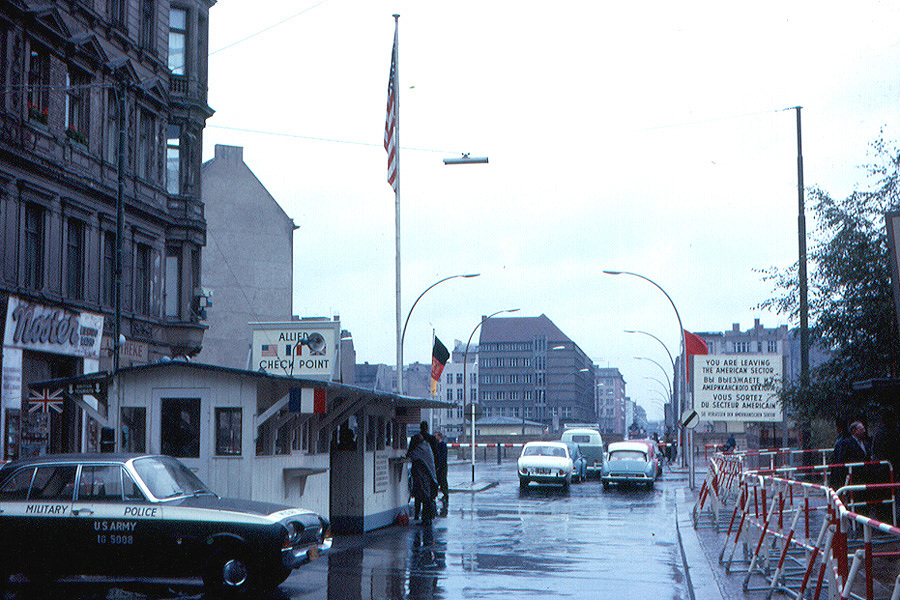
Checkpoint Charlie is the most famous Cold War crossing point between East and West Berlin. It is in Berlin, Germany. Most visitors spend 30–45 min here. The free Lokali audio guide runs 5 minutes.
✓ Verified August 2026 · how we write these guides
Visitor facts
| Time needed | 30–45 min |
|---|---|
| Lokali audio guide | 5 min · free |
| Type | Monument |
| Best for | History |
| Location | Berlin, Germany |
| Coordinates | 52.5075, 13.3904 |
| Languages | 45, in the Lokali app |
The story
On a busy street corner, a small white guard booth stands in the middle of the road beneath a famous sign warning that you are leaving one sector of the divided city. This is Checkpoint Charlie, the best-known crossing point of the Cold War, where the armies of East and West once faced each other across a line of concrete.
When the city was split by the wall, this was one of the few points where foreigners and officials could cross between the Soviet-controlled east and the American-controlled west, a tense gateway watched by guards on both sides.
It became a symbol of the Cold War standoff, the place where, at one dangerous moment, the tanks of the two superpowers stood muzzle to muzzle across the line, the world holding its breath. That confrontation made the checkpoint famous far beyond the city.
The booth and sign you see today are a reconstruction, marking the spot where the real checkpoint stood, with the famous sign reading that you are leaving the American sector in several languages.
Around it, the story of the wall and the many daring, sometimes fatal, escapes across it is told in nearby museums and open-air displays, which give the touristy corner its real weight and meaning.
The site is, frankly, very commercial now, with crowds, souvenir stalls, and actors in uniform posing for photos, so the solemn history sits oddly alongside the tourist bustle.
Despite that, the spot remains a powerful marker of a time, within living memory, when a single line on a city street divided two worlds and could not be freely crossed.
The open-air panels along the street, free to read, set out the history of the checkpoint and the wall clearly, so even without entering a museum you can grasp what happened here.
It sits in the central city, within reach of other wall sites and the historic core, so it folds into a day tracing the line the wall once took through the city.
For the fullest sense of the era, the nearby museum of the wall, crammed with the stories and devices of escapes, is worth the time, turning the crowded corner into a real history lesson.
Stand by the booth beneath the old sign, read the panels of escapes and standoffs, and the tense, divided city of the Cold War comes briefly back. When you walk on, the ordinary traffic flows freely over a line that once could have started a war.
Key facts
What to look for
Practical tips
Common questions
How long do you need at Checkpoint Charlie?
Plan 30–45 min. That is the time most visitors spend at Checkpoint Charlie. The free Lokali audio guide adds about 5 minutes of narration you can listen to as you walk, so it fits inside your visit rather than adding to it.
Is there a free audio guide to Checkpoint Charlie?
Yes — the Lokali app narrates Checkpoint Charlie free of charge in 50+ languages. It covers the history, what to look for on site and practical tips, and it works offline once downloaded.
Where is Checkpoint Charlie?
Checkpoint Charlie is in Berlin, Germany, at 52.5075, 13.3904. Tap the map link on this page for directions from where you are.
What should you know before visiting Checkpoint Charlie?
Read the free open-air history panels.
What is Checkpoint Charlie known for?
The best-known Cold War crossing point in Berlin.
What is the best time to visit Checkpoint Charlie?
The site is heavily touristy, but the nearby Wall Memorial (Gedenkstätte Berliner Mauer) on Bernauer Strasse is quieter and more moving—it includes a preserved section of the original wall with the death strip visible.
On the map
Opens directions to Checkpoint Charlie from your location.
Reference
More to see in Berlin


Hear Checkpoint Charlie in your language
The full story, narrated, in 50+ languages. Download it before you go and it plays offline, at your own pace, with no ticket and no tour group.