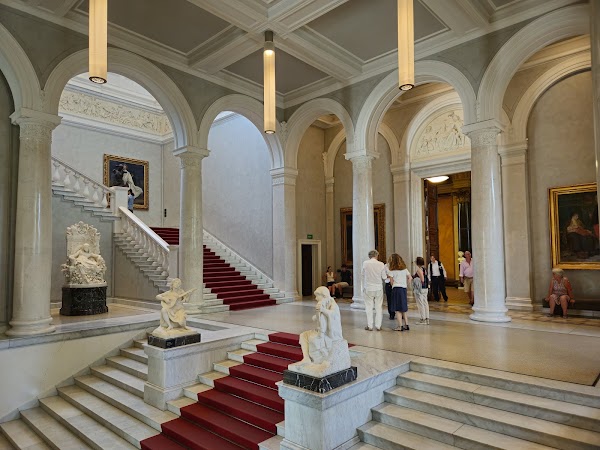
Old National Gallery is a neoclassical temple on Museum Island housing 19th-century German and European art, from Romanticism through Impressionism to early Modernism. It is in Berlin, Germany. Most visitors spend 1–1.5 hours here. The free Lokali audio guide runs 5 minutes.
✓ Verified August 2026 · how we write these guides
Visitor facts
| Time needed | 1–1.5 hours |
|---|---|
| Lokali audio guide | 5 min · free |
| Type | Museum |
| Best for | Editors' pick |
| Location | Berlin, Germany |
| Coordinates | 52.5215, 13.4019 |
| Languages | 45, in the Lokali app |
The story
Climb the wide stone staircase and stop halfway up. Ahead rises a building shaped like a temple from the ancient world. Tall columns. A triangular top. It sits high on a stone base, lifted above the square. On the steps, a king rides a bronze horse. Behind him, the doors lead into more than a century of paintings.
This is the Old National Gallery. It stands on Museum Island, a small island in the river Spree in the heart of Berlin. Five great museums sit close together here. The whole island is protected as a place of world importance. This gallery holds art from the eighteen hundreds.
The building opened in 1876. The design came from the architect Friedrich August Stüler, who worked from ideas sketched by the Prussian king Friedrich Wilhelm IV. Stüler died before the work was done, and others finished it. They shaped it to look like a Roman temple raised on a high platform, reached by a grand double staircase.
The bronze rider on the steps is that same king, Friedrich Wilhelm IV. He had dreamed of a place where art and learning would stand together, a kind of sanctuary for culture. The statue places him at the door of the gallery his idea helped create.
Inside, the collection follows the art of the nineteenth century, room after room. It moves from calm, ordered works in the classical taste, through the dramatic mood of the Romantics, toward the bright, loose brushwork that would open the door to modern art. You can walk the change in style as you walk the floors.
Some of the most loved paintings here come from the German Romantics. Caspar David Friedrich painted small human figures before vast skies, seas, and mountains. His work asks you to feel how large the world is, and how brief a single life. People often stand quietly before these canvases.
Another room belongs to Adolph Menzel. He painted Berlin and Prussian life with sharp, honest eyes, from royal ceremonies to the inside of an iron factory full of smoke and fire. His large painting of the factory shows the hard new world of machines and labor taking shape.
The gallery also holds French painting. There are works by Édouard Manet, Claude Monet, and Auguste Renoir, among the first by these artists to enter a public collection in Germany. Their scenes of gardens, rivers, and city life glow with quick strokes of color and light.
German painters of that lighter style hang here too. Max Liebermann and others took the new free brushwork and turned it to Berlin streets, gardens, and beaches. Together the rooms tell a story of artists slowly learning to trust their own eyes over old rules.
The building itself has suffered and recovered. In the Second World War, bombing badly damaged it. The art had been moved to safety, but the structure was wounded. Repairs went on for years. A deep, careful restoration was finished in 2001, bringing back the painted walls and grand stairs.
Take your time on the upper floors. The rooms are tall and quiet, lit from above. The colors of the walls were chosen to suit the paintings, deep reds and greens that make the gold frames glow. Benches let you sit and look. There is no need to rush from room to room.
Before you leave, step back outside onto the staircase. Look at the king on his bronze horse, and past him to the other museums and the river below. This building was an idea about beauty, broken by war and slowly healed. Inside, the people and landscapes painted long ago still wait, patient, for the next pair of eyes.
Key facts
What to look for
Practical tips
Common questions
How long do you need at Old National Gallery?
Plan 1–1.5 hours. That is the time most visitors spend at Old National Gallery. The free Lokali audio guide adds about 5 minutes of narration you can listen to as you walk, so it fits inside your visit rather than adding to it.
Is there a free audio guide to Old National Gallery?
Yes — the Lokali app narrates Old National Gallery free of charge in 50+ languages. It covers the history, what to look for on site and practical tips, and it works offline once downloaded.
Where is Old National Gallery?
Old National Gallery is in Berlin, Germany, at 52.5215, 13.4019. Tap the map link on this page for directions from where you are.
What should you know before visiting Old National Gallery?
Start on the top floor and work downward.
What is Old National Gallery known for?
Opened in 1876 on Berlin's Museum Island.
What is the best time to visit Old National Gallery?
The top-floor galleries of Caspar David Friedrich and Karl Friedrich Schinkel's paintings are serene.
On the map
Opens directions to Old National Gallery from your location.
More to see in Berlin


Hear Old National Gallery in your language
The full story, narrated, in 50+ languages. Download it before you go and it plays offline, at your own pace, with no ticket and no tour group.