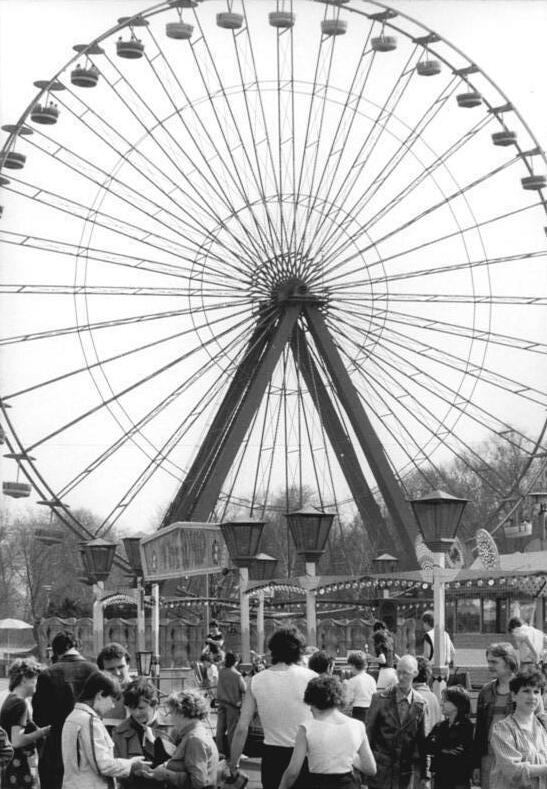
Photo: Klaus Franke · CC BY-SA 3.0 de · Wikimedia Commons
Spreepark is a former amusement park in Berlin. Opened in 1969 as Kulturpark Plänterwald. The free Lokali audio guide runs 6 minutes.
✓ Published October 2026 · how we write these guides
Visitor facts
| Lokali audio guide | 6 min · free |
|---|---|
| Type | Amusement Park |
| Location | Berlin, Germany |
| Coordinates | 52.4858, 13.4878 |
| Official website | spreepark.berlin |
| Languages | 50+, in the Lokali app |
The story
Listen first. Wind moves through the beech and oak trees of the Plänterwald, and somewhere above the canopy, metal shifts and settles. The path under your feet is soft with fallen leaves. The River Spree runs close by, slow and grey-green. Then, between the trunks, you see something that does not belong in a forest. It is the curve of a giant wheel, or the painted flank of a dinosaur. This is Spreepark, and for decades it has been one of Berlin's strangest places.
The story begins in East Berlin, in 1969. The government of the German Democratic Republic, the socialist state that ruled the eastern half of the divided city, opened an amusement park here on the riverbank. It was called the Kulturpark Plänterwald. It became the only permanent amusement park of its kind in East Germany. Families came from across the country. For many children growing up behind the Berlin Wall, a day here was a rare kind of treat.
Think about what that meant. Western amusement parks were out of reach for most East Germans. Travel to the West was heavily restricted. So this park on the edge of the forest had to carry a lot of hope. It offered rides, music, snacks, and a few hours of ordinary fun. The giant wheel became its landmark. You could see it from the river and from the far bank, turning slowly above the trees.
Then, in 1989, the Wall fell. Germany reunified the following year, and everything in the East had to find a new place in a new economy. In the early 1990s, a private operator took over the park and renamed it Spreepark. New attractions arrived. The managers tried to compete with Western theme parks. For a while, there was a fresh coat of paint, a log flume, a Western-style town, and big ambitions.
Those ambitions did not hold. Visitor numbers fell. Prices rose, parking was difficult, and the park's debts grew. By 2001, Spreepark had closed its gates. And here the history takes a turn that sounds like fiction. The operator, Norbert Witte, shipped several rides to Peru, apparently hoping to start again in Lima. That plan also failed.
The next chapter is the one most visitors never hear. Witte was later convicted in a German court for trying to smuggle cocaine back to Germany. According to the court case, the drugs were hidden inside the structure of one of the rides. It is a remarkable end to the commercial story of a family amusement park. Meanwhile, back in Berlin, the rides that remained here were simply left behind.
For more than a decade, the forest moved in. Grass grew through the tracks. Moss spread over the fibreglass dinosaurs. Swan-shaped boats lay on their sides. The giant wheel stood still, and locals say its gondolas creaked when the wind was strong. Urban explorers climbed the fences, photographers came for the decay, and the site gained a reputation far beyond Berlin. Filmmakers noticed too. Parts of the 2011 thriller Hanna were shot among these broken rides.
In 2014, the city of Berlin bought the site back. Management passed to Grün Berlin, the city-owned company that runs several of Berlin's parks and green spaces. The plan was not to rebuild a classic amusement park. Instead, the idea was to create a place for art, culture, and nature, while keeping the memory of what stood here. Work has moved forward step by step, and some areas have opened while others remain behind construction fencing.
One of the most important pieces of this plan is not a ride at all. On the riverbank stands the Eierhäuschen, which means the little egg house. It was a popular riverside inn and garden restaurant long before the amusement park existed, back in the nineteenth century. Berliners came here by boat on summer days. The building fell into ruin during the years of neglect. Its restoration links the site to a much older tradition of escaping the city to the river.
Now look around at the scale of the land. Spreepark is not a small lot. It is a large piece of riverside forest, and the paths, clearings, and old ride foundations are spread out between the trees. Walk slowly. Notice how the old concrete edges and painted metal sit beside very natural ground. This mix of wild growth and human leftovers is the main character of the place now.
The giant wheel deserves a second look. During the redevelopment, it was taken apart so that it could be restored. Its future role is planned as a working wheel again, though perhaps a quieter, slower one than before. Even when it is under repair, it remains the symbol that Berliners connect with this place. Ask anyone who grew up in the East, and many will tell you about riding it as a child.
What makes Spreepark special is not one single object. It is the layering. A nineteenth-century inn, a socialist leisure park, a failed capitalist theme park, a criminal case, a playground for explorers, and now a careful public project. Each period left something behind. Very few places in Berlin show the city's twentieth-century changes in such an unusual and personal way.
Before you leave, stand still for a moment near the edge of the trees, close to the water. Listen to the river, the birds, and the wind in the leaves. Look at whatever painted metal or concrete is closest to you. Someone once queued here with a ticket in hand and an ice cream melting. As you walk back through the Plänterwald, keep looking up between the branches. The forest here still holds a few surprises.
Key facts
What to look for
Practical tips
Common questions
Is there a free audio guide to Spreepark?
Yes — the Lokali app narrates Spreepark free of charge in 50+ languages. The guide runs about 6 minutes, covers the history, what to look for on site and practical tips, and works offline once downloaded.
Where is Spreepark?
Spreepark is in Berlin, Germany, at 52.4858, 13.4878. Tap the map link on this page for directions from where you are.
What is Spreepark known for?
Opened in 1969 as Kulturpark Plänterwald. East Germany's only permanent amusement park.
What should you look for at Spreepark?
The giant wheel's curve rising above the treetops. Painted dinosaur figures half hidden by vegetation. The restored Eierhäuschen building on the riverbank.
What should you know before visiting Spreepark?
Check Grün Berlin's site for current tours and open areas. Wear sturdy shoes for forest paths and uneven ground.
When is the best time to visit Spreepark?
Come in the morning for quiet paths and soft light.
On the map
Opens directions to Spreepark from your location.
More to see in Berlin


Hear Spreepark in your language
The full story, narrated, in 50+ languages. Download it before you go and it plays offline, at your own pace, with no ticket and no tour group.