
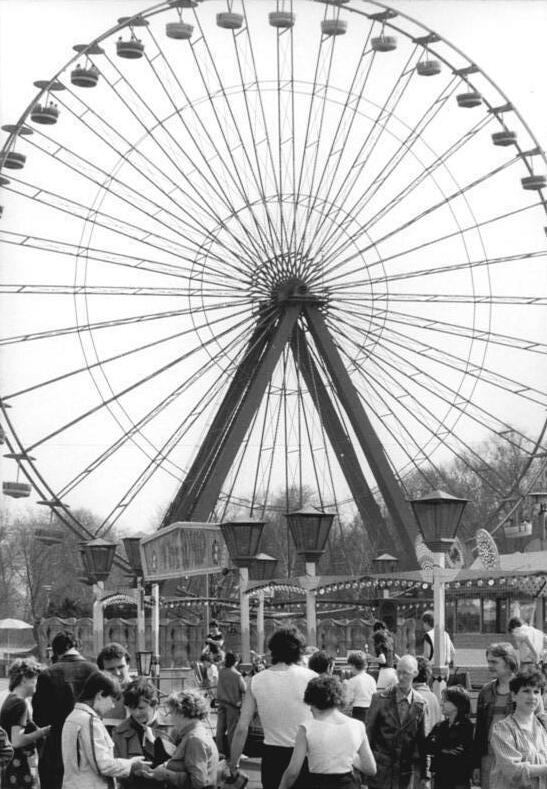
Photo: Andreas Steinhoff · Attribution · Wikimedia Commons
Treptower Park is a park in Berlin, Germany. Park designed by Gustav Meyer, Berlin's first municipal garden director. The free Lokali audio guide runs 6 minutes.
✓ Published October 2026 · how we write these guides
Visitor facts
| Lokali audio guide | 6 min · free |
|---|---|
| Type | Park |
| Location | Berlin, Germany |
| Coordinates | 52.4903, 13.4700 |
| Official website | treptowerpark.de |
| Languages | 50+, in the Lokali app |
The story
Listen first. Somewhere close, the water of the Spree slaps softly against a wooden landing stage. A tour boat engine idles. Bicycle tyres hiss along a gravel path, and above you the plane trees and chestnuts move in the wind off the river. This is Treptower Park, a long green strip on the eastern bank of the Spree, and for well over a century Berliners have come here simply to breathe.
The park belongs to the district of Treptow-Köpenick, in the south-east of Berlin. It was laid out in the late nineteenth century, at a time when the city was growing fast and filling with factories and crowded tenements. City planners wanted open space for working families. The design is credited to Gustav Meyer, Berlin's first municipal garden director. He favoured the English landscape style, which means gentle curves, wide lawns and carefully placed groups of trees that look natural, even though they were planned.
Walk out onto the great meadow and you can still feel that idea. The lawn opens wide and flat, and the sky suddenly feels large. On a warm weekend this ground fills with picnic blankets, frisbees, small speakers and the smell of charcoal grills. On a grey weekday morning it belongs to dog walkers and joggers. The space does not change much. The people do, and that is the point of it.
Here is the first thing many visitors miss. In 1896 this park hosted the Berlin Industrial Exhibition, an enormous trade fair meant to show the world what the young German capital could build and sell. Temporary halls, pavilions and attractions spread across the grounds. Millions of visitors came. Almost all of it was taken down afterwards — but one piece of that exhibition stayed, and you can still visit it today.
That piece is the Archenhold Observatory, on the eastern side of the park. It was built around a great refracting telescope, which uses a long tube of lenses rather than mirrors to gather light. This telescope is famous for its length, and it is often described as one of the longest of its kind in the world. Here is the second surprise. Albert Einstein gave a public lecture at this observatory in 1915, the same year he completed his general theory of relativity.
Now turn your thoughts in a very different direction. In the heart of the park lies the Soviet War Memorial, and the mood here changes completely. It was built in the years after the Second World War and completed at the end of the 1940s. It is not only a monument. It is also a cemetery. Several thousand Soviet soldiers who died in the battle for Berlin in 1945 are buried beneath these lawns.
The approach is slow and deliberate. You pass a kneeling figure of a grieving mother, a symbol of the Soviet homeland mourning its dead. Then two huge stylised flags in dark stone frame the entrance to the main avenue. People often say the red stone used here came from the ruins of Hitler's Reich Chancellery. That story is widely repeated, but it is better treated as a popular account than as a confirmed fact.
Along both sides of the central lawn stand sixteen stone blocks, carved with reliefs of war and sacrifice. The inscriptions are quotations from Joseph Stalin, in Russian on one side and German on the other. Many visitors are surprised that these words remain. Under the reunification treaties, Germany agreed to protect and maintain Soviet war memorials, so the site was kept intact after the Cold War ended.
At the far end, on a high mound, stands the statue that gives the memorial its power. A Soviet soldier holds a small child on one arm. In his other hand he lowers a sword, and beneath his boot lies a broken swastika. The sculptor was Yevgeny Vuchetich, a leading Soviet monumental artist. Inside the base there is a small hall with a mosaic. The whole figure rises several storeys above the trees, and from the lawn it seems to fill the sky.
This place is quiet for a reason. Every year in early May, around the anniversary of the end of the war in Europe, people gather here with flowers, wreaths and candles. Some come from former Soviet countries, some from Berlin families with their own memories. The memorial carries many meanings at once — liberation, loss, and the long shadow of Soviet power over East Germany, since this side of the city was part of East Berlin.
When you leave the memorial and walk back toward the water, the park returns to everyday life. Near the river you will find a rose garden with formal beds, a carp pond, and benches where older couples sit and watch the boats. Along the bank, the old harbour area is a starting point for river cruises on the Spree. A traditional riverside restaurant and beer garden has stood near here for generations, and it still fills on summer evenings.
Look downstream along the river, toward the north-west. In the water stands a tall aluminium sculpture of three figures leaning into each other, full of holes like lace. This is Molecule Man, by the American artist Jonathan Borofsky. It stands near the meeting point of three Berlin districts, and the figures are often read as a symbol of people coming together. South of the park, the forest of Plänterwald continues the green along the river.
So take a moment before you go. Notice the sound of the river again, the gravel under your shoes, the tall trees that have watched so many crowds come and go. In this one park, Berliners have celebrated industry, studied the stars, buried their former enemies' soldiers, and grilled sausages on a Sunday afternoon. As you walk away, look back once toward the water. The city's whole story is here, side by side.
Key facts
What to look for
Practical tips
Common questions
Is there a free audio guide to Treptower Park?
Yes — the Lokali app narrates Treptower Park free of charge in 50+ languages. The guide runs about 6 minutes, covers the history, what to look for on site and practical tips, and works offline once downloaded.
Where is Treptower Park?
Treptower Park is in Berlin, Germany, at 52.4903, 13.4700. Tap the map link on this page for directions from where you are.
What is Treptower Park known for?
Park designed by Gustav Meyer, Berlin's first municipal garden director. Hosted the Berlin Industrial Exhibition in 1896.
What should you look for at Treptower Park?
Kneeling figure of the grieving mother at the memorial entrance. Sixteen carved stone blocks with Russian and German inscriptions. Broken swastika beneath the soldier's boot on the mound.
What should you know before visiting Treptower Park?
Visit the memorial on a quiet weekday morning for reflection. Walk the riverside path south toward the Plänterwald forest.
When is the best time to visit Treptower Park?
Visit the memorial on a quiet weekday morning for reflection.
On the map
Opens directions to Treptower Park from your location.
More to see in Berlin



Hear Treptower Park in your language
The full story, narrated, in 50+ languages. Download it before you go and it plays offline, at your own pace, with no ticket and no tour group.