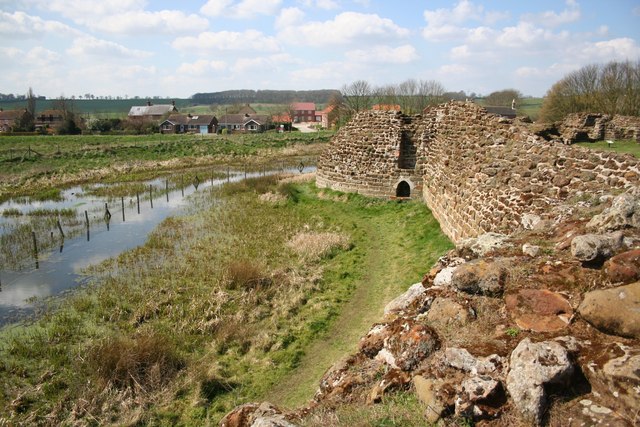
Bolingbroke Castle
53.1651° N · 0.0169° E · Archaeological Site
Photo: Richard Croft · CC BY-SA 2.0 · Wikimedia Commons
Bolingbroke Castle is a castle in Bolingbroke, England. Built around the 1220s by Ranulf, Earl of Chester. The free Lokali audio guide runs 7 minutes.
✓ Published October 2026 · how we write these guides
Visitor facts
| Lokali audio guide | 7 min · free |
|---|---|
| Type | Archaeological Site |
| Location | Bolingbroke, United Kingdom |
| Coordinates | 53.1651, 0.0169 |
| Official website | english-heritage.org.uk |
| Languages | 50+, in the Lokali app |
The story
Listen for a moment. Grass moves in the wind, a rook calls from the trees, and somewhere a sheep answers. Under your feet the ground is soft and uneven, rising into low green banks. The stone here is a greenish, crumbly sandstone, warm-toned in the sun and darker after rain. It does not look like the setting for a royal birth or a civil war siege. Yet this quiet ring of broken walls once held both.
You are standing in Old Bolingbroke, a small village on the southern edge of the Lincolnshire Wolds. The Wolds are a gentle band of chalk hills in eastern England, and this corner of the county feels far from any city. The castle sits low in the landscape, not on a dramatic crag. Its builders chose water over height. The flat ground around it once held a broad moat, and that water was the first line of defence.
The castle was built in the early thirteenth century, most likely in the 1220s, by Ranulf, Earl of Chester. Ranulf was one of the most powerful barons of his age. He had recently returned from crusade in the eastern Mediterranean. Some historians suggest that what he saw there shaped the way he built at home. Whatever the reason, the design here was modern for its time in England.
Look at the shape of the walls around you. There is no great square keep, no single tower where the lord would make a last stand. Instead, the castle is a polygon — a ring of curtain walls with towers spaced along them. Those towers were rounded on the outside, often described as D-shaped. Rounded faces were harder to undermine and deflected missiles better than square corners. This idea of strength spread evenly around a circuit became common in English castles later in that century.
Here is the first thing many visitors miss. The walls you see were never meant to stand alone above dry grass. Picture water lapping close to their base, and a single gatehouse giving the only safe way in. The gatehouse sat on one side of the ring, guarded by twin towers. Walk slowly toward its remains and imagine the approach across the moat, watched from above by archers on the wall walk.
After Ranulf, the castle passed through several noble hands. In time it came to the great House of Lancaster, one of the most powerful families in medieval England. Its most famous lord was John of Gaunt, a son of King Edward the Third. Gaunt held vast estates across the country, and Bolingbroke was one of many. But this modest Lincolnshire castle earned a special place in his family story.
In 1367, John of Gaunt's son Henry was born here. He became known as Henry of Bolingbroke, taking his name from this very place. That is the second surprise for many listeners. In 1399 Henry seized the throne from his cousin Richard the Second and became King Henry the Fourth. So a king of England carried the name of this small village, and Shakespeare later put that name on the stage in his history plays.
Once Henry became king, the castle became royal property, part of the Duchy of Lancaster. The Duchy is a private estate held by the reigning monarch, and it still exists today. Over the following centuries, Bolingbroke served mainly as an administrative centre. Courts were held here and estate business was managed from its rooms. It was useful, but no longer at the centre of national events.
That changed in the seventeenth century, during the English Civil War. In the 1640s, Parliament and King Charles the First fought for control of the country. Bolingbroke was held for the king. In 1643, Parliamentarian forces besieged it. Not far from here, the Battle of Winceby was fought that same autumn, and the Royalists lost. The defeat sealed the castle's fate.
After the war, Parliament ordered the castle to be slighted. Slighting means deliberately damaging a fortress so that no one can use it again. The walls were pulled down in places and the defences broken. After that, the stone slowly weathered and fell. Local people also took stone for their own buildings. The last major standing section collapsed in the early nineteenth century, and the site became a grassy mound.
For a long time, very little was visible. Then, in the twentieth century, archaeologists cleared and excavated the site. They uncovered the lower courses of the walls, the outlines of the towers, and the plan of the gatehouse. What you see now is largely the result of that work. The ruins are low, often only waist or shoulder height, but the plan is clear. Today the site is cared for by heritage organisations, and it often hosts community events.
As you walk the circuit, notice how the soft local stone has worn. Edges are rounded, surfaces pitted, and small plants root in the joints. The stone holds a faint green tint that changes with the weather. Low walls give you something taller castles cannot — you can see the whole plan at once. Stand in the centre and turn slowly. The entire medieval enclosure fits inside a single glance.
Locals tell ghost stories about this place, as people do about most old castles. One popular tale speaks of a strange hare that appears in the grounds and cannot be caught. These are legends, not history, but they show how the ruin still lives in village memory. The castle is not a remote monument here. It sits beside cottages and gardens, part of everyday life.
Before you leave, climb onto one of the grassy banks and look outward. Beyond the walls, the land rolls gently toward the Wolds. Imagine the moat shining below you, the gatehouse busy with carts, and a young Lancastrian prince playing in the courtyard. Then let the picture go, and notice the present instead — the wind, the rooks, the quiet stone. As you walk back into the village, the name Bolingbroke will travel with you, as it once travelled to the throne.
Key facts
What to look for
Practical tips
Common questions
Is there a free audio guide to Bolingbroke Castle?
Yes — the Lokali app narrates Bolingbroke Castle free of charge in 50+ languages. The guide runs about 7 minutes, covers the history, what to look for on site and practical tips, and works offline once downloaded.
Where is Bolingbroke Castle?
Bolingbroke Castle is in Bolingbroke, United Kingdom, at 53.1651, 0.0169. Tap the map link on this page for directions from where you are.
What is Bolingbroke Castle known for?
Built around the 1220s by Ranulf, Earl of Chester. King Henry the Fourth was born here in 1367.
What should you look for at Bolingbroke Castle?
Greenish local sandstone, softly worn and pitted by weather. Rounded D-shaped tower bases along the curtain wall. Remains of the twin-towered gatehouse on the entrance side.
What should you know before visiting Bolingbroke Castle?
Walk the full wall circuit to understand the polygonal plan. Stand on the outer banks for the clearest overall view.
On the map
Opens directions to Bolingbroke Castle from your location.
More to see near Bolingbroke Castle


Hear Bolingbroke Castle in your language
The full story, narrated, in 50+ languages. Download it before you go and it plays offline, at your own pace, with no ticket and no tour group.