
Tattershall Castle
53.1013° N · 0.1926° W · Archaeological Site
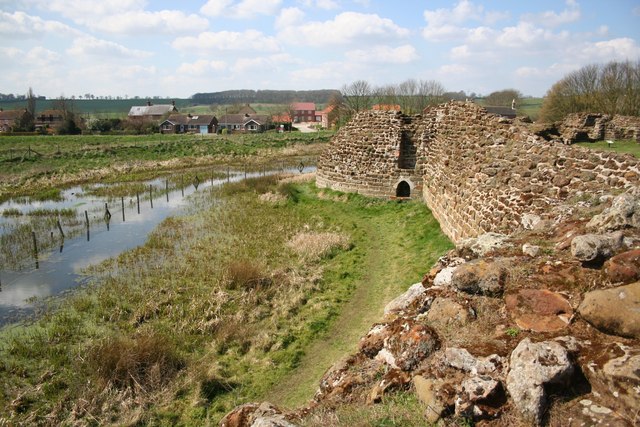
Photo: Brian from UK · CC BY-SA 2.0 · Wikimedia Commons
Tattershall Castle is a castle in Tattershall, Lincolnshire, England, UK. Great tower built for Ralph Cromwell, Lord Treasurer. The free Lokali audio guide runs 7 minutes.
✓ Published October 2026 · how we write these guides
Visitor facts
| Lokali audio guide | 7 min · free |
|---|---|
| Type | Archaeological Site |
| Location | Tattershall, United Kingdom |
| Coordinates | 53.1013, -0.1926 |
| Official website | nationaltrust.org.uk |
| Languages | 50+, in the Lokali app |
The story
Stand still for a moment and look up. The tower in front of you is made of brick... thousands upon thousands of small, warm, red bricks, each one shaped by hand. In low sun they glow almost orange. On a grey Lincolnshire afternoon they turn deep rust. Around you the land runs flat to the horizon. Water lies in the moat at your feet, and the wind crosses the fields with nothing to stop it. Then this tall block of red rises straight out of the plain.
Welcome to Tattershall Castle. What you see is the great tower of a fifteenth-century fortress. It is one of the finest pieces of medieval brickwork in England. Most English castles you know from postcards are grey stone. This one is different. Brick was still an unusual, fashionable choice in this country when the tower went up. Choosing it was a statement. It showed wealth, taste, and a link to the stylish brick buildings of the Low Countries across the North Sea.
The tower was not the first building here. A castle already stood on this site in the thirteenth century. It was built of stone by the Tateshale family, who gave the village its name. Little of that early castle survives above ground today. The story that matters most begins two centuries later, when one ambitious man arrived with money, power, and a very clear idea of how he wanted the world to see him.
His name was Ralph Cromwell. He served as Lord Treasurer of England under King Henry the Sixth. In plain terms, he looked after the nation's money. It was one of the most powerful jobs in the kingdom. In the second quarter of the fifteenth century, Cromwell rebuilt Tattershall on a grand scale. He wanted a home fit for his status. The great tower was the showpiece. Courtyards, service buildings and moats once spread around it. Most of those have gone.
Here is something many visitors miss. Look closely at the carved stone details inside, especially around the great fireplaces. You will find a purse. It is a small carved bag, repeated again and again. This was Cromwell's badge as Treasurer. He put his job title into the decoration of his own house, the way a modern executive might hang a framed award. Nearby you may also spot a motto. It translates roughly as, Have I not the right? It sounds proud. Perhaps it was meant to.
Now think about what this tower really was. It looks like a fortress. It has battlements, corner turrets and thick walls. But it was built in a time when great families competed through display as much as through force. The tower worked like a stage set for a powerful lord. Guests climbed from floor to floor. Each level was more private and more richly decorated than the one below. Reaching the top rooms meant you had reached the inner circle.
As you move inside, notice the light. Big windows let it pour into the main chambers. That is a clue. A castle built only for war keeps its windows small. These rooms were made for comfort, for feasting, and for being seen. Each floor holds one large room, with a grand fireplace as its centrepiece. Imagine the rooms with painted cloth hangings, rushes on the floor, smoke curling up, and servants running up the spiral stairs with dishes.
Those fireplaces carry the castle's second surprise. Early in the twentieth century, the tower stood empty and unloved. The great stone fireplaces were torn out and sold. They were packed up, and it seemed they would leave the country for good, perhaps to a buyer overseas. For a moment, the soul of the building nearly vanished. Then a rescuer stepped in.
That rescuer was Lord Curzon, a former Viceroy of India and a passionate lover of old buildings. He bought the castle, tracked down the fireplaces, and brought them back. Then he paid for careful restoration of the tower and its moats. When he died in the 1920s, he left Tattershall to the National Trust, the charity that cares for historic places across England. The fireplaces you see today are here because one man refused to let them go.
When you climb, take the spiral stairs slowly. The steps are worn smooth in the centre from centuries of feet. Your hand will find a cool, curved wall. At the top, the roof walk opens up. On a clear day the flat country spreads out in every direction, with fields, hedges, drainage ditches and church towers. Locals say that in the right weather you can pick out distant landmarks miles away. It shows how easily this tower could be seen, and how much it was meant to be.
Look down from the top at the ground below. You can trace the lines of the moats in the grass and water. They once held the outer parts of Cromwell's estate. Then turn toward the large church nearby. Cromwell also planned that church, Holy Trinity, as a college for priests who would pray for his soul. Castle and church were designed together, power on earth and hope for the next world, side by side across the meadow.
Listen, too. This part of Lincolnshire sits close to an active Royal Air Force base. On some days you may hear an engine and see a vintage aircraft pass low over the fields. It is a strange and lovely moment. A fifteenth-century tower and a twentieth-century plane share the same wide sky. The flat land that made the tower visible for miles makes the sky feel enormous too.
Before you leave, walk back out and stand where you began. Look at the brick again, now that you know its story. Notice how the colours change across the wall, darker in some places, paler where repairs were made. Every brick was set by a craftsman you will never know, for a lord who wanted to be remembered. Nearly six centuries later, here you are, looking up. In a way, Ralph Cromwell got his wish.
Key facts
What to look for
Practical tips
Common questions
Is there a free audio guide to Tattershall Castle?
Yes — the Lokali app narrates Tattershall Castle free of charge in 50+ languages. The guide runs about 7 minutes, covers the history, what to look for on site and practical tips, and works offline once downloaded.
Where is Tattershall Castle?
Tattershall Castle is in Tattershall, United Kingdom, at 53.1013, -0.1926. Tap the map link on this page for directions from where you are.
What is Tattershall Castle known for?
Great tower built for Ralph Cromwell, Lord Treasurer. Cromwell served as Treasurer under King Henry the Sixth.
What should you look for at Tattershall Castle?
Carved Treasurer's purse badges on the great fireplaces. Steps worn smooth in the spiral staircase centre. Large windows lighting each floor's single main room.
What should you know before visiting Tattershall Castle?
Visit late afternoon when low sun warms the red brick. Bring a windproof layer for the exposed roof walk.
When is the best time to visit Tattershall Castle?
Visit late afternoon when low sun warms the red brick.
On the map
Opens directions to Tattershall Castle from your location.
More to see near Tattershall Castle


Hear Tattershall Castle in your language
The full story, narrated, in 50+ languages. Download it before you go and it plays offline, at your own pace, with no ticket and no tour group.