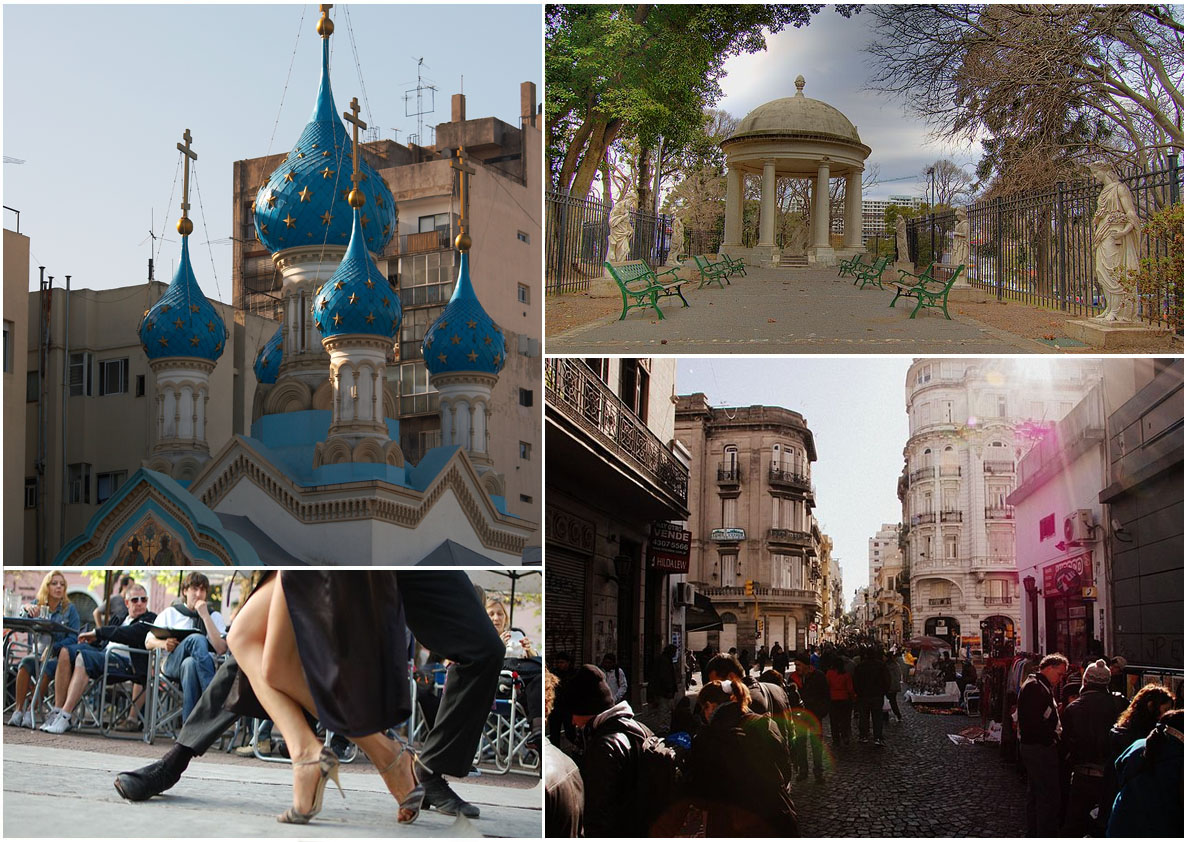
Iglesia de San Telmo
34.6253° S · 58.3696° W · Church
Iglesia de San Telmo is a neoclassical church (1735) on Humberto Primo, one of the oldest in Buenos Aires. It is in Buenos Aires, Argentina. Most visitors spend 20–30 min here. The free Lokali audio guide runs 5 minutes.
✓ Verified August 2026 · how we write these guides
Visitor facts
| Time needed | 20–30 min |
|---|---|
| Lokali audio guide | 5 min · free |
| Type | Church |
| Best for | History |
| Location | Buenos Aires, Argentina |
| Coordinates | -34.6253, -58.3696 |
| Languages | 45, in the Lokali app |
The story
The bells reach the square first. Then you see the two towers, rising above the low roofs of the street, pale stone set against the sky. Step through the doors, and the noise of the city falls away behind you. Cool air, dim light, the smell of candle wax and old wood. This is the church that gave the whole surrounding neighborhood its name.
Its full name is the parish of San Pedro González Telmo. The man behind that name was a friar who lived in the thirteenth century and later became a patron saint of sailors. Long ago, this was a quarter of sailors and dockworkers, close to the old port. They took the saint as their own protector, and over time the neighborhood itself came to be called San Telmo.
The Jesuits began building the church in 1734. They chose this spot on the rising ground just south of the old city center. The work went slowly from the start. Stone, labor, and money were all hard to gather in a young colonial town far from Europe. The thick walls rose over the course of years, not months, one slow season at a time.
Then, in 1767, the Spanish crown expelled the Jesuits from all of its lands. The half-finished church passed into other hands. Another religious order took over the work, and later it fell to the local diocese to continue. Because of these long interruptions, the building took more than a century to reach the finished form you see today.
This long and broken history shows plainly in the building itself. The base is colonial baroque, heavy and unadorned. Later additions brought neoclassical lines, with straight columns and cleaner shapes. The two towers do not perfectly match one another. Look closely and you can read a building made by many different hands across many years, each set of builders adding its own idea.
Stand back on the street and study the front for a moment. The main doorway is framed by columns. Above it, windows and shallow niches break up the flat face of the stone. The towers hold bells that still ring out for Mass. The pale surface has weathered through long city summers and damp winters. The building carries its great age openly, without trying to hide it.
Step inside. The church is long and high, with a central aisle leading the eye toward the altar. Side chapels open one by one along the walls. Wooden images of saints stand in the quiet corners. Candles burn low before some of them. People come in off the street to sit, to pray, or simply to rest a while in the cool and the deep silence.
Light enters from the high windows and falls in soft columns through the dim air. The gold of the altar catches that light and seems to glow from within. Sound behaves strangely in here. A whisper carries a long way. A single footstep echoes. The hush is the particular kind that gathers only in old stone buildings, built up slowly over many years of quiet.
For nearly three hundred years this church has marked the days and seasons of the neighborhood around it. Births, marriages, and funerals have all passed through these doors. The bells have called people in to gather, again and again. In a quarter that has changed and changed again, the church has remained one of the very few constant things.
Outside, the streets of San Telmo press in close. Cafés, antique shops, and worn old houses crowd the narrow ways. On Sundays the nearby fair fills the air with music and voices and the noise of the crowd. The church stands in the middle of all this, a little apart from it, its doors left open to anyone who wants to step out of the day for a while.
It helps to remember just how this building grew. No single architect ever drew the whole of it. Generations of builders started it, paused, and then carried it on. What you see around you is the sum of all their patience. The church is less a single design than a long conversation in stone, stretched out across more than a hundred years.
Before you go back out into the light, stop near the door and look down the long aisle once more. The candles, the worn stone floor, the saints standing in their niches. This church was built slowly, by people who knew they might never see it finished. They built it anyway. That patience is still here, waiting in the quiet, for whoever comes next.
Key facts
What to look for
Practical tips
Common questions
How long do you need at Iglesia de San Telmo?
Plan 20–30 min. That is the time most visitors spend at Iglesia de San Telmo. The free Lokali audio guide adds about 5 minutes of narration you can listen to as you walk, so it fits inside your visit rather than adding to it.
Is there a free audio guide to Iglesia de San Telmo?
Yes — the Lokali app narrates Iglesia de San Telmo free of charge in 50+ languages. It covers the history, what to look for on site and practical tips, and it works offline once downloaded.
Where is Iglesia de San Telmo?
Iglesia de San Telmo is in Buenos Aires, Argentina, at -34.6253, -58.3696. Tap the map link on this page for directions from where you are.
What should you know before visiting Iglesia de San Telmo?
Step inside quietly to rest from the street.
What is Iglesia de San Telmo known for?
The Jesuits began building the church in 1734.
What is the best time to visit Iglesia de San Telmo?
Enter during afternoon light when the interior glows softly.
On the map
Opens directions to Iglesia de San Telmo from your location.
More to see in Buenos Aires


Hear Iglesia de San Telmo in your language
The full story, narrated, in 50+ languages. Download it before you go and it plays offline, at your own pace, with no ticket and no tour group.