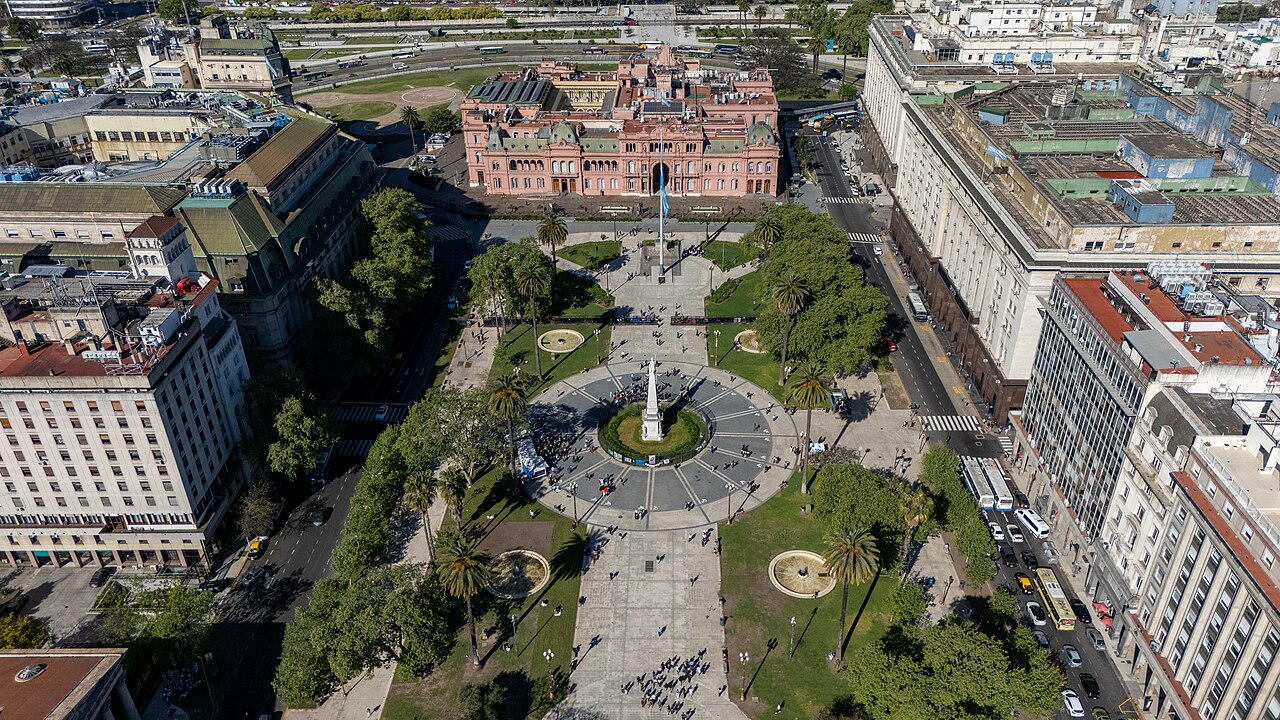
Plaza de Mayo is the political and symbolic heart of Buenos Aires since 1580. It is in Buenos Aires, Argentina. Most visitors spend 30–45 min here. The free Lokali audio guide runs 5 minutes.
✓ Verified August 2026 · how we write these guides
Visitor facts
| Time needed | 30–45 min |
|---|---|
| Lokali audio guide | 5 min · free |
| Type | Square |
| Best for | History |
| Location | Buenos Aires, Argentina |
| Coordinates | -34.6037, -58.3819 |
| Languages | 45, in the Lokali app |
The story
Pigeons scatter across warm paving stones. Palm trees sway in front of a palace painted pink. Drums echo from a march somewhere down the avenue. This is Plaza de Mayo, the main square of Buenos Aires. Nearly every major avenue of the old city begins or ends here, and Argentina's history has crossed this open space again and again for more than four centuries.
The square was born with the city itself. In 1580, the Spanish founder Juan de Garay traced the town around this spot during the second founding of Buenos Aires. The first founding, decades earlier, had failed. A fort stood where the palace now stands, guarding the river shore. Under Spanish rule, the square held the market, executions, and festivals. It was the stage of public life.
The name honors one week in history. On May 25, 1810, a crowd gathered here and pushed out the Spanish viceroy. A local governing junta took power for the first time. That event, the May Revolution, began the road to Argentine independence. Light blue and white ribbons, the future national colors, appeared in those May days. You still see those colors everywhere in the square.
At the center stands the Pirámide de Mayo, a slim white monument. It went up in 1811, on the first anniversary of the revolution, which makes it the oldest patriotic monument in the country. A figure of Liberty crowns its top, added when the monument was remodeled in 1856. It has been moved across the square, but it never left it.
On the east side rises the Casa Rosada, the pink house of the presidents. Its color is a subject of debate. One story says an early president mixed white paint with ox blood, a common sealant at the time. Another says the pink blended the colors of two rival parties. From its balcony, Juan Perón and Eva Perón spoke to enormous crowds. On October 17, 1945, workers filled this square to demand Perón's release from detention, a founding moment of his movement.
Behind the palace, a museum displays objects from past presidencies, from presidential sashes to portraits. On weekends, free guided visits walk through the palace halls; registration is done online. Even from outside, watch the guard at the gates: the Grenadiers, the historic regiment created by San Martín.
Across the square, on the west side, stands the Cabildo, the white colonial town hall with arches and a small tower. Inside its rooms, the revolution of 1810 was argued and decided. The building lost several of its arches when new avenues were cut through the block, but its core survives as a museum of the colonial era.
On the north corner, the Metropolitan Cathedral looks more like a Greek temple than a church. Twelve stone columns support its front. Inside, gold covers the colonial altarpiece, and Venetian-style mosaics spread underfoot. The tomb of General José de San Martín, liberator of Argentina, Chile, and Peru, rests in a side chapel under a soldier's guard. Before becoming Pope Francis in 2013, Jorge Bergoglio led this cathedral as archbishop.
Look down at the paving near the Pirámide. White headscarves are painted on the ground. They honor the Madres de Plaza de Mayo, mothers whose children disappeared under the military dictatorship of the 1970s. Beginning in 1977, the mothers walked here every Thursday, wearing white scarves, demanding answers. Their quiet circles around this square became known far beyond Argentina.
The square has also known darkness. In 1955, military planes bombed a crowd here during an attempted coup, and hundreds died. In December 2001, an economic collapse brought protests and clashes to these stones. When Argentines have something to say to power, they come here to say it.
In front of the palace rides General Manuel Belgrano in bronze, sword raised. He created the Argentine flag. His equestrian statue was unveiled in 1873. Around him, the daily life of the square rolls on: office workers with coffee, tourists with cameras, vendors selling flags and roasted peanuts. The smell of caramelized sugar drifts from the nut carts.
Political rhythm rules the space. Union banners rise for an afternoon rally, then fold away by evening. Police barriers come and go with the calendar. The plaza absorbs it all and returns, by nightfall, to the pigeons.
Find a bench and stay a moment. Revolutions, funerals, speeches, and songs have crossed this ground. The square does not keep history behind glass. It keeps history in use, one march and one quiet afternoon at a time.
Key facts
What to look for
Practical tips
Common questions
How long do you need at Plaza de Mayo?
Plan 30–45 min. That is the time most visitors spend at Plaza de Mayo. The free Lokali audio guide adds about 5 minutes of narration you can listen to as you walk, so it fits inside your visit rather than adding to it.
Is there a free audio guide to Plaza de Mayo?
Yes — the Lokali app narrates Plaza de Mayo free of charge in 50+ languages. It covers the history, what to look for on site and practical tips, and it works offline once downloaded.
Where is Plaza de Mayo?
Plaza de Mayo is in Buenos Aires, Argentina, at -34.6037, -58.3819. Tap the map link on this page for directions from where you are.
What should you know before visiting Plaza de Mayo?
Register online ahead for free weekend visits to the Casa Rosada.
What is Plaza de Mayo known for?
Founded as the town square by Juan de Garay in 1580.
What is the best time to visit Plaza de Mayo?
The Mothers of Plaza de Mayo still walk here on Thursdays, circling the central obelisk in silent witness to the disappeared.
On the map
Opens directions to Plaza de Mayo from your location.
More to see in Buenos Aires


Hear Plaza de Mayo in your language
The full story, narrated, in 50+ languages. Download it before you go and it plays offline, at your own pace, with no ticket and no tour group.