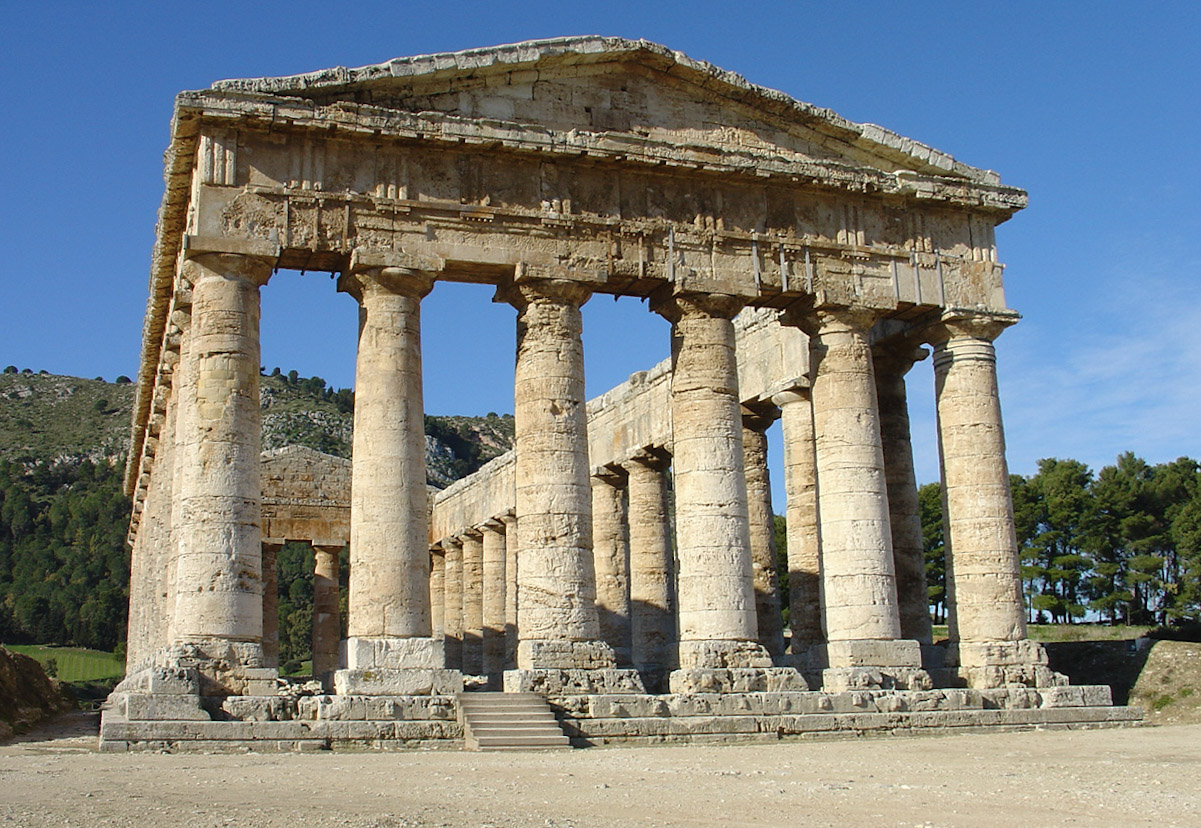
Photo: Wikimedia Commons contributor · Public domain · Wikimedia Commons
Segesta is an ancient city. It is near Calatafimi-Segesta, Italy. Segesta was a city of the native Elymian people. The free Lokali audio guide runs 7 minutes.
✓ Published October 2026 · how we write these guides
Visitor facts
| Lokali audio guide | 7 min · free |
|---|---|
| Type | Archaeological Site |
| Location | Calatafimi-Segesta, Italy |
| Coordinates | 37.9159, 12.8636 |
| Official website | regione.sicilia.it |
| Languages | 50+, in the Lokali app |
The story
Listen first. On most days here, the loudest sound is the wind moving through dry grass and wild fennel. The air smells of warm earth and herbs. Under your feet, the path is pale and dusty, and ahead of you, on a low hill above a green valley, stands a Greek temple of honey-coloured stone. There is no town around it. No traffic. Just the columns, the sky, and the hills of western Sicily rolling away on every side.
Welcome to Segesta. Today it belongs to the small municipality of Calatafimi-Segesta, but in the ancient world this was a city with its own people and its own ambitions. Those people were not Greek. They were the Elymians, one of the native peoples of western Sicily. Ancient writers, including the Athenian historian Thucydides, said the Elymians claimed descent from refugees of Troy. Whether that story is history or legend, it shaped how the city saw itself for centuries.
The Elymians lived next to Greek colonies and Phoenician trading towns, and they borrowed freely from both. They used Greek letters to write their own language. They minted coins in the Greek style. And at some point in the late fifth century before Christ, they decided to build a temple in the Doric order — the plain, sturdy Greek style with thick columns and simple, cushion-shaped tops. That temple is what you are walking toward now.
Look at it from a little distance before you go closer. The proportions are classic Greek: a rectangle of columns, six across each short end and fourteen along each long side. A triangular gable still sits on top at both ends. From here it looks complete, almost new. But step closer, and something feels unfinished. That feeling is correct.
Here is the first surprise. Run your eyes down one of the columns. Most Greek columns are carved with vertical grooves, called fluting. These are smooth. The grooves were never cut. Now look down at the base of the steps. You may see small stone knobs sticking out from some blocks. Builders left these bumps on the stone so they could attach ropes and lever the heavy blocks into place. Normally they were chiselled away at the end. Here, nobody came back to finish the job.
And step inside the ring of columns. There is no inner room, no chamber for a cult statue, and no roof. The temple is an outer shell. Scholars still discuss why. The most common view is that work simply stopped, perhaps because of war. A few have suggested other ideas. What is certain is this: you are looking at a building frozen in the middle of construction, roughly two and a half thousand years ago. It shows you how a Greek temple was made, step by step.
The war is a good story. Segesta had a long and bitter rivalry with the Greek city of Selinunte, on Sicily's southern coast. Around 416 BC, Segesta asked Athens for help. According to Thucydides, Athenian envoys came to check whether Segesta could pay for an army. The locals showed them temple treasures and held banquets with gold and silver cups. Thucydides writes that the same borrowed cups were passed from house to house to make the city look richer than it was.
The trick worked, at least for a while. Athens launched its great expedition to Sicily in 415 BC, and it ended in disaster for the Athenians at Syracuse. Segesta then turned to Carthage, the Phoenician power across the sea in North Africa. In 409 BC, a Carthaginian army destroyed Selinunte. Segesta had won its old quarrel, but it now lived in the shadow of much larger powers.
That shadow stayed. Later, the Greek tyrant Agathocles of Syracuse attacked the city with great violence, and ancient sources describe a terrible massacre. Then, during the First Punic War between Rome and Carthage, Segesta went over to the Roman side. Roman writers liked the city's Trojan legend, because Romans also traced their origins to Troy, through the hero Aeneas. A shared myth became a political tool.
Now turn toward the higher hill across the valley. That is Monte Barbaro, where the ancient town itself stood. A road climbs it, and a shuttle bus usually runs from the entrance area for visitors who prefer not to walk the steep way up. Near the top is the theatre, built in the Hellenistic period — the centuries after Alexander the Great, when Greek culture spread across the Mediterranean.
The theatre is set into the slope of the hill, with curved rows of stone seats rising in a half circle. Here is the second surprise. The audience did not face a closed stage wall the way many visitors imagine. Sit near the top, look out past the stage area, and the hills open toward the north. On a clear day, you can see a line of blue sea in the Gulf of Castellammare. Plays were performed with the whole landscape behind the actors.
The hilltop did not empty when antiquity ended. Archaeologists have found traces of medieval life up here, including the remains of a mosque from the period of Muslim rule in Sicily and the ruins of a castle from the later Norman era. Long after that, travellers on the Grand Tour came looking for the temple. The German writer Goethe visited in 1787 and wrote about it in his account of his Italian journey. Many visitors since then have felt the same pull you may feel now.
Before you leave, stand for a moment where you can see both hills at once: the temple on its own low rise, and Monte Barbaro with the theatre above. Notice how quiet the valley is. Notice the colour of the stone as the light moves across it — paler at midday, warmer toward evening. As you walk back down the path, listen again to the wind in the grass. The builders never finished their temple... but the place they chose still holds it exactly where they left it.
Key facts
What to look for
Practical tips
Common questions
Is there a free audio guide to Segesta?
Yes — the Lokali app narrates Segesta free of charge in 50+ languages. The guide runs about 7 minutes, covers the history, what to look for on site and practical tips, and works offline once downloaded.
Where is Segesta?
Segesta is near Calatafimi-Segesta, Italy, at 37.9159, 12.8636. Tap the map link on this page for directions from where you are.
What is Segesta known for?
Segesta was a city of the native Elymian people. The Doric temple dates to the late fifth century BCE.
What should you look for at Segesta?
Smooth, ungrooved column shafts on every side of the temple. Small stone lifting knobs left on the temple steps. Empty space inside the columns where an inner room would stand.
What should you know before visiting Segesta?
Take the shuttle bus up Monte Barbaro to save energy. Bring water and a hat; the hillsides have little shade.
When is the best time to visit Segesta?
Visit the temple early morning before the heat builds.
On the map
Opens directions to Segesta from your location.
More to see near Segesta


Hear Segesta in your language
The full story, narrated, in 50+ languages. Download it before you go and it plays offline, at your own pace, with no ticket and no tour group.