
Photo: AdiJapan · CC BY 2.5 · Wikimedia Commons
Selinunte is a city of Sicily. Founded by Greek settlers from Megara Hyblaea. The free Lokali audio guide runs 6 minutes.
✓ Published October 2026 · how we write these guides
Visitor facts
| Lokali audio guide | 6 min · free |
|---|---|
| Type | Archaeological Site |
| Location | Castelvetrano, Italy |
| Coordinates | 37.5836, 12.8247 |
| Official website | selinunte.gov.it |
| Languages | 50+, in the Lokali app |
The story
Listen for a moment. Wind moves through dry grass, and somewhere below, the sea breaks softly on the sand. The ground under your feet is pale and uneven, scattered with honey-coloured stone. Each block was cut by hand more than two thousand years ago. Welcome to Selinunte, on the southwest coast of Sicily, a short drive from Castelvetrano.
This was once a Greek city called Selinous. Settlers came here in the seventh century BCE from Megara Hyblaea, an older Greek colony on Sicily's eastern coast. They chose a low plateau between two river valleys, facing the open Mediterranean. Africa lies just across the water, beyond the horizon. That closeness to Africa shaped this city's whole story, as we will see.
Here is the first surprise. The name of the city comes from a plant. In ancient Greek, selinon means wild celery, or perhaps wild parsley. It grew thickly in the marshy river mouths here. The citizens were proud of it. They stamped a celery leaf on their silver coins. Look down at the edges of the paths in spring. The same wild plant still grows among the ruins today.
Selinous grew rich quickly. Its farmland was wide and fertile, and its two harbours brought trade from across the sea. With that wealth, the citizens built temples. They built many, and they built them big. Today, the park around you protects one of the largest archaeological areas in Europe. You could walk here for a whole day and still not see everything.
Now, a puzzle. Archaeologists do not know for certain which god or goddess lived in most of these temples. Inscriptions are rare, and the evidence is thin. So the temples carry letters instead of names: Temple C, Temple E, Temple G, and others. It sounds cold at first. But it is an honest choice. The letters admit that some questions remain open.
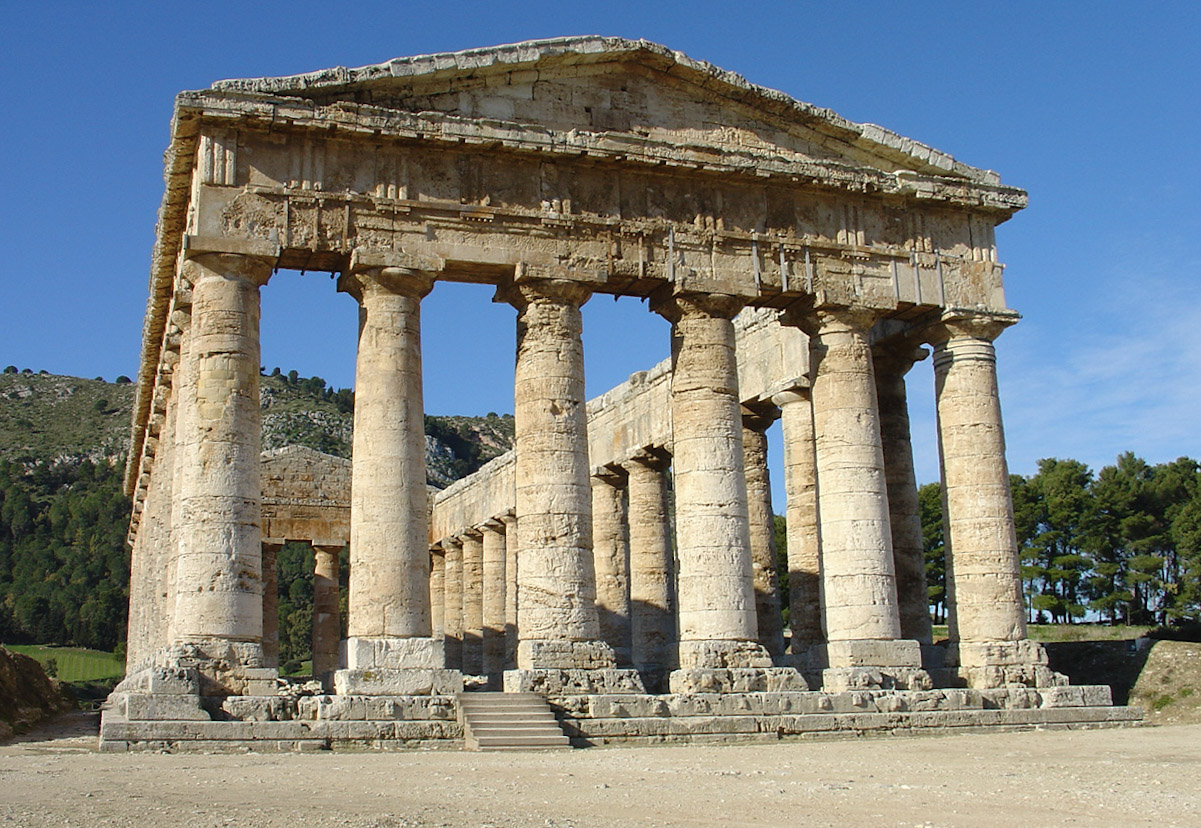
On the eastern hill stands the temple most visitors photograph first. This is Temple E. Its columns rise in a long Doric row, the plain and sturdy style of early Greek architecture, with simple cushion-shaped tops. But here is the second surprise. This temple did not survive standing. Earthquakes threw it down centuries ago. In the 1950s, engineers lifted the fallen pieces and set them back in place. What you see is ancient stone, rebuilt in modern times.
Walk closer and look at the surface of those columns. In places the stone is rough and full of tiny holes, like a sponge. This is a local limestone, soft enough to carve, but it weathers badly. The Greeks once covered it with a smooth coat of white plaster, and parts of the temples were painted in strong colours. Try to imagine it. Not pale ruins, but bright buildings shining above the sea.
Next to Temple E, you will see something very different. A huge field of broken stone lies across the ground. These are the remains of Temple G. It was one of the largest temples the Greeks ever built anywhere. Some of its column drums are taller than a person. And yet the builders never finished it. Some columns were never fluted, never given their final carved grooves. History stopped the work.
That history arrived in 409 BCE. A Carthaginian army landed on this coast. Carthage was a powerful city in what is now Tunisia, and a long rival of the Sicilian Greeks. The siege was short and brutal. The ancient historian Diodorus Siculus describes the city falling and its people killed or enslaved. Selinous never fully recovered. A smaller settlement lived on here, under Carthaginian control, until it was finally abandoned in the third century BCE.
Cross over to the acropolis, the fortified high point of the old city. Here the streets are still visible, laid out in a neat grid. You can trace walls, gates, and the bases of houses. Temple C stands here, with a row of columns raised again in the twentieth century. Many of the finest carved panels from these temples are no longer on site. They are in the archaeological museum in Palermo, where they are protected from the weather.
If you have energy left, look west, across the river valley. On the far side lies a sanctuary of Demeter, the goddess of grain and harvest. Here she had a special title: Malophoros, which means the apple-bearer, or the fruit-bearer. Travellers and pilgrims left thousands of small offerings here. It is a quieter corner of the park. Few visitors make the walk, and that is part of its appeal.
One more place deserves a mention, even though it is not inside this park. A few kilometres away are the ancient quarries called Cave di Cusa. That is where the stone for these temples was cut. Work there stopped suddenly when Carthage attacked. Huge column drums still lie in the ground, half-carved, exactly as the workers left them. It is a rare chance to see an ancient building site frozen in the middle of a working day.
Now, stand still once more. Look out past the columns toward the water. The same sea carried the first settlers here, and the same sea brought the army that ended their city. Between those two arrivals, people lived, traded, prayed, and built on this ground. As you walk back, notice the stones at your feet... the wild celery in the grass... and the long, quiet light over the coast.
Key facts
What to look for
Practical tips
Common questions
Is there a free audio guide to Selinunte?
Yes — the Lokali app narrates Selinunte free of charge in 50+ languages. The guide runs about 6 minutes, covers the history, what to look for on site and practical tips, and works offline once downloaded.
Where is Selinunte?
Selinunte is near Castelvetrano, Italy, at 37.5836, 12.8247. Tap the map link on this page for directions from where you are.
What is Selinunte known for?
Founded by Greek settlers from Megara Hyblaea. City name comes from selinon, meaning wild celery.
What should you look for at Selinunte?
Sponge-like holes in the weathered limestone columns. Unfinished, unfluted column drums in fallen Temple G. Grid pattern of ancient streets on the acropolis.
What should you know before visiting Selinunte?
Wear sturdy shoes for loose stones and uneven ground. Bring water and a hat; shade is very limited.
When is the best time to visit Selinunte?
Visit early morning to avoid the strongest heat.
On the map
Opens directions to Selinunte from your location.
More to see near Selinunte
Hear Selinunte in your language
The full story, narrated, in 50+ languages. Download it before you go and it plays offline, at your own pace, with no ticket and no tour group.