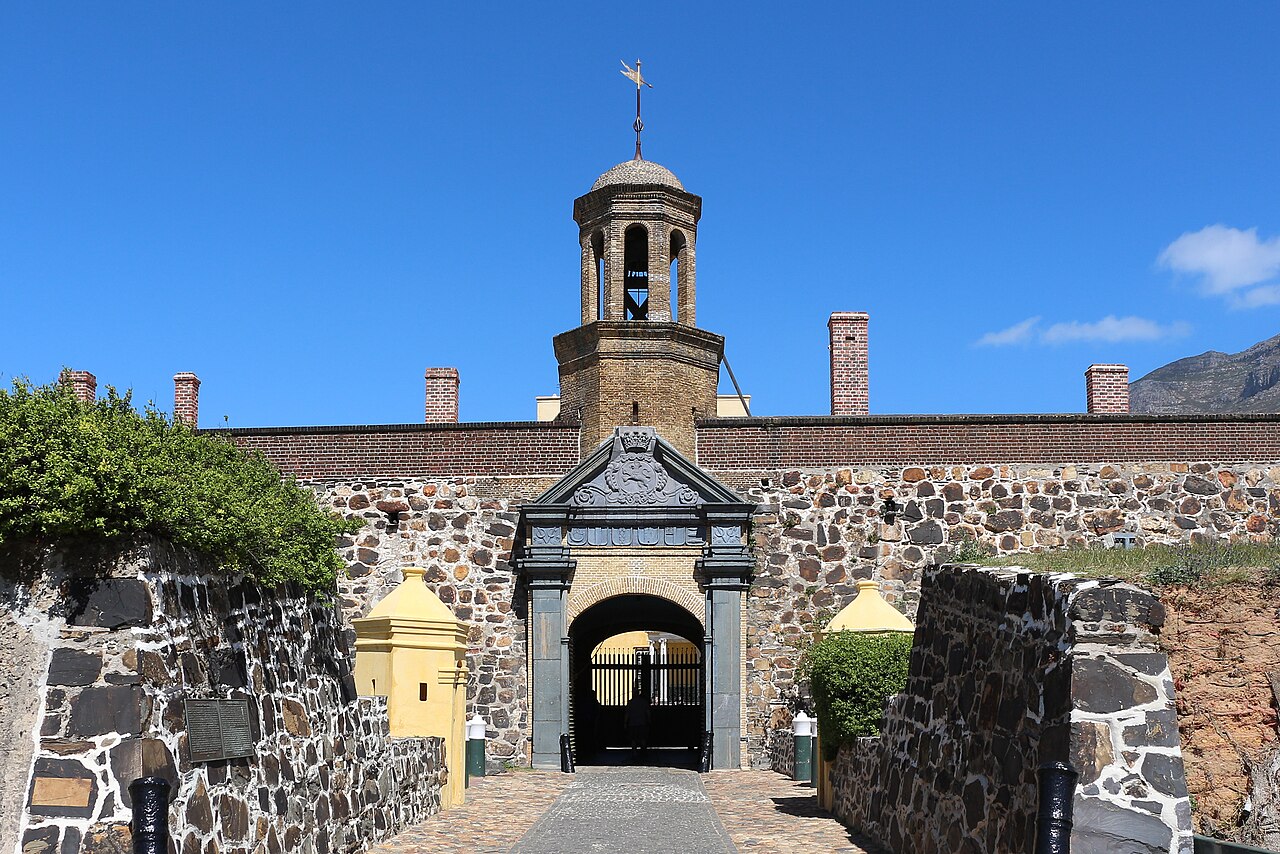
Castle of Good Hope is a castle in Cape Town, South Africa. Five-pointed fortress built between 1666 and 1669 by the Dutch East India Company. Most visitors spend 1–2 hours here. The free Lokali audio guide runs 5 minutes.
✓ Verified August 2026 · how we write these guides
Visitor facts
| Time needed | 1–2 hours |
|---|---|
| Lokali audio guide | 5 min · free |
| Type | Castle |
| Best for | History |
| Location | Cape Town, South Africa |
| Coordinates | -33.9054, 18.4216 |
| Languages | 45, in the Lokali app |
The story
Run your hand along the outer wall. The stone is cool, even under the midday sun. The plaster has faded to a soft yellow gold, worn smooth by more than three centuries of wind off the bay. Salt rides in that wind. You are standing at the gate of the oldest surviving colonial building in all of South Africa.
The Castle of Good Hope was built between 1666 and 1679. The Dutch East India Company ordered it. This was a trading firm so large and so rich that it acted almost like a state of its own. The company wanted a strong base at the southern tip of Africa. Ships sailing the long route between Europe and Asia stopped here to take on fresh water, vegetables, and meat. A fortress protected that vital stop.
An earlier fort once stood close by. Jan van Riebeeck raised it from clay and timber in 1652, in the first year of Dutch settlement at the Cape. That simple fort crumbled in the heavy winter rains. Its builders chose stone and brick for the replacement, materials that could hold against weather and cannon alike. The work took many years.
Step back and study the shape of the walls. The castle has five sides, with a sharp pointed bastion thrusting out at each corner. Military engineers across Europe favored this star design. From each angled point, defenders could watch and fire along the length of the walls, leaving no blind corner. The five bastions carry the titles of the Prince of Orange: Leerdam, Buuren, Catzenellenbogen, Nassau, and Oranje.
When the castle was new, the sea came almost to its feet. Waves once broke close to the spot where you now stand. Over the centuries the growing city pushed the shoreline outward with reclaimed land. The harbor today lies several blocks away. The castle sits inland now, ringed by streets and buildings, far from the water it was built to guard.
Pass through into the central courtyard. A tall decorated wall cuts the open space in two. This structure is called the Kat. It was added late in the seventeenth century. Its balcony served as a stage for power. Governors read official orders from here, and addressed the soldiers and townspeople gathered below. The fine plasterwork above the balcony still carries its old detail.
Now listen for the bell. The bell tower rises over the main gate, the highest point of the castle. It was built in 1684, and the original bell still hangs inside it. The bell was rung to mark the hours, to call soldiers to their posts, and to warn the town when danger neared. Its single voice once reached across the whole small settlement below the mountain.
The castle was far more than a wall and a cannon. Inside its five sides stood offices, living quarters, a church, a bakery, workshops, and cells. For many years this was the seat of government for the entire Cape. Trials were held here. People were imprisoned and punished here. The lower rooms hold that memory plainly, without hiding it.
Today the castle keeps its stories in museums. The William Fehr Collection fills several rooms with paintings, furniture, and objects from the colonial age. The military museum traces the long history of conflict at the Cape, war after war. The halls are calm now. The old things behind the glass speak softly of the many hands that once held them.
In one deep chamber you may feel the air turn cold. These were the dungeons. Prisoners once scratched marks and shapes into the walls to count their days. Some of those carvings survive, faint lines in the stone. Stand here a moment in the dim light. Let the room remind you of the people who lost their freedom inside it.
Out in the courtyard again, give yourself time. Watch how the sunlight travels across the yellow walls as the hours pass. In the early morning the stone looks pale and soft. By late afternoon it glows a deep and golden warm. Few places change their face so gently with the moving sun.
The Castle of Good Hope has stood for more than three hundred years. It has been a fortress, a seat of rulers, a prison, and now a place of memory open to all. Walls once built to keep enemies out, and prisoners in, today welcome anyone who comes to learn. Rest your hand once more on the cool stone. Let the long centuries settle quietly around you, and then walk on.
Key facts
What to look for
Practical tips
Common questions
How long do you need at Castle of Good Hope?
Plan 1–2 hours. That is the time most visitors spend at Castle of Good Hope. The free Lokali audio guide adds about 5 minutes of narration you can listen to as you walk, so it fits inside your visit rather than adding to it.
Is there a free audio guide to Castle of Good Hope?
Yes — the Lokali app narrates Castle of Good Hope free of charge in 50+ languages. It covers the history, what to look for on site and practical tips, and it works offline once downloaded.
Where is Castle of Good Hope?
Castle of Good Hope is in Cape Town, South Africa, at -33.9054, 18.4216. Tap the map link on this page for directions from where you are.
What should you know before visiting Castle of Good Hope?
Allow at least two hours to explore fully.
What is Castle of Good Hope known for?
Built between 1666 and 1679 by the Dutch East India Company.
What is the best time to visit Castle of Good Hope?
The pentagonal design is a masterclass in 17th-century military architecture.
On the map
Opens directions to Castle of Good Hope from your location.
Reference
More to see in Cape Town


Hear Castle of Good Hope in your language
The full story, narrated, in 50+ languages. Download it before you go and it plays offline, at your own pace, with no ticket and no tour group.