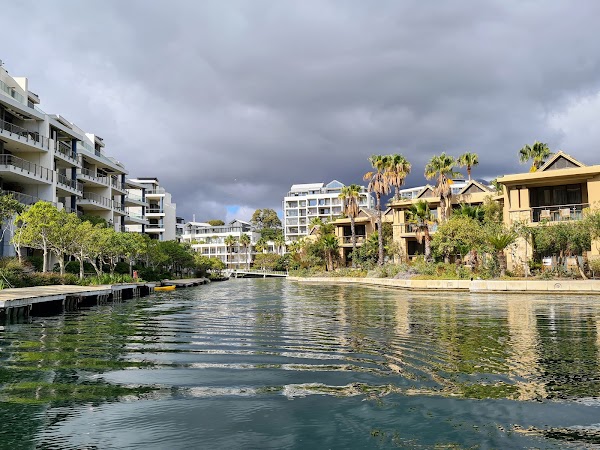
V&A Waterfront is a landmark in Cape Town, South Africa. Gulls cry over masts and cranes. The free Lokali audio guide runs 5 minutes.
✓ Verified August 2026 · how we write these guides
Visitor facts
| Lokali audio guide | 5 min · free |
|---|---|
| Location | Cape Town, South Africa |
| Coordinates | -33.9025, 18.4208 |
| Languages | 45, in the Lokali app |
The story
Gulls cry over masts and cranes. Ropes slap, water glitters, and somewhere a seal barks from a jetty. Behind it all stands Table Mountain. This is the Victoria and Alfred Waterfront, where Cape Town's oldest harbor and its liveliest public space share the same stretch of water.
Notice the name. Victoria and Alfred, not Victoria and Albert. The harbor honors Queen Victoria and her second son, Prince Alfred. In 1860 the young prince visited the Cape and ceremonially tipped the first load of stone for a new breakwater. Until then the bay had been a dangerous anchorage, open to winter storms that wrecked ships within sight of the town. The breakwater changed that.
Two basins followed. The smaller Alfred Basin was completed in 1870. The larger Victoria Basin came later, finished in the early years of the twentieth century as ships outgrew the first harbor. Convict labor built much of the early works, a hard fact resting under the harbor's pleasant surface.
This is still a working port, and that is what sets it apart from waterfront developments elsewhere. Tugboats nose against the quays. Fishing trawlers land their catch. In the Robinson Dry Dock, opened in 1882 and still in use, ships sit high and dripping while welders send down showers of sparks. You can stand at a rail and watch real work happen a few meters away.
The small red and gray clock tower by the swing bridge is the harbor's oldest landmark. Built in 1882 as the Port Captain's office, it is a Victorian Gothic building with an octagonal shape and a clock that still keeps time. The pedestrian swing bridge beside it pivots open for boats, so your walk may pause while a yacht slides through.
For much of the twentieth century the old basins fell quiet as shipping moved to newer docks next door. In 1988 a company was formed to bring the historic harbor back to life, and the first restored buildings opened soon after. Warehouses became shops, restaurants, and theaters. The idea was simple. Keep the port working, keep the old buildings standing, and let the public back in. Today the waterfront counts millions of visits every year.
The boldest transformation came in 2017. A concrete grain silo complex from the 1920s, once the tallest building in sub-Saharan Africa, was carved into the Zeitz Museum of Contemporary Art Africa. The architect Thomas Heatherwick cut a vast, cathedral-like atrium out of the silo tubes. Inside is the largest museum of contemporary African art in the world. After dark, look up at its bulging window panes glowing like lanterns.
At the Nelson Mandela Gateway, ferries leave for Robben Island, the prison island where Mandela spent eighteen of his twenty-seven years in captivity. The crossing takes about half an hour, and former political prisoners guide many of the tours. Sailings fill up and weather can cancel them, so plan that trip with care.
Families gravitate to the Two Oceans Aquarium, opened in 1995, where a kelp forest sways in a tall tank and ragged-tooth sharks cruise in slow circles. The Cape Wheel lifts you high above the rooftops for a slow turn with mountain and harbor views. In the Watershed, a converted warehouse, hundreds of local makers sell ceramics, textiles, and jewelry.
The harbor's wild residents ignore all of this. Cape fur seals haul out on the wooden jetties, scratch, yawn, and flop back into the water. Gulls and cormorants work the basins. The smell of salt and fish mixes with coffee and grilled seafood from the quayside kitchens.
Give the place time to change around you. Morning brings joggers, dog walkers, and working boats. Midday fills the squares with buskers and school groups. In the evening the mountain turns pink, lights come on across the water, and music drifts from open doors. The harbor wears a different face every hour.
Find a bollard by the Victoria Basin and sit for a moment. A century and a half ago, this was open water and bare rock. People built the breakwater by hand, stone by stone, many of them against their will. Their work still holds the sea back. Every calm reflection you see in the basin rests on it.
Key facts
What to look for
Practical tips
Common questions
How long is the audio guide for V&A Waterfront?
The free Lokali audio guide for V&A Waterfront runs about 5 minutes. Allow extra time beyond that to look around at your own pace.
Is there a free audio guide to V&A Waterfront?
Yes — the Lokali app narrates V&A Waterfront free of charge in 50+ languages. It covers the history, what to look for on site and practical tips, and it works offline once downloaded.
Where is V&A Waterfront?
V&A Waterfront is in Cape Town, South Africa, at -33.9025, 18.4208. Tap the map link on this page for directions from where you are.
What should you know before visiting V&A Waterfront?
Book Robben Island ferry tickets several days ahead.
What is V&A Waterfront known for?
Named for Queen Victoria and her son Prince Alfred.
On the map
Opens directions to V&A Waterfront from your location.
More to see in Cape Town


Hear V&A Waterfront in your language
The full story, narrated, in 50+ languages. Download it before you go and it plays offline, at your own pace, with no ticket and no tour group.