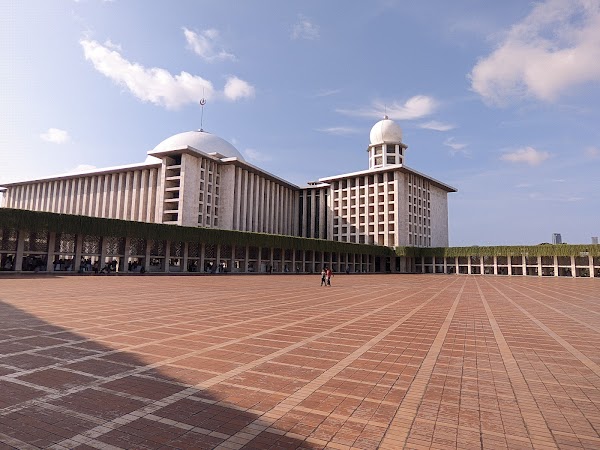
Istiqlal Mosque
6.1708° S · 106.8229° E · Mosque
Istiqlal Mosque is a mosque in Central Jakarta, Indonesia. Southeast Asia's largest mosque, completed in 1978. Most visitors spend 45–60 min here. The free Lokali audio guide runs 5 minutes.
✓ Verified August 2026 · how we write these guides
Visitor facts
| Time needed | 45–60 min |
|---|---|
| Lokali audio guide | 5 min · free |
| Type | Mosque |
| Best for | History |
| Location | Central Jakarta, Indonesia |
| Coordinates | -6.1708, 106.8229 |
| Languages | 45, in the Lokali app |
The story
The air changes the moment you step inside. The noise of the city falls away behind you. Your footsteps turn quiet on the cool stone floor. Above your head, a great white dome opens like a second sky, and soft light slips down from its rim. This is Istiqlal Mosque, the largest place of prayer in all of Southeast Asia. Outside, the heat and the traffic wait; in here, there is only space and stillness.
The name holds the whole story. The word "Istiqlal" means "independence" in the Arabic language. Indonesia won its freedom in 1945, after long centuries under foreign rule. The people wanted a way to give thanks for that hard-won freedom. So they chose to build a mosque large enough to hold the gratitude of an entire nation.
The work began in 1961. President Sukarno himself laid the first stone in the ground. The building rose slowly across many years. It finally opened in 1978. By then it had grown into something far more than a mosque. It had become a clear and lasting statement about the kind of country that Indonesia hoped to be.
The architect surprises almost everyone who hears the story. His name was Frederich Silaban. He was a Christian, born on the island of Sumatra. He entered a national design competition, and he won it. That a Christian man shaped the country's grandest mosque says something quiet and large about the open spirit of this place.
Now look up at the wide dome above the main hall. It measures forty-five meters across. That number is not there by chance. It points back to 1945, the year of independence. The builders folded their own history into the very shape of the roof, so that the meaning would never be lost.
The main hall can hold an enormous crowd. On the holiest days of the year, more than two hundred thousand people gather here together. They stand in long and even rows, shoulder to shoulder. The space is wide and open, carried on round steel columns, and the polished floor seems to stretch on almost without end. On an ordinary day, though, the hall lies nearly empty, and a single visitor feels very small beneath the dome.
Outside, a single minaret rises, tall and slender against the open sky. From its great height, the call to prayer has long carried out across the rooftops of the city below. The tower stands alone, simple and clean in its shape, reaching steadily upward in one unbroken line toward the moving clouds.
Near the entrance stands one older object worth a pause. It is a giant drum, called a bedug, carved from a single great log and covered with stretched hide. For many centuries, drums like this one called the faithful to prayer across the islands. This drum keeps that old custom alive beside the modern loudspeakers.
Now move toward a doorway and look across the road. There stands a large Catholic cathedral, with tall and pointed spires. The mosque and the cathedral face each other directly, with only the street between them. On the major holidays of each faith, the two neighbors share their parking spaces and their goodwill.
This closeness was a deliberate choice. Sukarno wanted the two great buildings placed near each other, as a sign that different faiths could share a single city in peace. In recent years, a walkway was built to join them beneath the ground. The people here have named it the Tunnel of Friendship. People can now pass from one house of worship to the other without ever crossing the street.
Inside, the style is plain on purpose. There is little gold here, and little heavy decoration. The beauty comes instead from sheer scale and from falling light. Sunlight drops through the high openings and moves slowly across the marble all through the day. The simple design is meant to turn the mind gently toward reflection.
If you wish to visit, dress modestly, and you will be made welcome. Long robes are offered freely to anyone who needs to cover up. Friendly guides will walk you through the wide halls and answer your questions, often with real warmth, simply glad that you have come to see their house of prayer. There is no fee to enter.
Before you leave, stand a moment at the center of the great hall. Listen to how each sound rises and then disappears into the height far above your head. A whole young country once poured its deepest hope for the future into this one open and quiet space. That hope still hums softly in the air.
Key facts
What to look for
Practical tips
Common questions
How long do you need at Istiqlal Mosque?
Plan 45–60 min. That is the time most visitors spend at Istiqlal Mosque. The free Lokali audio guide adds about 5 minutes of narration you can listen to as you walk, so it fits inside your visit rather than adding to it.
Is there a free audio guide to Istiqlal Mosque?
Yes — the Lokali app narrates Istiqlal Mosque free of charge in 50+ languages. It covers the history, what to look for on site and practical tips, and it works offline once downloaded.
Where is Istiqlal Mosque?
Istiqlal Mosque is in Central Jakarta, Indonesia, at -6.1708, 106.8229. Tap the map link on this page for directions from where you are.
What should you know before visiting Istiqlal Mosque?
Dress modestly; robes are lent free to visitors who need them.
What is Istiqlal Mosque known for?
Largest mosque in Southeast Asia, holding over two hundred thousand worshippers.
What is the best time to visit Istiqlal Mosque?
Visit outside prayer times for quieter exploration.
On the map
Opens directions to Istiqlal Mosque from your location.
Reference
More to see in Central Jakarta


Hear Istiqlal Mosque in your language
The full story, narrated, in 50+ languages. Download it before you go and it plays offline, at your own pace, with no ticket and no tour group.