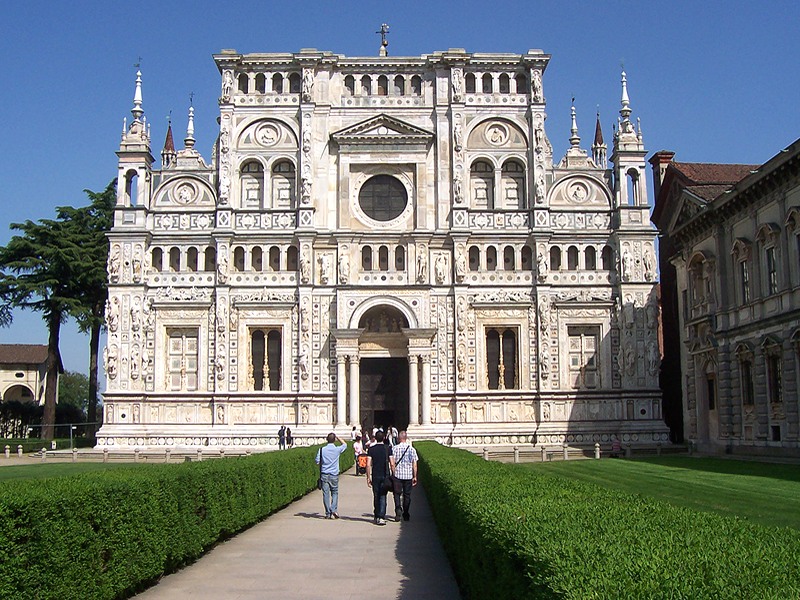
Photo: Geobia · CC BY-SA 3.0 · Wikimedia Commons
Certosa di Pavia is a monastery in Italy. Founded in 1396 by Gian Galeazzo Visconti of Milan. The free Lokali audio guide runs 7 minutes.
✓ Published October 2026 · how we write these guides
Visitor facts
| Lokali audio guide | 7 min · free |
|---|---|
| Type | Monastery |
| Location | Certosa di Pavia, Italy |
| Coordinates | 45.2570, 9.1483 |
| Official website | certosadipavia.it |
| Languages | 50+, in the Lokali app |
The story
Gravel shifts under your shoes as you cross the open forecourt. Ahead, a wall of carved marble catches the light. Up close it is not one surface at all. It is hundreds of small figures, medallions, columns and garlands, packed so tightly that the stone almost looks woven. Somewhere behind it, a bell marks the hour. The fields of Lombardy lie flat and quiet all around. This is the Certosa di Pavia, and it was built for a very particular kind of silence.
The word certosa means a charterhouse, a monastery of the Carthusian order. The Carthusians were the most solitary of medieval monks. Each man lived alone for most of the day. He prayed, worked and ate in his own small house, and met his brothers only for certain services and occasional meals. So picture the contrast. A community devoted to quiet, hidden behind one of the most richly decorated church fronts in Italy. That tension runs through everything you will see here.
The story begins in 1396. Gian Galeazzo Visconti, the powerful ruler of Milan, founded this monastery. He had large ambitions. He wanted a religious house of great size, and he also wanted a burial place worthy of his family. The site was chosen with care. It sat between Milan and Pavia, the two main cities of his state, and near the edge of a vast hunting park that the Visconti family kept. Prayer, power and private pleasure all met on this stretch of land.
Building a place like this took a very long time. Work continued for well over a century, through the rule of the Visconti and then the Sforza family who followed them. You can read that long timeline in the architecture itself. The body of the church, with its pointed arches and tall proportions, belongs to the late Gothic world. The decoration that covers it, especially on the façade, belongs to the Renaissance, the period when Italian artists turned back to the forms of ancient Rome.
Now look closely at the lower half of the façade. Much of this carving was directed by the sculptor Giovanni Antonio Amadeo, working with other Lombard masters in the late fifteenth century. Look for the round medallions near the base. Many show heads in profile, modelled on Roman coins and emperors. Above them run panels of biblical scenes, saints and tiny decorative creatures. Different coloured marbles frame the white stone. Take a moment to trace one strip from end to end. The detail rewards slow eyes.
Here is something many visitors miss. Let your gaze rise to the upper part of the façade. It is noticeably plainer. The carving thins out, the surfaces flatten, and the energy of the lower storey fades. The upper section was completed later, in the sixteenth century, after money and priorities had changed. The façade was never finished in the way its first designers seemed to imagine. So the front of this church also records the moment when the great project finally ran out of steam.
Step inside, and the temperature drops. The light softens. Your eyes need a moment to adjust after the bright marble outside. The nave feels tall and calm, with painted vaults overhead and side chapels opening one after another along the walls. Many of these chapels hold altarpieces and frescoes by Lombard painters. One name to listen for is Bergognone, a local artist whose gentle, silvery colours appear in several parts of the church. His work fits the quiet mood of the place.
In one chapel you may find an altarpiece connected to Perugino, the Umbrian master who taught the young Raphael. Here is a second surprise. Only part of what you see is his original work. Other panels from this altarpiece left the monastery long ago and now hang in the National Gallery in London. What remains here sits beside later replacements. It is a small reminder that the treasures of Italian churches often travelled far, through sales, wars and changes of ownership.
Near the transept, the arms of the church that cross the nave, you will find two important tombs. One is the monument to the founder, Gian Galeazzo Visconti, an elaborate Renaissance tomb raised long after his death. The other is the funerary monument of Ludovico Sforza, known as Il Moro, and his wife Beatrice d'Este. Their marble figures lie side by side, carved by Cristoforo Solari. These effigies were first intended for a church in Milan and were moved here later. Notice the fine detail of Beatrice's clothing and shoes.
Now leave the church and enter the cloisters. The small cloister sits close to the church. Its arches carry warm terracotta decoration, baked clay moulded into figures, faces and leafy patterns. Terracotta was a natural choice in Lombardy, a region of rich clay and little native stone. In the afternoon, the reddish brown surfaces seem to glow. From one corner of this cloister you can look back at the side of the church, rising above the arcade with its towers and layered roofs.
Beyond lies the great cloister, and it is here that the Carthusian way of life becomes clear. A long arcade runs around a vast green courtyard. Along its sides stand the monks' cells. But do not imagine a narrow room. Each cell is a small private house, with its own rooms and its own walled garden. A small opening beside each door allowed food to be passed in without any conversation. Solitude was not an accident here. It was designed into the walls.
The later history of the monastery was not peaceful. In 1525 the Battle of Pavia was fought in the countryside nearby, one of the great clashes between France and the Habsburg empire. In the late eighteenth century, under Austrian rule, the Carthusian community was suppressed and the monks left. Over the following centuries the complex passed through different hands. Today a religious community lives here once more, and visits to the monastery are often guided by its members. Their presence keeps this a living house of prayer, not only a museum.
Before you go, return to the forecourt and turn around one last time. Notice how the plain brick buildings around you frame the bright marble front. Listen for the gravel, the birds, perhaps a distant bell. Somewhere behind those walls, the cells and gardens still stand in their long row. As you walk back toward the road, think of the men who lived here for centuries in near silence, and of how much noise, money and art it took to protect that quiet.
Key facts
What to look for
Practical tips
Common questions
Is there a free audio guide to Certosa di Pavia?
Yes — the Lokali app narrates Certosa di Pavia free of charge in 50+ languages. The guide runs about 7 minutes, covers the history, what to look for on site and practical tips, and works offline once downloaded.
Where is Certosa di Pavia?
Certosa di Pavia is in Certosa di Pavia, Italy, at 45.2570, 9.1483. Tap the map link on this page for directions from where you are.
What is Certosa di Pavia known for?
Founded in 1396 by Gian Galeazzo Visconti of Milan. Built as a Carthusian monastery and Visconti family mausoleum.
What should you look for at Certosa di Pavia?
Coin-style profile medallions along the base of the façade. The plainer, unfinished feel of the upper façade. Side-by-side marble effigies of Ludovico and Beatrice.
What should you know before visiting Certosa di Pavia?
Allow time for the cloisters, not only the church. Bring binoculars to study the upper façade carvings.
When is the best time to visit Certosa di Pavia?
Visit in late afternoon for warm light on terracotta.
On the map
Opens directions to Certosa di Pavia from your location.
More to see near Certosa di Pavia


Hear Certosa di Pavia in your language
The full story, narrated, in 50+ languages. Download it before you go and it plays offline, at your own pace, with no ticket and no tour group.