
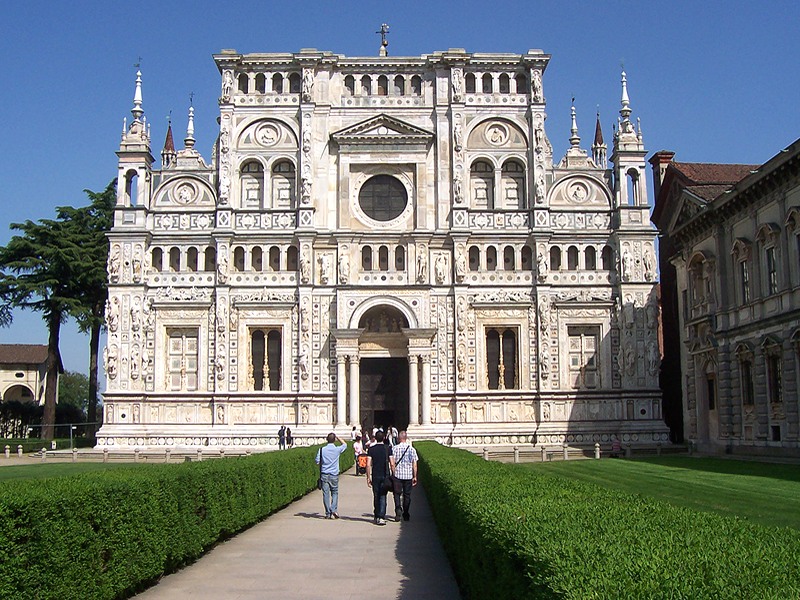
Photo: G.dallorto · Attribution · Wikimedia Commons
San Pietro in Ciel d'Oro is a church in Pavia, Lombardy, Italy. Name means Saint Peter in the Golden Sky. The free Lokali audio guide runs 7 minutes.
✓ Published October 2026 · how we write these guides
Visitor facts
| Lokali audio guide | 7 min · free |
|---|---|
| Type | Church |
| Location | Pavia, Italy |
| Coordinates | 45.1913, 9.1549 |
| Official website | basilicasanpietroincieldoro.com |
| Languages | 50+, in the Lokali app |
The story
Stand in front of the church for a moment and look at the colours. Warm red brick, pale sandstone, and a single broad gable that slopes down on both sides like the roof of a simple house. The square in front is quiet. You may hear a bicycle bell, footsteps on stone, perhaps a bird in the courtyard nearby. Nothing here shouts for attention. And yet behind this plain front lie two of the most important tombs in the history of Western thought.
The name comes first, because it is unusual. San Pietro in Ciel d'Oro means Saint Peter in the Golden Sky. The phrase refers to an earlier church on this site, whose ceiling was covered in gold. That ceiling is long gone. The name stayed. Even in the Middle Ages, people across Italy knew this place by that bright, almost poetic title. It was famous long before the present walls went up.
To understand why, picture Pavia many centuries ago. Under the Romans the town was called Ticinum. Later it became the capital of the Lombard kingdom, a Germanic people who ruled much of northern Italy in the early Middle Ages. Kings were crowned here. Courts met here. Pavia was, for a time, one of the most powerful cities on the peninsula. This church sat close to the heart of that royal world.
The building you see today is Romanesque. That is the style of European churches from roughly the eleventh and twelfth centuries — thick walls, round arches, and heavy, calm proportions. This church was consecrated in 1132 by Pope Innocent the Second. Look at the front again. The small arches running under the edge of the roof, the narrow windows, the mix of brick and stone — these are typical of Lombard Romanesque. Builders here worked with the clay of the river plain, and you can see it everywhere in Pavia.
Now step inside. The light drops at once. Your eyes need a few seconds to adjust. The nave, the long central space of the church, runs ahead of you between columns and arches. The air is cooler, and it often carries a faint smell of wax and old stone. Sound behaves differently here too. A cough or a whisper travels a long way. Walk slowly toward the altar, because the main reason most visitors come is waiting there.
Above the high altar stands a great tomb of white marble. This is the Arca of Saint Augustine. Augustine was a North African bishop of the late fourth and early fifth centuries. His writings, including the Confessions and The City of God, shaped Christian thinking for more than a thousand years. Many people are surprised to learn that his remains rest here, in a quiet corner of Lombardy, and not in Africa or Rome.
How did they arrive? The story runs through the Mediterranean. After Augustine's death, his remains were carried to Sardinia, according to tradition by bishops fleeing North Africa. In the eighth century, the Lombard king Liutprand arranged for them to be brought to Pavia, to protect them from raids on the island. He placed them in this church. Liutprand himself chose to be buried here as well. So a Lombard king and an African saint share the same roof.
Come closer to the Arca. It dates from the fourteenth century, and it is usually attributed to the Campionese masters, sculptors from the lakes north of Milan. Look at how crowded it is. Dozens upon dozens of small figures cover every surface — saints, apostles, virtues, and scenes from Augustine's life. At the centre, under a canopy, the saint lies on his bier, surrounded by figures who seem to watch over him. Take your time here. Every face is different.
Now for the second surprise. Go down into the crypt, the lower chamber beneath the altar. Here lie the remains of Boethius. He was a Roman philosopher and statesman of the early sixth century. He served the Gothic king Theodoric, then fell from favour and was imprisoned and executed. While in prison, he wrote The Consolation of Philosophy. For the whole Middle Ages, it was one of the most widely read books in Europe.
This is where the poet Dante enters the story. In the Paradiso, the third part of his Divine Comedy, Dante meets the soul of Boethius in heaven. He says that the body this soul was driven from now lies below, in Cieldauro — this very church. So when you stand in the crypt, you are standing in a place that Dante named in one of the great poems of world literature. Few visitors realise that connection.
The church has not always been so cared for. After the end of the eighteenth century, during the upheavals of the Napoleonic period, it was taken from religious use. For years it served as a military storehouse. The building decayed badly. Then, in the late nineteenth century, a long restoration brought it back, and it reopened for worship in the 1890s. Some of the clean lines you see today are the result of that careful work.
Today the church is in the care of the Augustinian friars, the religious order that follows Augustine's rule. Their presence gives the place a living rhythm. You may see a friar crossing the nave, or hear a short prayer at the side altar. In 2007, Pope Benedict the Sixteenth came here to pray at the tomb. He was a lifelong student of Augustine, and he left his pallium, a woollen band worn by popes, on the Arca as a gift.
Before you leave, turn around once more inside the nave. Look back at the white marble against the darker stone and brick. Think of the chain of people who brought you here — a bishop from North Africa, a philosopher from Rome, a Lombard king, a Florentine poet, and generations of friars and restorers. As you walk out into the square, listen again to the quiet streets of Pavia. The golden ceiling is gone. What it covered is still here.
Key facts
What to look for
Practical tips
Common questions
Is there a free audio guide to San Pietro in Ciel d'Oro?
Yes — the Lokali app narrates San Pietro in Ciel d'Oro free of charge in 50+ languages. The guide runs about 7 minutes, covers the history, what to look for on site and practical tips, and works offline once downloaded.
Where is San Pietro in Ciel d'Oro?
San Pietro in Ciel d'Oro is in Pavia, Italy, at 45.1913, 9.1549. Tap the map link on this page for directions from where you are.
What is San Pietro in Ciel d'Oro known for?
Name means Saint Peter in the Golden Sky. Present church consecrated in 1132 by Pope Innocent the Second.
What should you look for at San Pietro in Ciel d'Oro?
Small blind arches running under the roofline of the facade. The mix of red brick and pale sandstone outside. Reclining figure of Augustine at the centre of the Arca.
What should you know before visiting San Pietro in Ciel d'Oro?
Visit outside Mass times to approach the tomb freely. Let your eyes adjust before studying the marble details.
On the map
Opens directions to San Pietro in Ciel d'Oro from your location.
More to see near San Pietro in Ciel d'Oro


Hear San Pietro in Ciel d'Oro in your language
The full story, narrated, in 50+ languages. Download it before you go and it plays offline, at your own pace, with no ticket and no tour group.