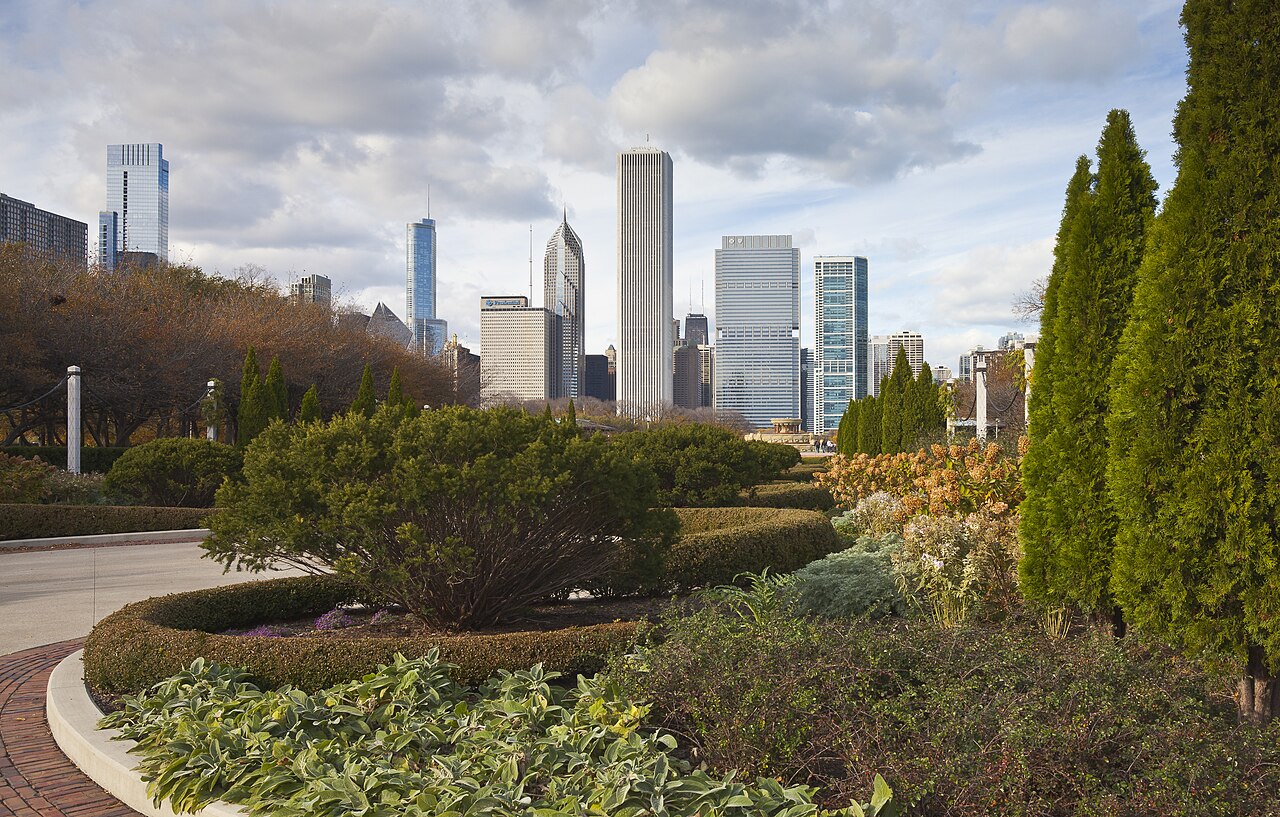
Grant Park is a park in Chicago, United States. Chicago's 319-acre lakefront green space stretches from downtown to the Museum Campus. Most visitors spend 1–3 hours here. The free Lokali audio guide runs 5 minutes.
✓ Verified August 2026 · how we write these guides
Visitor facts
| Time needed | 1–3 hours |
|---|---|
| Lokali audio guide | 5 min · free |
| Type | Park |
| Best for | Photography |
| Location | Chicago, United States |
| Coordinates | 41.8829, -87.6233 |
| Languages | 45, in the Lokali app |
The story
Wind off the lake, a plain of green, and a column of water climbing fifteen stories into the air. To the west, a cliff of skyscrapers. To the east, the horizon of Lake Michigan. Grant Park is where Chicago opens its arms.
Chicagoans call this the city's front yard. It covers about 320 acres between the towers of the Loop and the lakefront, a lawn the size of a small neighborhood kept open in the most valuable real estate in the Midwest. Ball fields, tennis courts, gardens, and monuments fill its quarters, stitched together by long straight walkways.
The openness is not an accident. In 1836, before Chicago was even a city, surveyors marked this strip of shoreline with a promise: public ground, forever open, clear, and free of any buildings. The land became Lake Park in 1844, and in 1901 it was renamed to honor Ulysses S. Grant, the Civil War general who became the eighteenth president.
The promise still needed a defender. Aaron Montgomery Ward, the mail-order merchant, spent about twenty years in court, from 1890 to 1911, suing again and again to keep buildings out of the park. Business leaders called him an enemy of progress. Today he is remembered as the man who saved the front yard.
The ground itself has a story. Much of the park is landfill, pushed out into the lake over decades. After the Great Chicago Fire of 1871, the ruins of the burned city, ash, brick, and rubble, were dumped along the shore here. You are walking on the debris of old Chicago, buried under lawns and gardens.
At the center of everything stands Buckingham Fountain, one of the largest fountains in the world. Kate Buckingham gave it to the city in 1927 in memory of her brother Clarence. Its design copies the Latona Fountain at Versailles, but at roughly twice the size, a very Chicago kind of tribute.
The fountain is a portrait of Lake Michigan. The four pairs of bronze seahorses around the pool stand for the four states that touch the lake: Illinois, Indiana, Michigan, and Wisconsin. In season, from spring to mid-autumn, the water runs daily, and once an hour it builds into a twenty-minute show. The center jet can reach about 150 feet. After dark, lights and music join in.
Winter treats the fountain differently. The water is drained before the first freeze, and the bronze sleeps dry until spring. If you visit in the cold months, you will find the basin still and quiet, and the seahorses wearing frost. The show begins again when the weather turns.
This park is also where the city gathers at full strength. In 1968, during the Democratic National Convention, clashes between police and anti-war protesters here played out on television around the world. Forty years later, in 2008, an enormous crowd filled the park on election night to hear Barack Obama, newly elected president, speak beneath the skyline. Estimates put that crowd around a quarter of a million people.
In summer the lawns turn into festival grounds. Lollapalooza brings hundreds of thousands of music fans over a long weekend. The Taste of Chicago spreads food stalls under the trees. The Blues Festival fills a June evening with guitar. The park absorbs them all, then returns to quiet grass.
The park's edges hold treasures of their own. On Michigan Avenue, two bronze lions guard the Art Institute of Chicago, one of the great art museums of the world. The northwest corner holds Millennium Park and its mirror-polished Bean. To the south, the Museum Campus gathers the Field Museum, the Shedd Aquarium, and the Adler Planetarium on a green point in the lake.
Give yourself time to wander. Formal rose gardens flank the fountain in summer. Long rows of trees shade the walkways, planted in straight lines in the French style. The lakefront trail runs the park's full length, past harbors of sailboats. Cross to the water's edge at Queen's Landing and look back for one of the best skyline views in the city.
Before you leave, think again about those words from 1836. Forever open, clear, and free. Nearly two centuries of pressure, money, and ambition have pushed against that promise, and the promise has held. The towers stopped at the street. The lawn runs to the water. Some of the best things a city can build are the spaces it refuses to fill.
Key facts
What to look for
Practical tips
Common questions
How long do you need at Grant Park?
Plan 1–3 hours. That is the time most visitors spend at Grant Park. The free Lokali audio guide adds about 5 minutes of narration you can listen to as you walk, so it fits inside your visit rather than adding to it.
Is there a free audio guide to Grant Park?
Yes — the Lokali app narrates Grant Park free of charge in 50+ languages. It covers the history, what to look for on site and practical tips, and it works offline once downloaded.
Where is Grant Park?
Grant Park is in Chicago, United States, at 41.8829, -87.6233. Tap the map link on this page for directions from where you are.
What should you know before visiting Grant Park?
Time your visit to the hourly twenty-minute fountain show.
What is Grant Park known for?
Covers about 320 acres between the Loop and lakefront.
What is the best time to visit Grant Park?
Walk the Lakefront Trail at sunset for the best light on the skyline.
On the map
Opens directions to Grant Park from your location.
More to see in Chicago


Hear Grant Park in your language
The full story, narrated, in 50+ languages. Download it before you go and it plays offline, at your own pace, with no ticket and no tour group.