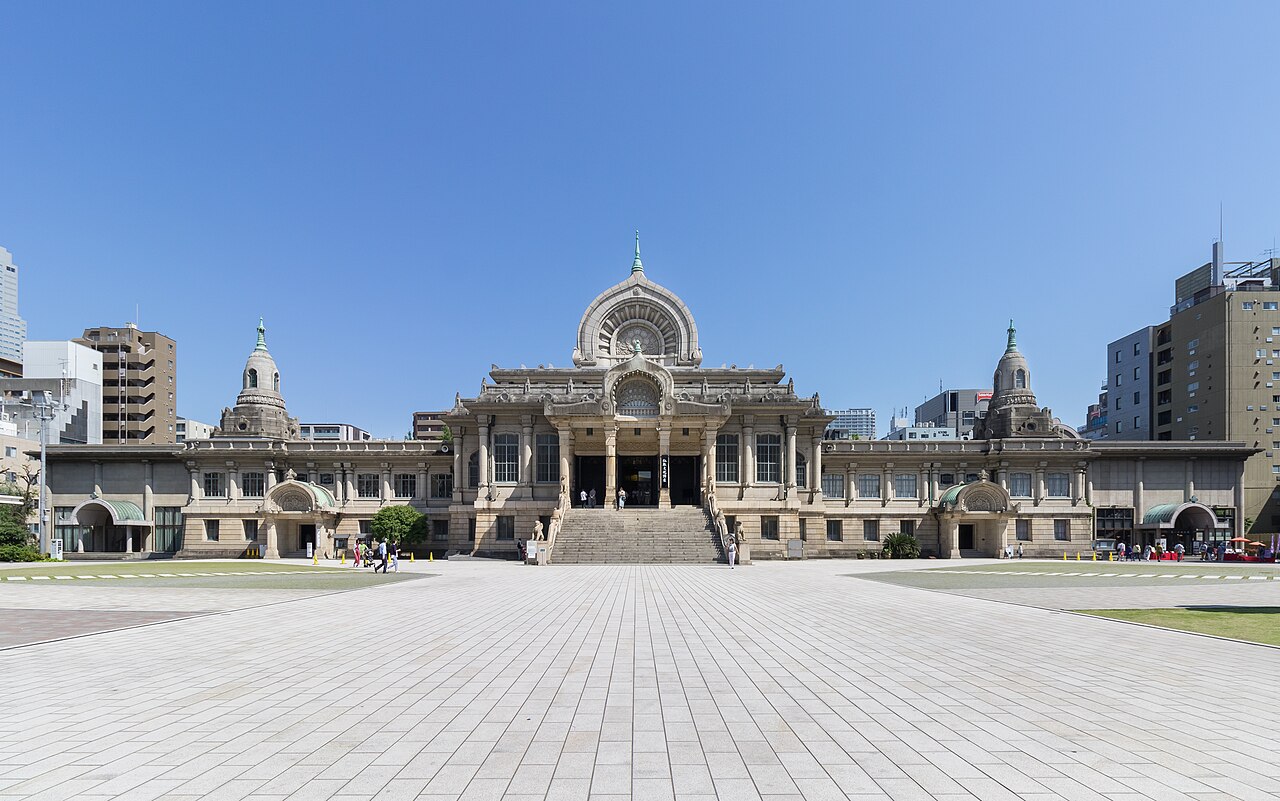
Tsukiji Hongan-ji Temple is a Jodo Shinshu Buddhist temple built in 1617, located near the Tsukiji market. It is in Chuo, Japan. Most visitors spend 30–45 min here. The free Lokali audio guide runs 5 minutes.
✓ Verified August 2026 · how we write these guides
Visitor facts
| Time needed | 30–45 min |
|---|---|
| Lokali audio guide | 5 min · free |
| Type | Temple |
| Best for | History |
| Location | Chuo, Japan |
| Coordinates | 35.6646, 139.7706 |
| Languages | 45, in the Lokali app |
The story
The traffic moves past on the wide avenue, and then you see it: a temple of pale stone, not wood. Rounded domes rise against the Tokyo sky. Carved creatures sit along the steps. Stop here for a moment, because almost nothing about this building looks the way you might expect a Japanese temple to look.
This is Tsukiji Hongan-ji. It belongs to the Jodo Shinshu school of Buddhism, the True Pure Land tradition, and it serves as the Tokyo branch of the great Nishi Hongan-ji temple in Kyoto. People have come here to pray for four centuries. The building in front of you, though, is younger than that, and its story explains the whole neighborhood.
The temple was first founded in 1617, in a different part of the city, closer to where Asakusa stands today. Then came the great fire of 1657, one of the worst in the history of old Edo. The temple burned along with much of the city. When the time came to rebuild, the original ground was no longer available, so the followers were given a stretch of marshland near the bay. The loss was enormous, and the work of rebuilding would take years.
There was no solid land to build on. So they made it. They filled in the shallows of the sea, packing earth into the water until the ground was firm enough to hold a temple. The Japanese word for reclaimed land is tsukiji. That is how the whole district got its name. You are standing on ground that people built by hand, plot by plot, to give this temple a home.
The building you see now came later still. Fire, earthquake, and time wore down the earlier wooden halls. The Great Kanto Earthquake of 1923 brought the final blow. For the rebuilding, the temple turned to an architect named Ito Chuta.
Ito was not only a builder. He was a scholar who studied the history of architecture, and he had traveled widely across Asia, tracing Buddhism back toward the lands where it began. He believed that a Buddhist temple in Japan could honor those distant roots. He had studied the great monuments of India and of China, and he wanted this hall to remember them. So he designed something that looked back to ancient India.
The hall was finished in 1934. Look at the stone domes, the rounded arches, the shapes carved above the doors. They echo the early Buddhist architecture of South Asia, far older than the wooden temples of Japan. At the time it must have surprised people. Even now it feels like a building that traveled a long way to reach this corner.
Walk up the steps and look closely at the stonework. Ito filled the building with animals. A pair of beasts guard the entrance. Inside and out, if you search, you can find carved creatures tucked into the design: winged figures, lions, and other forms drawn from legend. Above the entrance, a winged creature seems poised to take flight. Children love to hunt for them all, and so do many adults.
Step inside, and the surprise continues. The main hall holds a golden altar in the traditional Jodo Shinshu style, glowing softly at the far end. But around you there are stained glass windows, and up in a gallery there sits a pipe organ, an instrument you would never expect in a Buddhist temple. It was installed so that music could fill the hall. The mix of east and west in one room can take a few seconds to absorb.
Find a seat on one of the benches and let the room settle around you. The air is cool and still. People come and go quietly. Some bow toward the altar; some simply rest. There is no charge to enter, and no pressure to do anything but be here for a while.
Outside again, notice how the temple sits against the modern city. Cars, glass towers, the rush of Tokyo on every side. And here, this calm pale hall of stone, holding the memory of a fire, a marsh, and a long journey of ideas across a continent. The contrast is the whole point, and it is easy to feel.
Before you leave, turn back once and take in the whole front of the building. Think of the people who filled in the sea to make this ground, and of the architect who reached back across two thousand years and an ocean to shape what stands here. Few buildings carry their story so openly on the surface. This one does. Carry that quiet with you as you go.
Key facts
What to look for
Practical tips
Common questions
How long do you need at Tsukiji Hongan-ji Temple?
Plan 30–45 min. That is the time most visitors spend at Tsukiji Hongan-ji Temple. The free Lokali audio guide adds about 5 minutes of narration you can listen to as you walk, so it fits inside your visit rather than adding to it.
Is there a free audio guide to Tsukiji Hongan-ji Temple?
Yes — the Lokali app narrates Tsukiji Hongan-ji Temple free of charge in 50+ languages. It covers the history, what to look for on site and practical tips, and it works offline once downloaded.
Where is Tsukiji Hongan-ji Temple?
Tsukiji Hongan-ji Temple is in Chuo, Japan, at 35.6646, 139.7706. Tap the map link on this page for directions from where you are.
What should you know before visiting Tsukiji Hongan-ji Temple?
Entry is free; step inside to see the altar.
What is Tsukiji Hongan-ji Temple known for?
Founded in 1617, rebuilt at Tsukiji after the 1657 fire.
What is the best time to visit Tsukiji Hongan-ji Temple?
The temple's main hall has impressive wooden interior carvings.
On the map
Opens directions to Tsukiji Hongan-ji Temple from your location.
More to see in Chuo

Hear Tsukiji Hongan-ji Temple in your language
The full story, narrated, in 50+ languages. Download it before you go and it plays offline, at your own pace, with no ticket and no tour group.