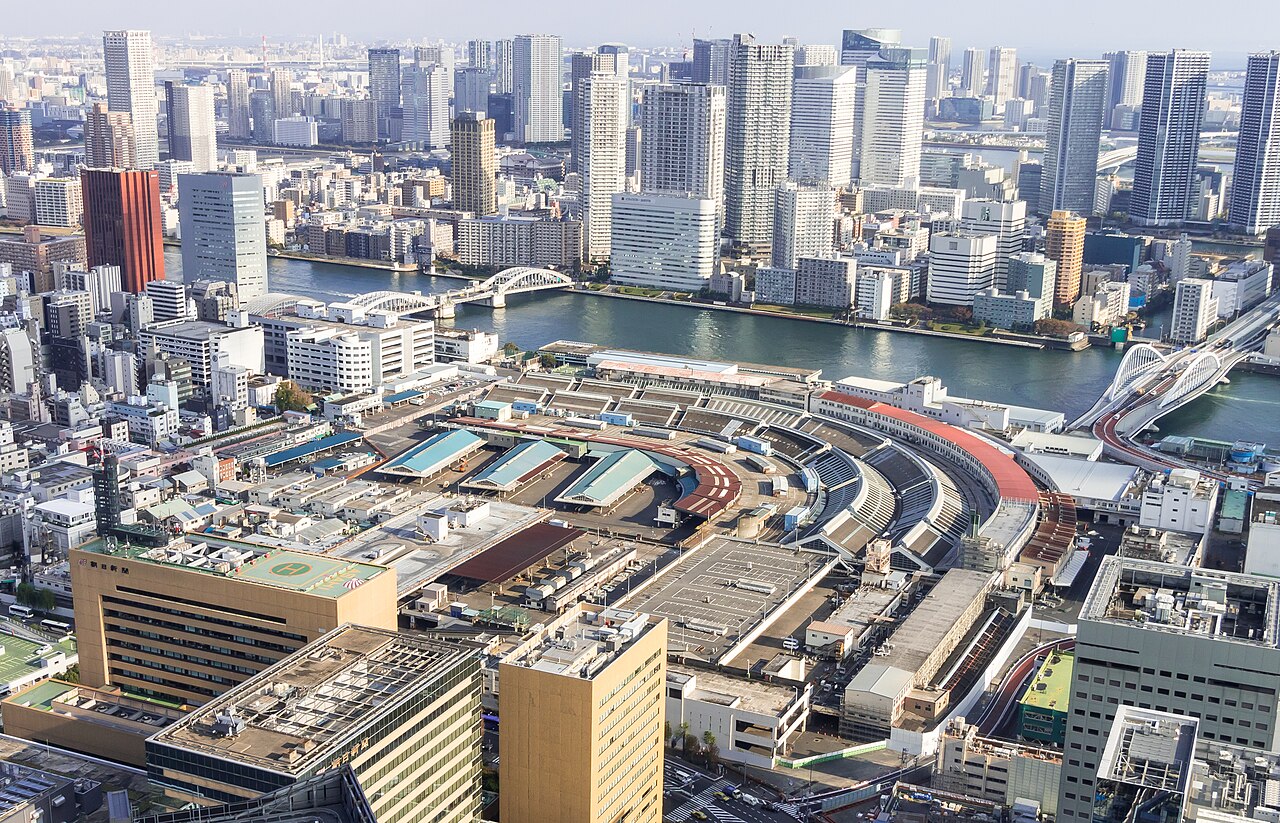
Tsukiji Outer Market
35.6654° N · 139.7707° E · Food Market
Tsukiji Outer Market is a sprawling wholesale and retail seafood market that operated for decades as Tokyo's primary fish hub. It is in Chuo, Japan. Most visitors spend 1–2 hours here. The free Lokali audio guide runs 9 minutes.
✓ Verified August 2026 · how we write these guides
Visitor facts
| Time needed | 1–2 hours |
|---|---|
| Lokali audio guide | 9 min · free |
| Type | Food Market |
| Best for | Local life |
| Location | Chuo, Japan |
| Coordinates | 35.6654, 139.7707 |
| Languages | 45, in the Lokali app |
The story
The air here is thick with brine and citrus, charcoal smoke curling up from street-side grills where vendors flip skewers of scallop and squid over open flames. You are standing in the Tsukiji Outer Market, a warren of narrow lanes and shopfronts that has fed Tokyo for nearly a century. The famous wholesale tuna auctions moved to Toyosu in 2018, but this outer ring — the public face of Tsukiji — stayed put, and it remains one of the most visceral food markets in the world.
Tsukiji began as a response to disaster. After the Great Kanto Earthquake leveled much of Tokyo in 1923, the city government consolidated dozens of scattered fish markets into a single site on reclaimed land near the Sumida River. The inner wholesale market opened in 1935, a modernist concrete hall built to handle the volume of a growing metropolis. The outer market grew organically around it — knife shops, tea merchants, dried-goods stalls, breakfast counters — serving the needs of the fishmongers and chefs who worked inside. Over decades, the two markets became symbiotic, the outer feeding off the energy of the inner.
Walk slowly here. The lanes are barely wide enough for a handcart, and the rhythm is intense in the morning hours. Shopkeepers call out prices in clipped Tokyo dialect, their voices layered over the hiss of steam from rice cookers and the scrape of knives on whetstones. You will see older women in rubber boots hosing down the pavement, younger men in white coats hauling crates of daikon and ginger, tourists queuing twenty deep for tamago sushi at counters no bigger than a closet. The market is a working place first, a tourist attraction second, and that tension gives it its particular charge.
The knife shops are worth your attention. Tsukiji is home to some of the finest blade smiths in Japan, and their windows display carbon-steel knives that cost more than a plane ticket. These are not souvenirs — they are tools built for professionals, balanced to the gram, sharpened to a single-bevel edge that slices through fish flesh without tearing the cell walls. If you step inside, the shopkeepers will let you hold one, feel the weight distribution, the way the handle sits in your palm. They will also tell you, politely, that these knives require daily maintenance and are not suited to a dishwasher.
The food here is elemental. Grilled eel brushed with sweet soy glaze, sea urchin spooned over warm rice, thick slabs of tuna belly that melt on the tongue. The best stalls have no English menus and no chairs — you eat standing at a counter, shoulder to shoulder with market workers on their break. The fish is hours old, sometimes minutes old, and the difference is palpable. Tuna that fresh has a faint mineral sweetness, a texture closer to custard than meat. Octopus grilled over binchotan charcoal takes on a smoky char that contrasts with the tender flesh beneath.
Tsukiji Outer Market runs along a grid of five main streets and a tangle of side alleys, covering roughly four city blocks. The core is densest between Shin-Ohashi Street and Harumi Street, where the oldest shops cluster. Some of these businesses are third or fourth generation, family operations that have occupied the same ten square metres since the nineteen-fifties. The continuity is visible in the worn wooden counters, the faded hand-painted signs, the way certain vendors know their regulars by name and have their order ready before a word is spoken.
Come early if you can. The market wakes around six in the morning, and by seven the energy is already building. The light at that hour is soft, the crowds thinner, and you can move through the lanes without constant jostling. By nine the tour groups arrive, and the atmosphere shifts — still lively, but more performative, vendors accustomed to posing for photographs. The market stays open until early afternoon, but many of the best stalls sell out by eleven and pull down their shutters.
The future of Tsukiji Outer Market is uncertain. The land beneath it is valuable, and there have been repeated proposals to redevelop the site for the 2020 Olympics and beyond. So far, the vendors have resisted, arguing that the market is not just a commercial space but a cultural one, a living archive of Tokyo's relationship with the sea. Whether that argument holds in a city as relentlessly forward-looking as Tokyo remains to be seen.
For now, the market endures. Stand at the corner of Namiyoke Street and listen — the clatter of crates, the sizzle of oil, the low hum of a hundred conversations in Japanese and broken English. This is Tokyo at its most unvarnished, a place where the work of feeding a city happens in plain sight. The smells will stay with you long after you leave, salt and smoke and the faint iron tang of fresh fish, a sensory memory you will carry home.
Key facts
What to look for
Practical tips
Common questions
How long do you need at Tsukiji Outer Market?
Plan 1–2 hours. That is the time most visitors spend at Tsukiji Outer Market. The free Lokali audio guide adds about 9 minutes of narration you can listen to as you walk, so it fits inside your visit rather than adding to it.
Is there a free audio guide to Tsukiji Outer Market?
Yes — the Lokali app narrates Tsukiji Outer Market free of charge in 50+ languages. It covers the history, what to look for on site and practical tips, and it works offline once downloaded.
Where is Tsukiji Outer Market?
Tsukiji Outer Market is in Chuo, Japan, at 35.6654, 139.7707. Tap the map link on this page for directions from where you are.
What should you know before visiting Tsukiji Outer Market?
Arrive before nine to avoid the largest crowds.
What is Tsukiji Outer Market known for?
Established in 1935 after the Great Kanto Earthquake.
What is the best time to visit Tsukiji Outer Market?
Arrive early morning to watch vendors arrange their displays and catch the energy before crowds peak.
On the map
Opens directions to Tsukiji Outer Market from your location.
More to see in Chuo

Hear Tsukiji Outer Market in your language
The full story, narrated, in 50+ languages. Download it before you go and it plays offline, at your own pace, with no ticket and no tour group.