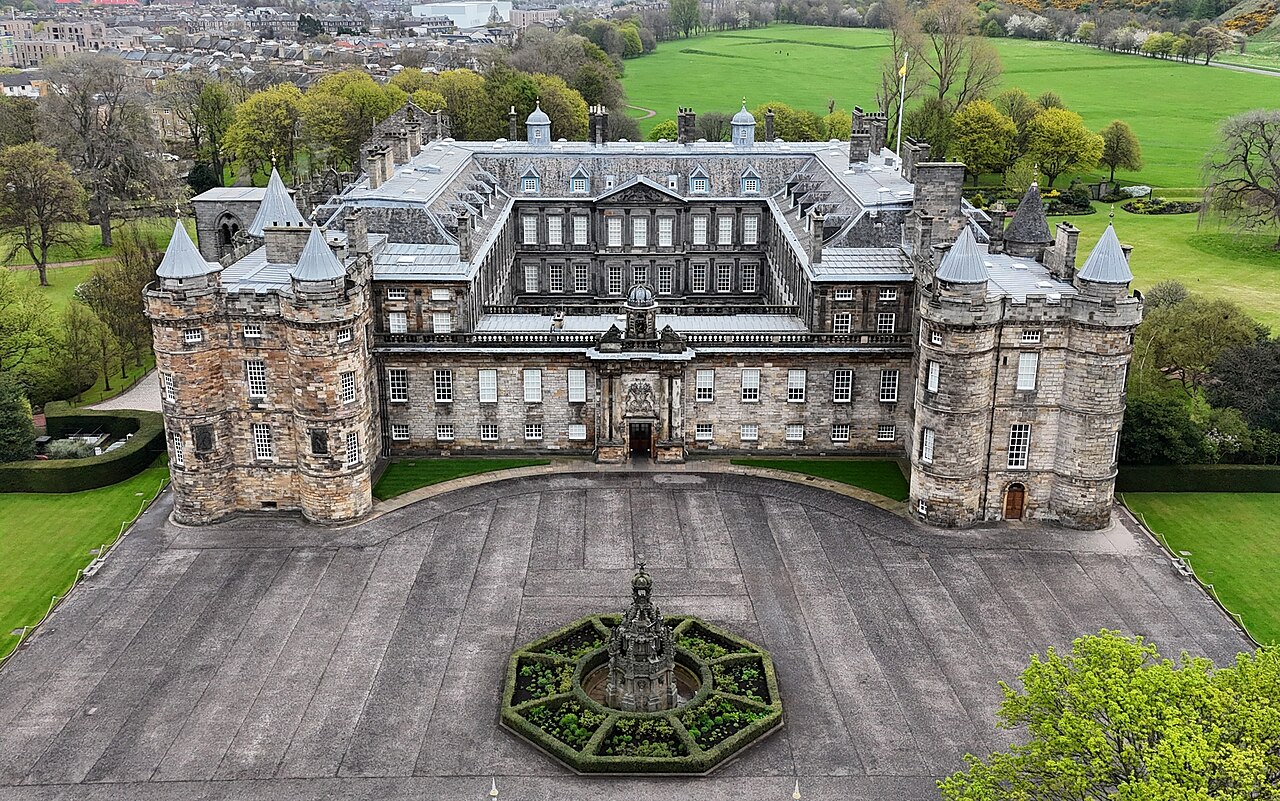
Palace of Holyroodhouse
55.9565° N · 3.1752° W · Palace
Palace of Holyroodhouse is the official Scottish residence of the monarch, standing at the eastern foot of the Royal Mile. It is in Edinburgh, United Kingdom. Most visitors spend 1–2 hours here. The free Lokali audio guide runs 5 minutes.
✓ Verified August 2026 · how we write these guides
Visitor facts
| Time needed | 1–2 hours |
|---|---|
| Lokali audio guide | 5 min · free |
| Type | Palace |
| Best for | History |
| Location | Edinburgh, United Kingdom |
| Coordinates | 55.9565, -3.1752 |
| Languages | 45, in the Lokali app |
The story
At the foot of the long hill, the road ends at a gate. Beyond it, a grey palace stands against green slopes. Behind the palace rises a wild hill of rock and grass. Beside it stand the broken walls of an old church, open now to the sky. You have reached the Palace of Holyroodhouse, where the city street finally meets the land of kings and queens.
This is the official home of the British king in Scotland. When the monarch is not here, the doors open to visitors. The palace sits at the bottom of the Royal Mile, the long street that runs down from the castle. Around it lies a wide royal park. Above it rises a tall green hill, the highest point for miles, looking down on the whole scene.
The story began with a church, not a palace. In 1128, King David the First founded an abbey here for a group of monks. The name Holyrood means holy cross. For hundreds of years, the abbey was a place of prayer. Kings came to stay in the guest rooms beside it. Slowly, those royal rooms grew larger and grander than the church itself.
By the sixteenth century, the kings of Scotland had built a true palace here. They came for the hunting in the park and the quiet away from the castle on its hard rock. The palace grew tower by tower, hall by hall. Stone was cut and raised over many years. What began as a few guest rooms became a seat of royal power.
One name marks these walls above all others. Mary, Queen of Scots, lived here in the years after she returned from France in 1561. She was young, and her reign was short and full of trouble. Her private rooms still stand in one of the towers. To walk near them is to come close to one of the saddest stories in the country's past.
In those rooms, a violent thing took place. In 1566, armed men climbed the narrow stair to the queen's chamber. They seized her private secretary, a man named David Rizzio, and killed him in front of her. She was carrying a child at the time. The deed shocked the country. A small marker still notes the spot where the body fell.
The palace you see today owes much to the seventeenth century. After years of war and neglect, the king ordered it rebuilt in a new and calmer style. The architect was Sir William Bruce. He gave the palace its balanced front, with matching towers and rows of even windows. This is the face the building still shows to the street today.
Inside, one room stands out from the rest. It is a long hall called the Great Gallery. Along its walls hang many portraits of Scottish kings, painted by a single artist in the seventeenth century. Some of the faces are real. Many are invented, since no true likeness survived. The line of kings stretches back into legend, painted to make the crown look old and strong.
Step outside to the ruined abbey. Its roof is long gone, and grass grows on the floor. Tall arches and empty windows still reach toward the sky. Birds nest in the high stone. This was the first building on the site, the church of 1128. Standing inside its broken walls, you can feel how much older it is than the palace beside it.
Look up beyond the palace to the green hill. This is part of a royal park, kept as open land for hundreds of years. Paths climb through grass and rock to the summit. From the top, the whole city spreads out below, with the sea beyond. Many visitors walk up after seeing the palace, to look back down on where they have been.
If you wish to go inside, check first whether the palace is open. The king and his family sometimes stay here, and then the doors are closed to visitors. A ticket includes a guide you can hold to your ear, which explains each room as you walk. Allow plenty of time. The rooms, the gallery, and the abbey each deserve a slow and careful look.
When you leave, turn and look back once more. The palace, the broken church, and the high green hill stand together in one quiet view. Here the long street of the city comes to its end, and the older world of monks and monarchs begins. Nine centuries of prayer, power, and loss rest in this single place. Carry its silence with you as you go.
Key facts
What to look for
Practical tips
Common questions
How long do you need at Palace of Holyroodhouse?
Plan 1–2 hours. That is the time most visitors spend at Palace of Holyroodhouse. The free Lokali audio guide adds about 5 minutes of narration you can listen to as you walk, so it fits inside your visit rather than adding to it.
Is there a free audio guide to Palace of Holyroodhouse?
Yes — the Lokali app narrates Palace of Holyroodhouse free of charge in 50+ languages. It covers the history, what to look for on site and practical tips, and it works offline once downloaded.
Where is Palace of Holyroodhouse?
Palace of Holyroodhouse is in Edinburgh, United Kingdom, at 55.9565, -3.1752. Tap the map link on this page for directions from where you are.
What should you know before visiting Palace of Holyroodhouse?
Check whether the palace is open before you arrive.
What is Palace of Holyroodhouse known for?
Official residence of the British monarch in Scotland.
What is the best time to visit Palace of Holyroodhouse?
The Queen's Gallery displays rotating royal art collections.
On the map
Opens directions to Palace of Holyroodhouse from your location.
More to see in Edinburgh


Hear Palace of Holyroodhouse in your language
The full story, narrated, in 50+ languages. Download it before you go and it plays offline, at your own pace, with no ticket and no tour group.