
Photo: Mike McBey · CC BY 2.0 · Wikimedia Commons
Princes Street Gardens is a park in Edinburgh, Scotland, UK. The gardens occupy the bed of the drained Nor Loch. The free Lokali audio guide runs 7 minutes.
✓ Published October 2026 · how we write these guides
Visitor facts
| Lokali audio guide | 7 min · free |
|---|---|
| Type | Park |
| Location | Edinburgh, United Kingdom |
| Coordinates | 55.9500, -3.2030 |
| Languages | 50+, in the Lokali app |
The story
Stand still for a moment and listen. Above you, the traffic of Princes Street hums along the edge of the slope. Below you, a train rumbles somewhere out of sight. In between there is grass, the smell of cut lawns and damp earth, and the call of gulls. And above it all, on a black rock, sits Edinburgh Castle, so close it almost seems to lean over the trees.
This green valley is Princes Street Gardens. It feels natural, as if it had always been here. It was not. Two and a half centuries ago, the ground under your feet was the bottom of a lake. The gardens are, in a sense, a scar that the city chose to plant with flowers.
That lake was called the Nor Loch, which simply means the North Loch. It was made deliberately in medieval times, as a watery defence on the castle's northern side. But the old town crowded the ridge above it, and for centuries waste ran down the slope into the water. Accounts from the period describe it as foul and stinking. Local tradition also says that women accused of witchcraft were ducked in its waters, though the details of those stories are hard to pin down.
In the second half of the eighteenth century, Edinburgh decided to escape its cramped medieval ridge. The city planned a New Town on the open ground to the north — the elegant grid of streets you can see along Princes Street today. To connect old and new, the Nor Loch had to go. It was drained in stages, and over time the marshy hollow became gardens.
Here is a surprise many visitors miss. At first these gardens were not for the public at all. They belonged to the owners of the grand houses along Princes Street, who held keys to private enclosures. Ordinary citizens looked in from the railings. The gardens were opened to everyone only in the late nineteenth century, after long arguments about who the land was really for.
Now look along the valley and you will notice that it is split in two. The dividing line is the Mound, the broad slope carrying a road up toward the old town. It is not a natural hill. It was built from earth and rubble dug out during the construction of the New Town, dumped here cartload after cartload. Today it carries two neoclassical temples of art, the National Gallery of Scotland and the Royal Scottish Academy, both designed by the architect William Henry Playfair.
At the foot of the Mound, close to the Princes Street steps, look for a circle of flowers set into the grass with hands sweeping across it. This is the floral clock. It has been planted here since the early 1900s and is often described as the first of its kind in the world. Gardeners replant it each year with thousands of small plants, and the design usually marks an anniversary or a cause.
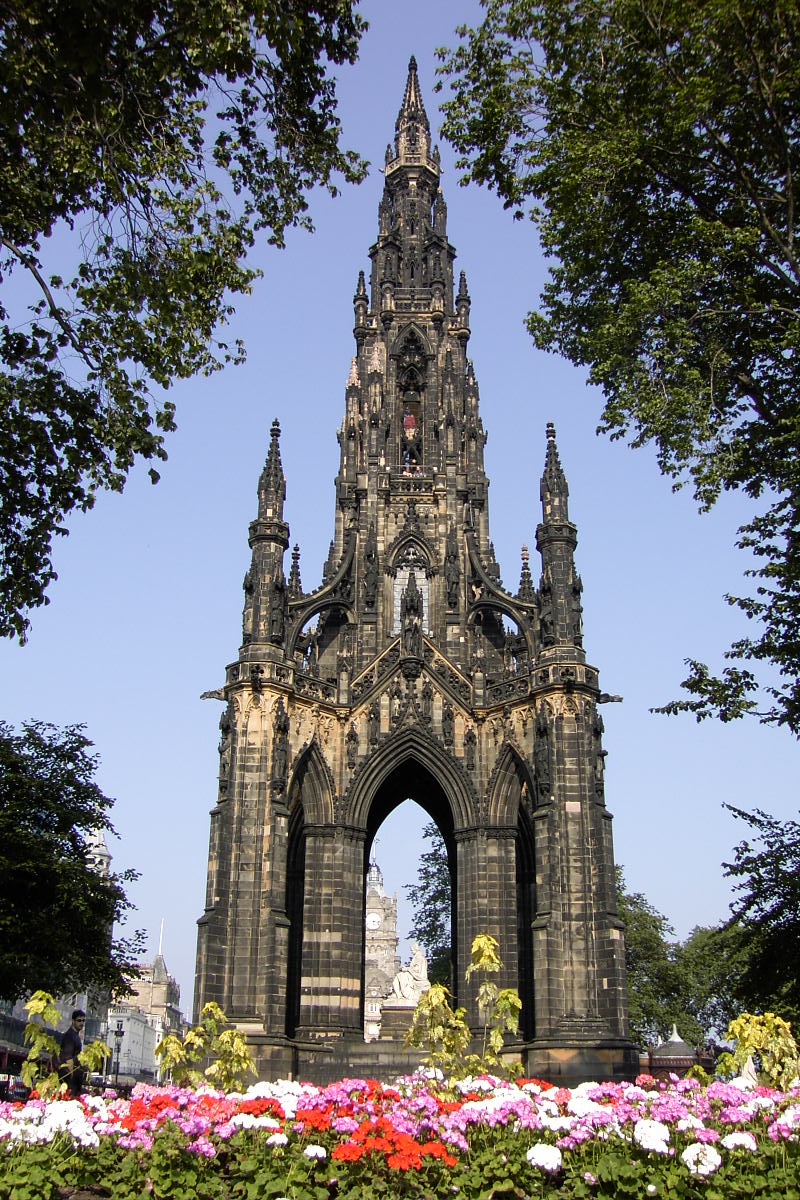
East of the Mound rises the dark Gothic spire of the Scott Monument. It honours Sir Walter Scott, the novelist and poet whose stories of Scottish history became popular across Europe in the early nineteenth century. Its designer, George Meikle Kemp, was largely self-taught, a joiner and draughtsman rather than a famous architect. The stone is darkened by generations of coal smoke from the old city, which is one reason Edinburgh earned the nickname Auld Reekie — Old Smoky.
Look between the four great pillars at the base. Sitting there in pale marble is Scott himself, with his dog Maida resting at his side. The statue was carved by John Steell. Higher up, the tower carries dozens of small figures from Scott's novels. If you have the legs for it, a narrow spiral staircase climbs inside the monument to viewing platforms, and the passages grow very tight near the top.
Walk west of the Mound and the mood changes. The West Gardens are larger and quieter, sloping steeply up toward the castle rock. In the middle stands the Ross Fountain, an ornate cast-iron fountain made in France and brought to Edinburgh by a local gunmaker, Daniel Ross, in the nineteenth century. Its female figures were thought rather daring at the time. After years of decay, it was carefully restored and painted in rich colours, and water flows through it again.
Further along, close to the western end, there is a bronze statue of a soldier walking beside a large bear. This is Wojtek, a brown bear adopted by Polish soldiers during the Second World War. He travelled with them, and stories say he helped carry ammunition. After the war he lived out his days at Edinburgh Zoo. The statue was unveiled in 2015 and quietly celebrates the bond between Scotland and Poland.
As you wander, you may hear trains again. The railway runs through the bottom of the valley, along the old bed of the loch, toward Waverley Station at the eastern end. Its name comes from Scott's Waverley novels. In the nineteenth century, many people opposed running a railway through the gardens. Today the line is mostly screened by trees and walls, so the sound arrives before the trains appear.
The gardens change with the calendar. In summer, people stretch out on the slopes with sandwiches, and music drifts from the West Gardens during the festival season. In winter, the East Gardens fill with a Christmas market, and at the turn of the year, Hogmanay crowds gather beneath the castle for concerts and fireworks. On a weekday morning in spring, though, you may share the paths only with dog walkers and gardeners.
Before you leave, find a bench facing the castle. Notice how the rock rises almost vertically from the grass, rough and dark against the sky. Then turn around and look at the straight, orderly line of Princes Street. You are standing exactly in the gap between those two cities — the medieval one on the ridge and the planned one on the plain. Once that gap held a stinking loch. Now it holds flowers, and a few minutes of quiet in the middle of the city.
Key facts
What to look for
Practical tips
Common questions
Is there a free audio guide to Princes Street Gardens?
Yes — the Lokali app narrates Princes Street Gardens free of charge in 50+ languages. The guide runs about 7 minutes, covers the history, what to look for on site and practical tips, and works offline once downloaded.
Where is Princes Street Gardens?
Princes Street Gardens is in Edinburgh, United Kingdom, at 55.9500, -3.2030. Tap the map link on this page for directions from where you are.
What is Princes Street Gardens known for?
The gardens occupy the bed of the drained Nor Loch. The Mound was built from New Town construction spoil.
What should you look for at Princes Street Gardens?
The moving hands on the floral clock near the Mound. Scott's marble dog Maida beneath the monument's arches. Coal-blackened stone on the Scott Monument's Gothic spire.
What should you know before visiting Princes Street Gardens?
Visit on a weekday morning for the quietest paths. Wear sturdy shoes for the steep West Gardens slopes.
When is the best time to visit Princes Street Gardens?
Find a west-facing bench for evening light on the castle.
On the map
Opens directions to Princes Street Gardens from your location.
More to see in Edinburgh



Hear Princes Street Gardens in your language
The full story, narrated, in 50+ languages. Download it before you go and it plays offline, at your own pace, with no ticket and no tour group.