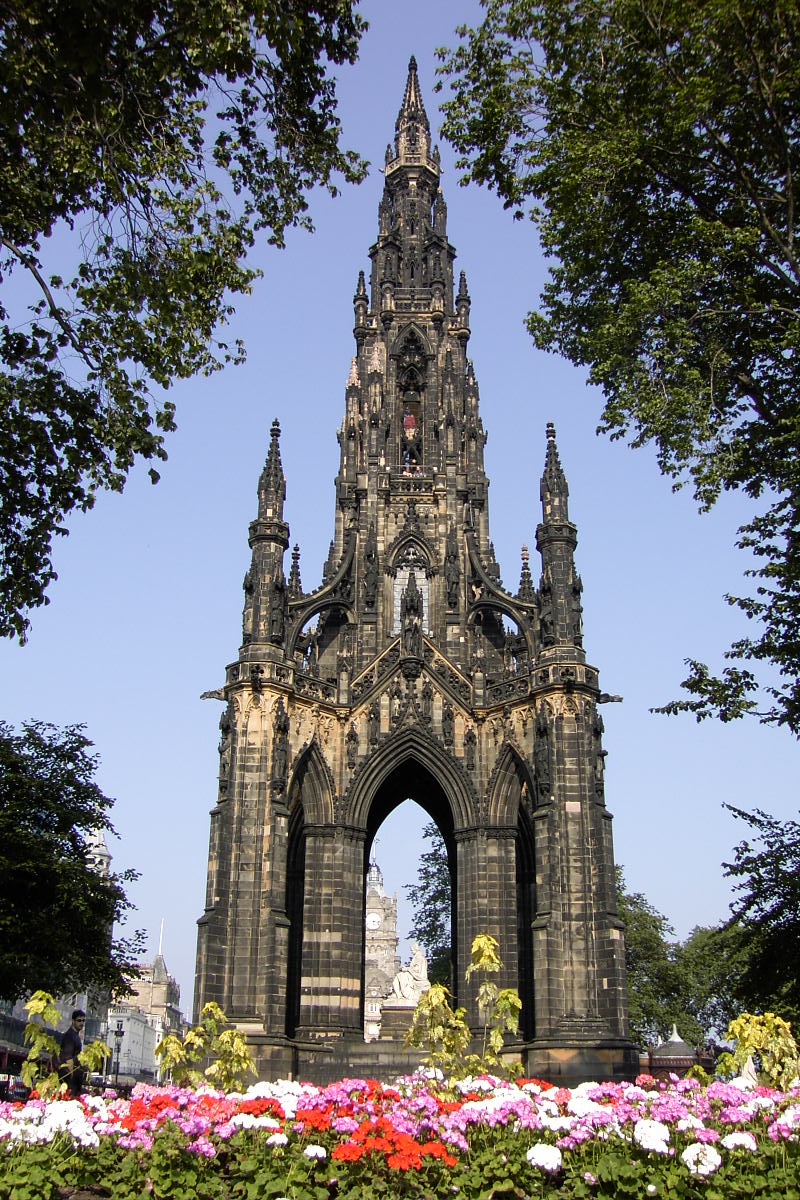
Photo: No machine-readable author provided. Schatir assumed (based on copyright claims). · Public domain · Wikimedia Commons
Scott Monument is a Victorian Gothic monument to Scottish author Sir Walter Scott. It is in Edinburgh, United Kingdom. Designed by George Meikle Kemp, a self-taught joiner. The free Lokali audio guide runs 6 minutes.
✓ Published October 2026 · how we write these guides
Visitor facts
| Lokali audio guide | 6 min · free |
|---|---|
| Type | Monument |
| Location | Edinburgh, United Kingdom |
| Coordinates | 55.9524, -3.1933 |
| Official website | edinburghmuseums.org.uk |
| Languages | 50+, in the Lokali app |
The story
Stand at the foot of it and tilt your head back. The stone above you is almost black, streaked and pitted, rising in a thicket of spires, arches and pinnacles. Trains rumble in the station below. Gulls call over the gardens. The air smells faintly of damp grass and diesel. This is the Scott Monument, and it looks less like a statue than a small cathedral spire set down on Princes Street.
The monument honours Sir Walter Scott, the novelist and poet who did more than almost anyone to shape how the world imagines Scotland. Think of tartan, misty glens, clan loyalty and romantic ruins. Much of that picture comes from his writing. When Scott died in 1832, Edinburgh wanted a memorial that matched his fame. The city did not want something modest. It wanted something people would see from across town.
So a design competition was held. And here is the first surprise. The winning entry did not come from a famous architect. It came from George Meikle Kemp, a largely self-taught joiner and draughtsman. He had spent years walking around Scotland and Europe, sketching Gothic churches and abbeys. He entered the competition under a false name, John Morvo. That was the name of a medieval master mason linked to Melrose Abbey, one of the ruins Scott himself loved.
That connection to Melrose matters. Look closely at the ribbed arches and the clustered pinnacles. Kemp borrowed heavily from the Gothic style of Scottish abbeys. Gothic, for anyone unfamiliar, is the medieval style of pointed arches, tall windows and stone that seems to climb toward the sky. Kemp took that church language and used it for a writer. The result feels almost religious... a shrine to literature rather than to a saint.
Work began in the early 1840s. Kemp did not live to see it finished. One foggy evening in 1844, walking home, he fell into the Union Canal and drowned. He was still in his forties. The monument was completed and opened in the mid-1840s without him. Every visitor who climbs it today is walking through the masterpiece of a man who never stood at the top.
Now look at the colour of the stone. Many people assume it was built from dark rock. It was not. The sandstone came from a quarry in West Lothian and was originally a pale, honeyed colour. The black you see is the result of decades of coal smoke and railway soot. Edinburgh was once nicknamed Auld Reekie, meaning Old Smoky, and this tower carries that history on its surface.
There have been debates about cleaning it. Sandstone is soft and absorbent. Scrubbing it too hard can damage the carved detail, so restorers have been careful. Some locals now love the dark finish. They say it gives the monument a brooding, gothic mood that suits Scott's stories of ghosts, battles and lost causes. Others would like to see it golden again. Either way, the stained stone is part of its character now.
At the centre, under the great arched canopy, sits Scott himself in white marble. The sculptor was John Steell, an Edinburgh artist, and the marble came from Carrara in Italy. Scott is shown seated, a book in hand, wrapped in a heavy plaid. At his feet lies his dog, Maida, a large deerhound he was deeply fond of. The bright white figure against the dark stone is one of the most striking contrasts in the city.
Here is the second surprise, and most visitors walk straight past it. The monument is crowded with small carved figures tucked into niches all over the structure. Most of them are characters from Scott's novels and poems. There are dozens of them. Kings, knights, outlaws, heroines and village eccentrics. It is like a stone cast list of his whole career. Bring binoculars or a good zoom lens, and you can spend a long time picking them out.
The monument is also built to be climbed. Inside, a very narrow spiral staircase winds up through the tower, with several viewing galleries on the way. The final stretch is tight. Your shoulders may brush both walls. Most guides count the climb at about 287 steps. It is not for anyone uncomfortable with tight spaces or heights, but the reward at the top is a wide view across the city.
From the upper galleries, Edinburgh lays itself out in two halves. To one side rises the Old Town, with the castle on its volcanic rock and the long ridge of the Royal Mile. To the other side spreads the New Town, with its neat Georgian streets in a grid. On a clear day you can look toward the Firth of Forth, the wide estuary to the north. It is one of the best ways to understand how the city fits together.
One more connection is worth noticing. The railway station just beside you is called Waverley. It takes its name from Scott's Waverley novels, the series that made him famous. Very few cities name their main station after a book. Edinburgh did. Between the station, the monument and the gardens, this whole corner of the city is a kind of tribute to one storyteller.
Before you move on, take a slow walk around the base. Notice how the tower changes as you circle it. From one angle it looks delicate, almost lace. From another it looks heavy and dark. Listen to the trains below, and watch people stop and look up, just as you did. When you walk away along Princes Street, glance back once more. The spire will still be there above the trees... a joiner's dream in blackened stone, built for a man who wrote Scotland into the world's imagination.
Key facts
What to look for
Practical tips
Common questions
Is there a free audio guide to Scott Monument?
Yes — the Lokali app narrates Scott Monument free of charge in 50+ languages. The guide runs about 6 minutes, covers the history, what to look for on site and practical tips, and works offline once downloaded.
Where is Scott Monument?
Scott Monument is in Edinburgh, United Kingdom, at 55.9524, -3.1933. Tap the map link on this page for directions from where you are.
What is Scott Monument known for?
Designed by George Meikle Kemp, a self-taught joiner. Kemp entered the design competition as John Morvo.
What should you look for at Scott Monument?
Soot-blackened sandstone that was once pale honey. White Carrara marble Scott under the central arch. Maida the deerhound resting at Scott's feet.
What should you know before visiting Scott Monument?
Avoid the climb if tight spaces make you uneasy. Bring binoculars to spot the small carved figures.
On the map
Opens directions to Scott Monument from your location.
More to see in Edinburgh


Hear Scott Monument in your language
The full story, narrated, in 50+ languages. Download it before you go and it plays offline, at your own pace, with no ticket and no tour group.