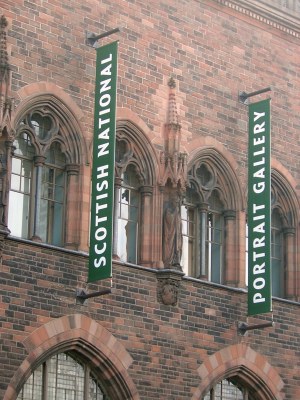
Scottish National Portrait Gallery
55.9555° N · 3.1936° W · Museum
Photo: Original uploader was Maccoinnich at en.wikipedia · CC BY-SA 3.0 · Wikimedia Commons
Scottish National Portrait Gallery is an art museum in Edinburgh, Scotland. Opened in 1889 on Queen Street. The free Lokali audio guide runs 7 minutes.
✓ Published October 2026 · how we write these guides
Visitor facts
| Lokali audio guide | 7 min · free |
|---|---|
| Type | Museum |
| Location | Edinburgh, United Kingdom |
| Coordinates | 55.9555, -3.1936 |
| Official website | nationalgalleries.org |
| Languages | 50+, in the Lokali app |
The story
Stand for a moment on Queen Street and look up. The stone in front of you is red sandstone, warm even on a grey Edinburgh day. It glows faintly against the paler, sooty buildings of the New Town. Turrets, pointed arches and carved niches rise above the pavement, and traffic hums behind you. It looks less like a gallery and more like a small Gothic palace. That is exactly what its builders wanted.
This is the Scottish National Portrait Gallery. It holds the faces of Scotland, painted, sculpted and photographed across many centuries. Kings and queens are here, but so are poets, scientists, footballers, campaigners and actors. The idea behind the building is simple and quite moving. A nation can tell its story through the people who shaped it. Here you can look those people in the eye.
The gallery opened in 1889. Here is the first surprise. It is widely described as the first building in the world designed specifically as a portrait gallery. London already had a National Portrait Gallery, but for many years that collection moved between borrowed spaces. Edinburgh built its gallery for this purpose from the very beginning, room by room and wall by wall.
The money came from one man, John Ritchie Findlay. He was the owner of The Scotsman newspaper, and he gave the funds for the building and helped to support the collection. The architect was Robert Rowand Anderson, one of the leading Scottish architects of the Victorian age. He chose a Gothic style inspired by medieval buildings on the Continent. The result feels like a shrine more than an office. In a way, it was meant to be one.
Before you go inside, look again at the outside walls. Statues of famous Scots stand in niches around the building, like a guard of honour. The facade was designed as a kind of open-air introduction to the collection. Writers, rulers and thinkers greet you in stone before you meet them in paint. Take a slow walk along the front, and notice how the figures change from corner to corner.
Now step through the doors into the Great Hall. Most visitors stop here, and many simply look up. The space rises through the full height of the building. Light falls from above onto a floor of patterned tiles. Above you, a dark blue ceiling holds a painted night sky of stars and constellations. In the middle of a city street, you are suddenly under the heavens.
Lower down, at the level of the first-floor balcony, runs a long painted frieze. It is the work of the artist William Hole, and it shows a great procession of famous Scots. They walk in a line through history, from very early figures to the Victorian era. It is a kind of family photograph of a nation, painted long before the camera could do the job. Try to follow the line around the hall and see who you recognise.
William Hole also painted large murals on the upper walls of the hall. They show scenes from Scottish history, battles, landings and turning points. They are not quiet pictures. They are full of movement, colour and Victorian drama. These murals tell you as much about how the nineteenth century saw Scotland's past as about the past itself. History, here, is also a story the Victorians wanted to tell.
Another surprise is hidden in the building's past. For most of its life, this was not only a portrait gallery. It also housed the National Museum of Antiquities, Scotland's collection of archaeology and historic objects. The two institutions shared the building for many decades. When the antiquities moved to the National Museum of Scotland, the gallery finally had the whole building to itself.
That change led to a major renovation, and the gallery reopened in 2011. Spaces that had been closed or divided for years were opened up again. Windows that had been blocked were cleared, and daylight returned to the upper rooms. The restoration also brought back much of the original Victorian decoration. So the colours you see today are close to what visitors saw in 1889, only cleaner and brighter.
Inside the galleries, the collection moves between centuries. You can meet Mary, Queen of Scots, one of the most famous and tragic figures in Scottish history. You can see Robert Burns, the national poet, in a portrait by Alexander Nasmyth that became the image most people know. Walter Scott is here too, the novelist who did so much to shape the romantic image of Scotland. Many faces you know from banknotes and book covers appear here as originals.
The gallery also holds one of the most important early photography collections in the world. In the 1840s, the painter David Octavius Hill and the photographer Robert Adamson worked together in Edinburgh. They made hundreds of portraits using an early process called the calotype, which printed images from paper negatives. Their pictures of fishwives, ministers and townspeople are soft, brown and surprisingly intimate. Because these early prints are fragile, they are shown carefully and not always on display.
Modern Scotland is here as well. The gallery collects contemporary portraits, so recent artists sit near the old masters. Some new works are paintings, some are photographs, and some use video or unusual materials. Walk through a few rooms and you can travel from royal portraits in heavy gold frames to faces from the present day. The conversation between old and new is part of the point. Who counts as an important Scot has changed over time.
Before you leave, return to the Great Hall and stand at its centre once more. Look up at the painted stars, then at the procession of figures walking around the walls. Listen to the soft echo of footsteps on the tiles. Every face in this building belonged to a real person who once stood somewhere in this city or this country. When you step back out onto Queen Street, glance at the red stone one last time. The people of the present are walking past it now.
Key facts
What to look for
Practical tips
Common questions
Is there a free audio guide to Scottish National Portrait Gallery?
Yes — the Lokali app narrates Scottish National Portrait Gallery free of charge in 50+ languages. The guide runs about 7 minutes, covers the history, what to look for on site and practical tips, and works offline once downloaded.
Where is Scottish National Portrait Gallery?
Scottish National Portrait Gallery is in Edinburgh, United Kingdom, at 55.9555, -3.1936. Tap the map link on this page for directions from where you are.
What is Scottish National Portrait Gallery known for?
Opened in 1889 on Queen Street. Often called the world's first purpose-built portrait gallery.
What should you look for at Scottish National Portrait Gallery?
Painted night sky of stars on the Great Hall ceiling. William Hole's procession frieze of famous Scots. Large historical murals on the upper hall walls.
What should you know before visiting Scottish National Portrait Gallery?
Start in the Great Hall to get your bearings. Use the balcony level for a closer view of the frieze.
On the map
Opens directions to Scottish National Portrait Gallery from your location.
More to see in Edinburgh


Hear Scottish National Portrait Gallery in your language
The full story, narrated, in 50+ languages. Download it before you go and it plays offline, at your own pace, with no ticket and no tour group.