
Photo: Amalster · CC BY-SA 4.0 · Wikimedia Commons
Lambeth Bridge is a Grade II listed road bridge in London, United Kingdom. It is in Westminster, United Kingdom. The current steel arch bridge opened in 1932. The free Lokali audio guide runs 7 minutes.
✓ Published October 2026 · how we write these guides
Visitor facts
| Lokali audio guide | 7 min · free |
|---|---|
| Type | Bridge |
| Location | Westminster, United Kingdom |
| Coordinates | 51.4946, -0.1239 |
| Languages | 50+, in the Lokali app |
The story
Stand still for a moment at the centre of the bridge. The Thames moves beneath you, brown and fast. It carries the smell of river mud and diesel from the passing boats. The railings feel cool and smooth under your hand, and they are painted a deep red. Look upstream and downstream, and you have one of the quieter views in central London. There are no crowds here, only the wind, the gulls and the river.
This is Lambeth Bridge. It joins the City of Westminster on the north bank to the borough of Lambeth on the south. It is not the most famous crossing on this stretch of the Thames. Most visitors crowd onto Westminster Bridge, just downstream, for the classic view of Big Ben. That is exactly why this bridge is worth your time. It offers the same river, the same skyline and the same history, with space to breathe.
Now look again at that red paint. It was not chosen at random. The colour is often said to match the red leather benches of the House of Lords. The Lords sit in the part of the Palace of Westminster that lies closest to this bridge. Downstream, Westminster Bridge is painted green, the colour of the benches in the House of Commons. So the two bridges frame Parliament with its two chambers. It is a small piece of political theatre, written in paint and steel.
Long before any bridge stood here, people crossed this point by boat. For centuries a horse ferry carried passengers, carts and animals across the water. The ferry served the Archbishops of Canterbury, whose London home stood on the south bank, as it still does today. You can still find the ferry's memory in the street plan. On the Westminster side, the road that leads up to the bridge is called Horseferry Road. The name has survived far longer than the boats.
The ferry also carries one of London's dramatic stories. According to the often-told account, in 1688 the Catholic queen, Mary of Modena, escaped from London at night by crossing the river near here with her infant son. Her husband, King James the Second, was losing his throne in the upheaval later called the Glorious Revolution. The crossing was cold and secret. Whatever the exact details, the scene captures how important this quiet ferry point once was.
The first bridge on this site came much later, in the 1860s. It was a suspension bridge, hung from chains in the style of the day. It was not a success. The structure was narrow, and it suffered badly from corrosion. By the early twentieth century it was closed to vehicles, and then to everyone. For a period, this stretch of the river had no crossing at all. Londoners had to walk to the next bridge along.
The bridge you are standing on opened in 1932. King George the Fifth performed the opening. It is a steel arch bridge, with five graceful spans that sit low over the water. The engineering was led by Sir George Humphreys, and the architect Sir Reginald Blomfield shaped its appearance. Look down over the side, if you can, and you will see the gentle curve of the arches. They give the bridge a calm, horizontal line against the busy river.
Here is a detail that most visitors miss. At each end of the bridge stand tall stone obelisks. On top of each one sits a carved shape. Many people call them pineapples, and you will often hear that name. Others say they are pine cones, an old symbol of hospitality and welcome. Either way, take a close look as you reach the end of the bridge. It is a small, playful touch on a structure that is otherwise sober and practical.
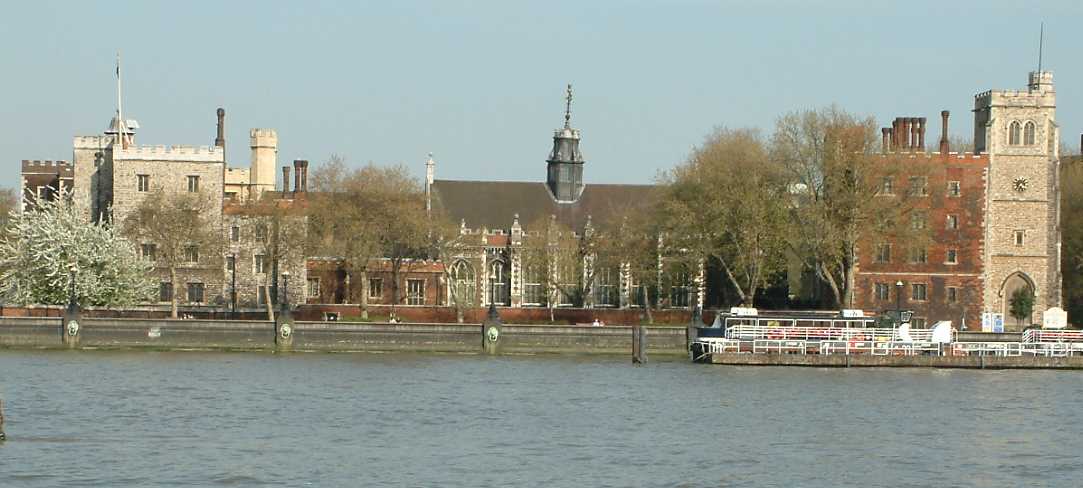
Now turn to the south bank. The old brick buildings behind the trees are Lambeth Palace, the London home of the Archbishop of Canterbury. Its red brick gatehouse, with two square towers, has stood for around five centuries. Beside it is the old parish church of Saint Mary-at-Lambeth. Today this church holds the Garden Museum, a museum dedicated to British gardens and gardening. Together they form one of the oldest corners of this part of London.
Turn back to the north bank. At the Westminster end of the bridge stands a large, pale stone building. This is Thames House, the headquarters of the Security Service, better known as MI5. It does not advertise itself. Just downstream lie the green lawns of Victoria Tower Gardens, which run along the river towards Parliament. In the gardens, you can find a cast of Rodin's sculpture, The Burghers of Calais. It sits very close to the Houses of Parliament.
Film fans may recognise this place for a different reason. In Harry Potter and the Prisoner of Azkaban, the magical purple Knight Bus races through London traffic. In one scene, it squeezes between two red double-decker buses on a bridge. That bridge is Lambeth Bridge. When you watch the scene again, look for the red railings and the river behind. Ordinary London traffic crosses here every day, with no magic required, but the moment is easy to imagine.
The view from here changes with the hours. In the morning, the light falls on the river and the stone of Parliament turns pale gold. In the evening, the lamps along the bridge come on, and the water turns dark and glossy. Look downstream to see the Victoria Tower of Parliament rise above the trees. Beyond it you can see the London Eye. Upstream, the river curves away towards Vauxhall and its glass towers.
So take one last look before you walk on. Feel the slight movement of the bridge as a bus rolls past. Listen to the water below the arches, and the call of the gulls overhead. The ferry is long gone, but people still cross here every day, on their way to work, to church or to the river. As you step off the bridge, look up at the stone obelisk and its carved fruit. Then carry the river with you.
Key facts
What to look for
Practical tips
Common questions
Is there a free audio guide to Lambeth Bridge?
Yes — the Lokali app narrates Lambeth Bridge free of charge in 50+ languages. The guide runs about 7 minutes, covers the history, what to look for on site and practical tips, and works offline once downloaded.
Where is Lambeth Bridge?
Lambeth Bridge is in Westminster, United Kingdom, at 51.4946, -0.1239. Tap the map link on this page for directions from where you are.
What is Lambeth Bridge known for?
The current steel arch bridge opened in 1932. King George the Fifth opened the present bridge.
What should you look for at Lambeth Bridge?
Carved pine cones atop the stone obelisks. Deep red paint on the railings and arches. Red brick gatehouse towers of Lambeth Palace.
What should you know before visiting Lambeth Bridge?
Walk the bridge's full length for views both ways. Visit at dusk when the bridge lamps come on.
When is the best time to visit Lambeth Bridge?
Visit at dusk when the bridge lamps come on.
On the map
Opens directions to Lambeth Bridge from your location.
More to see in Westminster


Hear Lambeth Bridge in your language
The full story, narrated, in 50+ languages. Download it before you go and it plays offline, at your own pace, with no ticket and no tour group.