
Photo: Colin Smith · CC BY-SA 2.0 · Wikimedia Commons
Lyceum Theatre is a theatre in London. It is in Westminster, United Kingdom. Henry Irving managed the theatre from 1878. The free Lokali audio guide runs 7 minutes.
✓ Published October 2026 · how we write these guides
Visitor facts
| Lokali audio guide | 7 min · free |
|---|---|
| Type | Theatre |
| Location | Westminster, United Kingdom |
| Coordinates | 51.5116, -0.1197 |
| Official website | thelyceumtheatre.com |
| Languages | 50+, in the Lokali app |
The story
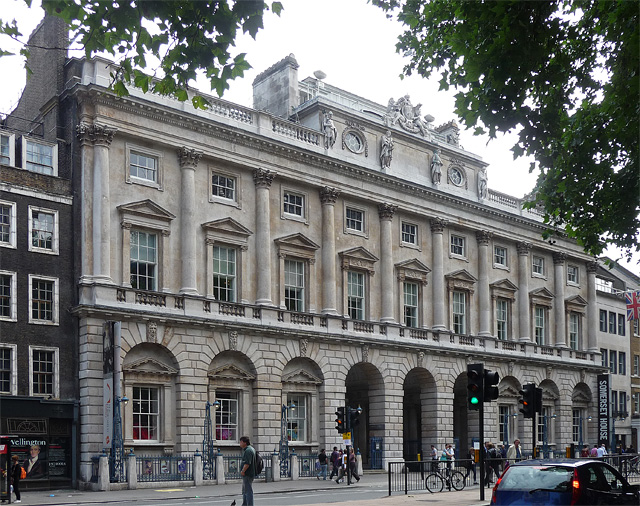
Stand on Wellington Street for a moment and look up. Six tall columns hold a deep stone portico above the pavement. Behind you, the Strand carries buses and taxis in a steady roar. In front of you, the theatre doors wait, and on most evenings the queue starts to gather long before curtain up. There is a smell of rain on stone, roasted nuts from a street cart, and perfume from the crowd. This is the Lyceum Theatre, and those columns are older than almost everything around them.
That portico is the oldest visible part of the building. It survived from a theatre that opened here in the 1830s, after an earlier Lyceum burned down. When the rest of the site was rebuilt at the start of the twentieth century, the builders kept this front. So the columns you see now belong to one age, while the auditorium behind them belongs to another. It is a little like a house that kept its old front door when everything inside was replaced.
The name itself goes back even further. A Lyceum stood on this spot in the eighteenth century, but it was not a theatre at first. It was a hall for exhibitions, lectures and shows of every kind. Here is a surprise that most visitors miss. In the early 1800s, a young woman named Marie Tussaud showed her wax figures here, years before her name became known across the world. London's appetite for spectacle has a long history on this corner.
Over time, the hall turned into a proper playhouse. For a period it was known as the English Opera House, a home for music and drama in English rather than Italian. Then came the fire, and the rebuilding, and the columns that still stand above you. Through the nineteenth century, the Lyceum changed hands many times. Managers came and went. Some made money, many lost it. Theatre in London was a risky business, and this house saw both sides.
The golden age began in 1878. That year the actor Henry Irving took control of the theatre. Irving was the most celebrated performer of Victorian England, and he was later the first actor ever to receive a knighthood. Under his management, the Lyceum became the most talked-about stage in the capital. His productions of Shakespeare were famous for their scale, their scenery and their careful lighting. Audiences came as much for the spectacle as for the poetry.
Irving did not work alone. His leading lady was Ellen Terry, one of the best-loved actresses of the age. Together they played Hamlet and Ophelia, Shylock and Portia, Macbeth and his Lady. Their partnership lasted for many seasons, and people spoke of the pair almost as one name. Irving was also a careful innovator. He is often credited with dimming the lights in the auditorium during a performance, so the audience looked only at the stage. Today we take that for granted.
Now for the second surprise. Irving's business manager at the Lyceum was an Irishman named Bram Stoker. Every day Stoker handled the accounts, the letters and the endless work of running a great theatre. In his spare hours, he wrote fiction. In 1897 he published a novel called Dracula. Many readers have seen something of Irving in the tall, commanding Count, though that is a theory, not a proven fact. Either way, the vampire was born partly in these offices.
Irving's reign did not end happily. A fire destroyed much of his stored scenery, and money troubles followed. By the early twentieth century, the theatre was no longer his. The building was then largely rebuilt behind the old portico, opening again in 1904 as a large house for variety shows. In the decades that followed, the Lyceum became known for popular entertainment, including its famous Christmas pantomimes, which drew families from all over London every winter.
The theatre closed as a playhouse at the end of the 1930s. There were plans to clear the site for road improvements, but they did not go ahead. Instead, the building found a very different life. After the Second World War, the auditorium became a ballroom. Couples danced where actors once spoke Shakespeare. Later still, it hosted rock and pop concerts. In 1975, Bob Marley and the Wailers recorded a famous live album here, and reggae fans still know the Lyceum for that night.
For years the building waited, often quiet, its future uncertain. Then in the 1990s it went through a major restoration. The plasterwork, the gilding and the deep red tones of the interior were brought back to life. The theatre reopened in 1996 with a revival of Jesus Christ Superstar. A few years later, a new show arrived from Broadway. Disney's The Lion King opened here in 1999, and it has played on this stage ever since, for more than two decades.
Think about what that means. Children who saw the show here at the turn of the century now bring children of their own. Some evenings, you can hear the opening call of the song Circle of Life rise inside the auditorium, while outside the traffic keeps moving along the Strand. Few theatres anywhere have hosted one production for so long. The Lyceum has become, for many families, the first theatre they ever enter.
Look around the surrounding streets as well. You are on the edge of Covent Garden, close to the old market and the Royal Opera House. Wellington Street slopes gently down toward the Strand and the river beyond. On matinee days, the pavements fill with school groups, tourists and Londoners on a day out. In the evening, restaurants light their windows, and the stone of the portico turns warm under the street lamps. This corner has been an entertainment district for well over two centuries.
Before you move on, look once more at those six columns. They have seen wax figures and opera, Irving's Hamlet and a ballroom full of dancers, a reggae band and a singing lion. The building changed its purpose again and again, yet this front stayed. As you walk away toward the Strand or into Covent Garden, listen for the hum of the crowd behind you... It is the same sound this street has heard on theatre nights for generations.
Key facts
What to look for
Practical tips
Common questions
Is there a free audio guide to Lyceum Theatre?
Yes — the Lokali app narrates Lyceum Theatre free of charge in 50+ languages. The guide runs about 7 minutes, covers the history, what to look for on site and practical tips, and works offline once downloaded.
Where is Lyceum Theatre?
Lyceum Theatre is in Westminster, United Kingdom, at 51.5116, -0.1197. Tap the map link on this page for directions from where you are.
What is Lyceum Theatre known for?
Henry Irving managed the theatre from 1878. Bram Stoker worked here as Irving's business manager.
What should you look for at Lyceum Theatre?
Six tall columns of the surviving nineteenth-century portico. Deep red and gold tones of the restored interior. The theatre name carved above the columns.
What should you know before visiting Lyceum Theatre?
Arrive early on show nights to avoid the entrance queue. Book Lion King seats well ahead of your visit.
When is the best time to visit Lyceum Theatre?
Photograph the portico at dusk when street lamps light it.
On the map
Opens directions to Lyceum Theatre from your location.
More to see in Westminster



Hear Lyceum Theatre in your language
The full story, narrated, in 50+ languages. Download it before you go and it plays offline, at your own pace, with no ticket and no tour group.