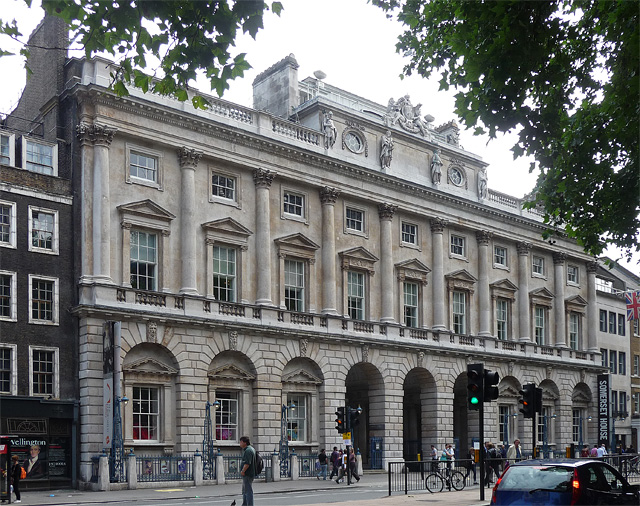
Photo: Stephen Richards · CC BY-SA 2.0 · Wikimedia Commons
Courtauld Gallery is an art museum of the Courtauld Institute of Art, located in Somerset House, London. It is in Westminster, United Kingdom. Samuel Courtauld's family fortune came from textiles and rayon. The free Lokali audio guide runs 7 minutes.
✓ Published October 2026 · how we write these guides
Visitor facts
| Lokali audio guide | 7 min · free |
|---|---|
| Type | Museum |
| Location | Westminster, United Kingdom |
| Coordinates | 51.5116, -0.1177 |
| Official website | courtauld.ac.uk |
| Languages | 50+, in the Lokali app |
The story
Listen for a moment before you go inside. Behind you, the traffic of the Strand hums and brakes. Ahead, under a deep stone archway, the sound drops away. Your footsteps start to echo off pale Portland stone. This is Somerset House, and tucked into its northern wing, just off that archway, is the Courtauld Gallery. It is a small museum by London standards. But room for room, it holds one of the most remarkable collections of painting anywhere in the city.
First, the building itself, because it is older than the gallery by a long way. Somerset House was designed by the architect Sir William Chambers in the late eighteenth century. It was one of the first large buildings in Britain made for government offices and learned societies. The wing you are entering was planned for some of the country's leading institutions of art and science. So this was a place of pictures and ideas long before any modern museum moved in.
Here is the first surprise. Before the Victoria Embankment was built in the nineteenth century, the River Thames came right up to the southern edge of this building. Boats could pull up to its water gate. Today a wide road and a strip of gardens separate Somerset House from the river. If you walk through to the far terrace later, try to picture the water lapping almost at your feet. The city has quite literally moved the river away.
Now to the man behind the name. Samuel Courtauld came from a family business that made textiles, and later the artificial silk known as rayon. In the early twentieth century he became fascinated by French painting of the late nineteenth century. He bought Impressionist and Post-Impressionist works at a time when many British collectors still thought them crude. He also gave money so that the national collection could buy such paintings for the public.
In 1932, Courtauld helped found the Courtauld Institute of Art, a centre for the serious study of art history. The gallery grew up alongside it as a teaching collection. Students could stand in front of real masterpieces, not just photographs. Over the decades, other collectors added their own gifts. The gallery and the institute moved into Somerset House in 1989, and they have shared this home ever since.
As you climb through the building, notice the staircase. It is narrow, steep and elegant, and it turns tightly upward. In the late eighteenth century, crowds pushed up these steps to see the Royal Academy's annual exhibitions on the top floor. The caricaturist Thomas Rowlandson drew a famous comic print of visitors tumbling head over heels down a staircase like this one. Hold the rail. You are walking in their footsteps, hopefully more steadily.
At the top waits the Great Room. For decades, this was where the Royal Academy hung its summer shows. Paintings covered the walls almost from floor to ceiling, frame touching frame. Artists fought for the best positions at eye level. Look above the doorway for an inscription in ancient Greek. Its message is roughly this — let no one who is a stranger to the arts enter here. It is a playful warning, and you have clearly passed the test.
The heart of the collection, for many visitors, is French painting from the late nineteenth century. Search out Édouard Manet's A Bar at the Folies-Bergère, painted in 1882. A young barmaid stands behind a marble counter covered with bottles and a bowl of oranges. Her face looks tired, distant, almost unreadable. Behind her, a large mirror shows the glittering crowd of a Paris music hall.
Now look carefully at that mirror, because this is the second surprise. The reflection does not quite match the scene in front of it. The barmaid's reflected figure sits off to the side, leaning toward a man in a top hat. Yet facing you, she stands straight and alone. Scholars have argued about this puzzle for well over a century. Did Manet make a mistake... or did he want you to feel uneasy? Stand to the left, then to the right, and decide for yourself.
Nearby hangs one of the most personal paintings in the building. It is Vincent van Gogh's Self-Portrait with Bandaged Ear, from 1889. He painted it soon after the crisis in which he injured his own ear. He wears a heavy coat and a fur cap, and the bandage is plain to see. Behind him is a Japanese print, a reminder of how much he admired Japanese art. His gaze is calm, almost watchful. It is a quiet picture of a man trying to recover.
Keep walking and you will meet Paul Cézanne in force. His Card Players shows two men bent over a game, completely absorbed, built from solid blocks of colour. His views of Mont Sainte-Victoire, the mountain near his home in Provence, turn rock and pine into patches of green and violet. There is also work by Paul Gauguin, Georges Seurat, Pierre-Auguste Renoir and Edgar Degas. Seeing them this close together lets you compare how each artist broke the old rules.
The collection reaches much further back than the Impressionists, so do not rush past the earlier rooms. There are medieval and Renaissance panels glowing with gold leaf. There is Lucas Cranach's small, strange painting of Adam and Eve in the Garden of Eden. There is also a strong group of works by Peter Paul Rubens, the Flemish master of swirling, energetic baroque painting. Many of these came through later gifts from private collectors.
When you finish, step out into the great courtyard of Somerset House. On a warm day, rows of fountains jump straight up from the paving, and children run between them. In winter, the same space often becomes an ice rink. Look back at the long grey façade and the rows of windows. Somewhere behind them, a barmaid still waits at her counter, and a painter still studies his own face. Take a breath here, and let the noise of London slowly return.
Key facts
What to look for
Practical tips
Common questions
Is there a free audio guide to Courtauld Gallery?
Yes — the Lokali app narrates Courtauld Gallery free of charge in 50+ languages. The guide runs about 7 minutes, covers the history, what to look for on site and practical tips, and works offline once downloaded.
Where is Courtauld Gallery?
Courtauld Gallery is in Westminster, United Kingdom, at 51.5116, -0.1177. Tap the map link on this page for directions from where you are.
What is Courtauld Gallery known for?
Samuel Courtauld's family fortune came from textiles and rayon. The Courtauld Institute of Art was founded in 1932.
What should you look for at Courtauld Gallery?
The Greek inscription above the Great Room's doorway. The mismatched reflection in Manet's bar mirror. The Japanese print behind Van Gogh's bandaged head.
What should you know before visiting Courtauld Gallery?
Come early on a weekday for quieter rooms upstairs. Hold the handrail on the steep historic staircase.
When is the best time to visit Courtauld Gallery?
Come early on a weekday for quieter rooms upstairs.
On the map
Opens directions to Courtauld Gallery from your location.
More to see in Westminster


Hear Courtauld Gallery in your language
The full story, narrated, in 50+ languages. Download it before you go and it plays offline, at your own pace, with no ticket and no tour group.