
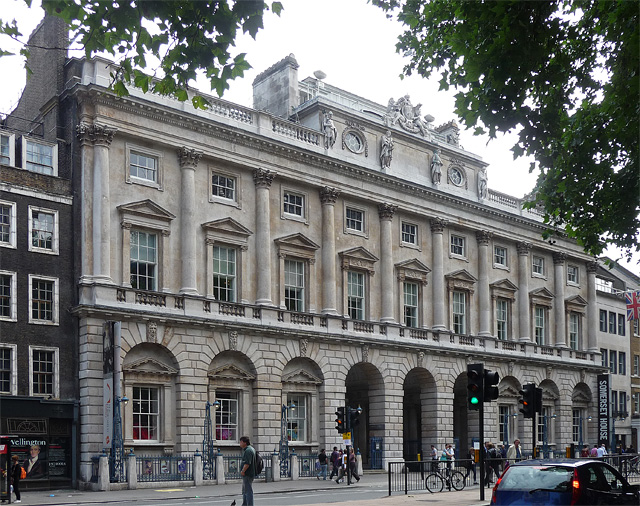
Photo: No machine-readable author provided. Edward assumed (based on copyright claims). · Public domain · Wikimedia Commons
Aldwych Theatre is a theatre in London. It is in Westminster, United Kingdom. The theatre opened in 1905 on newly built Aldwych. The free Lokali audio guide runs 7 minutes.
✓ Published October 2026 · how we write these guides
Visitor facts
| Lokali audio guide | 7 min · free |
|---|---|
| Type | Theatre |
| Location | Westminster, United Kingdom |
| Coordinates | 51.5133, -0.1179 |
| Official website | aldwychtheatre.com |
| Languages | 50+, in the Lokali app |
The story
Stand still for a moment on the pavement where Aldwych curves toward Drury Lane. Listen. Black cabs hum past, buses sigh at the kerb, and somewhere a stage door clicks open. Above you, a pale stone corner building rises in tiers of columns and carved detail. As evening falls, the glass canopy glows and people start gathering under it. This is the Aldwych Theatre. For more than a century, it has been one of London's working playhouses.
Before we look at the building, look at the street itself. The name Aldwych comes from Old English and means roughly "old trading settlement." Long before medieval London grew up around the walls of the City, the Anglo-Saxons had a busy riverside market town near here. Historians call it Lundenwic. So when you say "Aldwych," you are saying a word that goes back well over a thousand years. Many visitors walk past without ever knowing this.
The curving road in front of you is much younger. In the early twentieth century, London cleared a dense tangle of old lanes and courts between Holborn and the Strand. Out of that work came the broad avenue of Kingsway and this crescent called Aldwych. The theatre was part of that rebuilding. It opened in 1905, in the same years the new street was taking shape. Grand Edwardian buildings went up here to show a modern, confident capital.
The architect was W. G. R. Sprague. He designed many theatres in London's West End around the turn of the century. Now, here is a detail that surprises people. Look along the block toward the far end. Sprague designed this theatre as one of a matching pair. Its twin sits at the other end of the same block, with the Waldorf Hotel between them. That twin was first called the Waldorf Theatre. Today it is known as the Novello. Two theatres and a grand hotel, all planned as one composition.
Take a moment to compare the two corners if you have time. The idea was symmetry — a theatre at each end, like bookends holding the hotel in the middle. In the Edwardian period, an evening out often meant dinner, a show, and perhaps a room for the night. This block offered all three under one long roofline. It is a clever piece of city planning, and it still works. On a busy night, you can see diners and theatregoers moving between the buildings.
The Aldwych was built with the actor-manager Seymour Hicks closely involved. Actor-managers were stars who also ran their own companies and venues. It was a common model in Victorian and Edwardian London. Hicks was known for light comedies and musical plays. Those early productions set a tone for the house. From the start, this was a place meant to entertain a wide audience, not only a narrow circle of critics.
That tone became famous in the 1920s and 1930s. During those years the theatre gave its name to a whole style of comedy — the Aldwych farces. Most were written by the playwright Ben Travers. A regular company of actors performed them, led by Tom Walls and Ralph Lynn. Farce is fast physical comedy, built on mistaken identities, slammed doors, and characters hiding in the wrong rooms. Audiences came back again and again to see the same troupe in each new play.
Think about the sound of that era for a moment. Imagine a full house laughing at perfectly timed door slams and misunderstandings. The farces were so closely linked with this building that people simply said "an Aldwych farce." Several of them were later made into films. For a generation of Londoners, this address meant one thing above all — a good laugh on a night out.
Then the theatre's story changed direction completely. In 1960, the Royal Shakespeare Company, based in Stratford-upon-Avon, made the Aldwych its London home. For more than two decades, this stage carried Shakespeare, classic drama, and bold new plays. The company stayed here until the early 1980s, when it moved to the new Barbican Centre in the City of London. It is a striking contrast. A house known for farce became a home for some of the most serious theatre in Britain.
During those years, the Aldwych also hosted international work. Visiting companies from around the world performed here, and London audiences saw productions they could not easily see elsewhere. Many actors who later became household names worked on this stage early in their careers. So the walls of this building carry two very different traditions. One is the quick comedy of the interwar years. The other is the ambitious classical theatre of the postwar decades.
After the Royal Shakespeare Company left, the Aldwych returned to the commercial West End. It has hosted plays, revivals, and large musicals. In recent years, it has become closely associated with big musical productions, including Tina, the stage show about the life of the singer Tina Turner. The show changes, but the pattern stays the same. Every evening, the canopy lights up, and the pavement fills with people holding tickets and checking the time.
If you go inside, notice how the auditorium wraps around the stage in curved balconies. Edwardian theatres were designed so that many people could sit fairly close to the performers. Look up at the decorative plasterwork and the boxes near the stage. Look at how the seating rises in layers. The building is listed, which means its historic character is protected by law. Much of what you see today follows the shape Sprague gave it.
Outside, the neighbourhood is worth a slow walk. Drury Lane runs right beside the theatre, a street long linked with London's stage history. A few minutes away lie Covent Garden, the Strand, and the river. Bush House, the large building across the crescent, was for many decades home to the BBC World Service. On this one curve of road, you have Anglo-Saxon trade, Edwardian ambition, broadcasting, and theatre, all side by side.
Before you move on, look once more at the corner. Notice the stone, the columns, the curve of the facade following the road. Listen to the traffic, the voices, the doors of the hotel swinging open next door. More than a century of audiences have waited exactly where you are standing now. Some came to laugh. Some came for Shakespeare. Some came for a singer's life story set to music. Tonight, someone new will take their seat... and the lights will go down again.
Key facts
What to look for
Practical tips
Common questions
Is there a free audio guide to Aldwych Theatre?
Yes — the Lokali app narrates Aldwych Theatre free of charge in 50+ languages. The guide runs about 7 minutes, covers the history, what to look for on site and practical tips, and works offline once downloaded.
Where is Aldwych Theatre?
Aldwych Theatre is in Westminster, United Kingdom, at 51.5133, -0.1179. Tap the map link on this page for directions from where you are.
What is Aldwych Theatre known for?
The theatre opened in 1905 on newly built Aldwych. Architect W. G. R. Sprague designed this theatre.
What should you look for at Aldwych Theatre?
The curved stone facade following the bend of Aldwych. The Waldorf Hotel set between two matching theatres. The glass canopy over the main entrance.
What should you know before visiting Aldwych Theatre?
Arrive early to see the canopy lit at dusk. Walk to the block's far end to compare the twin theatre.
When is the best time to visit Aldwych Theatre?
Book seats ahead for popular evening musical performances.
On the map
Opens directions to Aldwych Theatre from your location.
More to see in Westminster



Hear Aldwych Theatre in your language
The full story, narrated, in 50+ languages. Download it before you go and it plays offline, at your own pace, with no ticket and no tour group.