
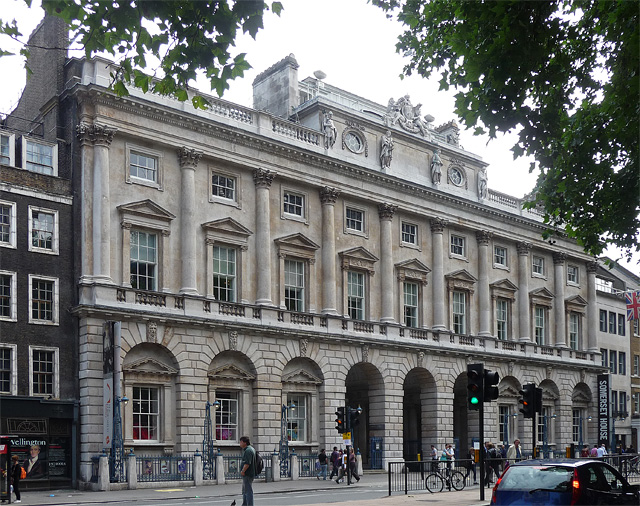
Photo: Stephen Richards · CC BY-SA 2.0 · Wikimedia Commons
St Clement Danes is an Anglican church in the City of Westminster, London, England, UK. Sir Christopher Wren rebuilt the church in the 1680s. The free Lokali audio guide runs 7 minutes.
✓ Published October 2026 · how we write these guides
Visitor facts
| Lokali audio guide | 7 min · free |
|---|---|
| Type | Church |
| Location | Westminster, United Kingdom |
| Coordinates | 51.5131, -0.1139 |
| Official website | stclementdanesraf.org |
| Languages | 50+, in the Lokali app |
The story
Stand still for a moment and listen. Traffic runs past on both sides of you, because this church sits on its own island in the middle of the Strand. Buses pass close by. Taxis swing around the stone walls. Then, above all that noise, the bells may begin to ring, and you may recognise a tune from childhood. This is St Clement Danes, and it is one of the strangest and most moving churches in London.
First, that tune. If you grew up with English nursery rhymes, you may know the words. Oranges and lemons, say the bells of Saint Clement's. The church bells here play that melody at set times of the day. There is a catch, though. Another church in the City of London, Saint Clement Eastcheap, also claims to be the one in the rhyme. Nobody can settle the argument for certain. This church, however, has made the tune its own.
Now look at the name. Why would a London church be named after the Danes? The answer goes back more than a thousand years, and it mixes history with tradition. Vikings from Scandinavia settled across large parts of England in the ninth and tenth centuries. According to one popular account, Danes who had married English women were allowed to live in this area outside the walls of the old city. They built a church here. Historians treat the details with caution, but the Danish link to this site is very old.
The building in front of you is much younger than that first church. In the 1680s, the great architect Sir Christopher Wren rebuilt it. Wren was the man who rebuilt Saint Paul's Cathedral and many City churches after the Great Fire of 1666. Interestingly, the fire did not reach this church. The old building was simply in poor condition, so Wren gave it a new body of pale Portland stone. The rounded east end, called an apse, is typical of his calm and orderly style.
Lift your eyes to the steeple. Wren did not design all of it. The upper stages were added around 1719 by another architect, James Gibbs. Gibbs also designed Saint Martin-in-the-Fields on Trafalgar Square. His tower here rises in layers. Each stage is a little narrower than the one below, and the whole thing ends in a slim point against the sky. From the pavement, it looks like a telescope that someone has pulled open.
Here is a detail many visitors miss. The writer Samuel Johnson worshipped in this church in the eighteenth century. Johnson wrote one of the most important early dictionaries of the English language. He lived nearby, off Fleet Street, and he came here regularly. Walk around to the east end of the church and you will find a statue of him. He holds a book, and he looks down the Strand toward the life of the city he loved so much.
Now we come to the darkest chapter. During the Second World War, German bombers attacked London night after night in the campaign known as the Blitz. In 1941, firebombs hit St Clement Danes. The fire burned out the inside of the church. Only the outer walls and the tower survived. For years afterwards, the building stood as an empty shell in the middle of the road, with the sky where the roof had been.
Its rescue came from an unexpected direction. After the war, the Royal Air Force raised money to rebuild the church. The work was finished in 1958, and the church was consecrated again as the central church of the Royal Air Force. So a building destroyed from the air now honours the men and women who served in the air. That turn of history gives this place its special atmosphere.
Go inside, and look down. This is the surprise that stays with most people. Set into the floor are hundreds of badges, cut from Welsh slate. Each one represents a squadron or unit of the Royal Air Force and related air forces. Some badges show animals, some show weapons, some show symbols from local history. Walk slowly. You may find a badge that connects to your own family, or to a country far from Britain.
Around the church, you will also see books of remembrance. Their pages list the names of air force personnel who died in service. The pages are turned regularly, so the names on display change. The interior itself is light and clean. White walls and dark wood carry gold details. It feels less like a museum and more like a family room for a very large family, still in use, still visited by veterans and their relatives.
Outside again, look at the two bronze statues in front of the church. One shows Lord Dowding, who led Fighter Command during the Battle of Britain in 1940. The other shows Sir Arthur Harris, who led Bomber Command later in the war. The Harris statue, unveiled in 1992, has been controversial. Many people remember the heavy civilian losses from the bombing of German cities. Its presence here reminds us that war memory is rarely simple.
The neighbourhood around you adds to the story. Just to the east stand the Royal Courts of Justice, a huge Gothic building full of towers and arches, where major court cases are heard. Behind you, along the curve of the Aldwych, are grand stone buildings from the early twentieth century. Lawyers in dark suits, students from nearby universities and tourists all pass the same spot. The church sits quietly among them, like a stone ship anchored in a river of traffic.
Before you move on, take one last look. Notice the soft grey of the Portland stone, marked by centuries of London air. Notice the steeple, layer upon layer, rising above the buses. Perhaps the bells will ring again as you walk away, playing that old children's tune. It is light and cheerful, yet it rings over a church that burned in war and was rebuilt in memory. Listen for it as you go.
Key facts
What to look for
Practical tips
Common questions
Is there a free audio guide to St Clement Danes?
Yes — the Lokali app narrates St Clement Danes free of charge in 50+ languages. The guide runs about 7 minutes, covers the history, what to look for on site and practical tips, and works offline once downloaded.
Where is St Clement Danes?
St Clement Danes is in Westminster, United Kingdom, at 51.5131, -0.1139. Tap the map link on this page for directions from where you are.
What is St Clement Danes known for?
Sir Christopher Wren rebuilt the church in the 1680s. James Gibbs added the upper steeple around 1719.
What should you look for at St Clement Danes?
Hundreds of slate squadron badges set into the floor. Samuel Johnson's statue at the church's east end. The layered stone steeple narrowing toward its point.
What should you know before visiting St Clement Danes?
Cross only at marked crossings; traffic surrounds the church. Arrive near the hour to hear the bells ring.
On the map
Opens directions to St Clement Danes from your location.
More to see in Westminster



Hear St Clement Danes in your language
The full story, narrated, in 50+ languages. Download it before you go and it plays offline, at your own pace, with no ticket and no tour group.