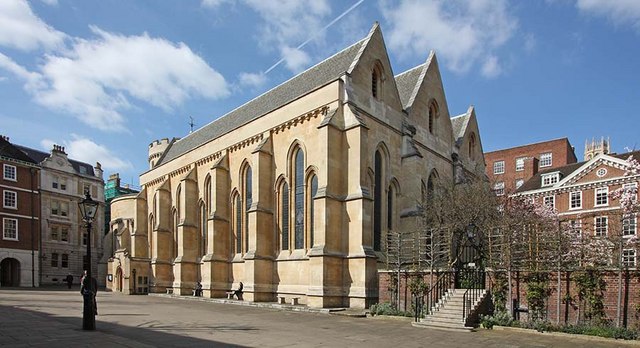
Photo: John Salmon · CC BY-SA 2.0 · Wikimedia Commons
Temple Church is a 12th-century church in London built for and by the Knights Templar. The round church was consecrated in 1185. The free Lokali audio guide runs 6 minutes.
✓ Published October 2026 · how we write these guides
Visitor facts
| Lokali audio guide | 6 min · free |
|---|---|
| Type | Church |
| Location | London, United Kingdom |
| Coordinates | 51.5132, -0.1104 |
| Official website | templechurch.com |
| Languages | 50+, in the Lokali app |
The story
Step through the doorway and the city noise drops away almost at once. The air is cool and smells faintly of old stone and candle wax. Under your feet the floor is smooth and worn. Around you the walls curve in a full circle, and dark polished columns rise toward a ring of high windows. You are standing in one of the oldest buildings in London that is still in daily use.
This is Temple Church, and it was built by the Knights Templar. They were a military religious order founded after the First Crusade. Their first job was to protect Christian pilgrims travelling to Jerusalem. Over time they became powerful, wealthy and international. They held land across Europe, and they also handled money and valuables for kings and nobles. London was one of their key bases, and this church sat at the heart of it.
Notice the shape of the room. Most English churches are long and rectangular, but this part is round. That choice was deliberate. The Templars modelled their churches on the Church of the Holy Sepulchre in Jerusalem, the church built over the place Christians honour as the tomb of Christ. Standing inside this circle, a knight in medieval London could feel connected to the holiest site of his faith, thousands of kilometres away.
The round church was consecrated in 1185. Tradition holds that the ceremony was led by Heraclius, the Patriarch of Jerusalem, who had come to England to seek help for the crusader kingdoms. So the building has a direct link to the politics of the Holy Land. It also sits at an important moment in architecture. The rounded arches of the older style meet the pointed arches of the new Gothic style here, side by side.
Now look at the columns again. Many of them are made of Purbeck marble, a dark limestone from Dorset on the south coast of England. It takes a high polish, almost like glass. Masons loved it because it gave slender columns a rich, dark sheen against the paler stone. Run your eyes up from the base to the capital, and you can see how thin these supports are for the weight above them.
Here is a detail many visitors miss. Look up at the wall arcade that runs around the lower part of the round. Above the small arches sits a ring of carved stone heads. Some look calm. Some grimace, bare their teeth or pull strange faces. Many have been restored or replaced over the centuries, but together they form a crowd of watchers around the edge of the room. Take a moment to find your favourite.
On the floor of the round lie the stone effigies — carved figures of knights, stretched out in armour. Some have crossed legs, and some hold swords or shields. One of them is traditionally identified as William Marshal, a famous knight who served several English kings and helped guide the country after the death of King John. These men were not all Templars themselves. Many were powerful supporters who chose to be commemorated here.
Now turn east, toward the long, bright part of the church. This is the chancel, added in the thirteenth century. It feels very different from the round. It is wide, light and airy, with tall pointed windows and clusters of slender columns. In the round, the space draws you inward, toward the centre. In the chancel, the space carries your eye forward, toward the altar. Two styles, two moods, one building.
The Templars did not last. In the early fourteenth century the order was suppressed across Europe, amid accusations that historians today largely view as politically driven. Their property in London passed to another crusading order, the Knights Hospitaller. In time, lawyers came to lease the land. That is why this area is still called the Temple, and why the church today belongs to two legal societies, the Inner Temple and the Middle Temple.
Those societies are two of the four Inns of Court, the historic professional bodies for barristers in England and Wales. Walk outside and you are inside a quiet legal village of courtyards, chambers and gardens. You may see the emblems of the two Inns on gates and doorways. A winged horse, Pegasus, marks the Inner Temple. A lamb carrying a flag marks the Middle Temple. Lawyers still worship, marry and hold memorials here.
The church has survived a great deal. It escaped the Great Fire of London in 1666, and Christopher Wren later refurbished the interior. In the nineteenth century, Victorian restorers changed much of his work. Then, in 1941, during the Blitz, incendiary bombs set the roof on fire. The effigies were badly damaged, and much of the interior was lost. What you see today is largely the result of careful rebuilding after the war.
Music is part of this place too. The church choir has a long reputation, and a famous 1927 recording made here, of a boy soprano singing O for the Wings of a Dove, sold in huge numbers. After the war, the church also gained an organ that had first been built for a house in Scotland. Some visitors know the church for a different reason. It appears in Dan Brown's novel The Da Vinci Code, which brought a new wave of curious readers to these effigies.
As you leave, pause in the courtyard outside. Look for a tall column topped by a small sculpture of two knights riding one horse. It recalls the Templar seal, which showed two knights sharing a single mount, a sign of the order's early poverty. Fleet Street and the traffic of the Strand are only a short walk away, yet here it is still quiet. Listen to your footsteps on the stone, and to the sound of the city, waiting just beyond the gate.
Key facts
What to look for
Practical tips
Common questions
Is there a free audio guide to Temple Church?
Yes — the Lokali app narrates Temple Church free of charge in 50+ languages. The guide runs about 6 minutes, covers the history, what to look for on site and practical tips, and works offline once downloaded.
Where is Temple Church?
Temple Church is in London, United Kingdom, at 51.5132, -0.1104. Tap the map link on this page for directions from where you are.
What is Temple Church known for?
The round church was consecrated in 1185. Built by the Knights Templar, a crusading military order.
What should you look for at Temple Church?
Ring of carved grotesque heads above the arcade. Stone knight effigies lying on the floor of the round. Dark polished Purbeck marble columns.
What should you know before visiting Temple Church?
Spend time in both the round and the chancel. Check the church website for services and choral events.
On the map
Opens directions to Temple Church from your location.
More to see in London


Hear Temple Church in your language
The full story, narrated, in 50+ languages. Download it before you go and it plays offline, at your own pace, with no ticket and no tour group.