
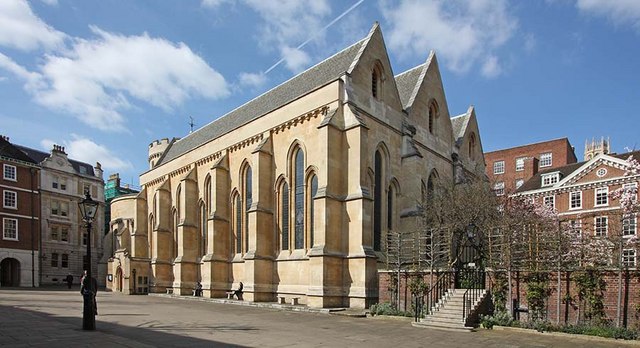
Photo: Tony Hisgett from Birmingham, UK · CC BY 2.0 · Wikimedia Commons
Sir John Soane's Museum is a museum in London. Soane bought three adjoining houses: numbers 12, 13 and 14. The free Lokali audio guide runs 7 minutes.
✓ Published October 2026 · how we write these guides
Visitor facts
| Lokali audio guide | 7 min · free |
|---|---|
| Type | Museum |
| Location | London, United Kingdom |
| Coordinates | 51.5171, -0.1169 |
| Official website | soane.org |
| Languages | 50+, in the Lokali app |
The story
Close the front door behind you, and the noise of London drops away. The light changes first. It falls from above, through small domes and coloured glass, onto plaster casts, marble fragments and dark wood. The air is cool and still. Floorboards creak underfoot. Everywhere you turn, there is something looking back at you: a carved face, a broken column, a mirror catching the edge of a room you have not entered yet.
This is the home of Sir John Soane, one of the most original architects Britain has produced. He lived and worked here, on the north side of Lincoln's Inn Fields, in the early nineteenth century. Over several decades he bought three neighbouring houses, numbers 12, 13 and 14. Then he rebuilt them again and again, knocking through walls and adding rooms. The result is part house, part museum, and part long experiment in light and space.
Soane was born in 1753, the son of a bricklayer. That detail matters. He rose from a modest start to become Professor of Architecture at the Royal Academy. His largest work was the Bank of England, which he designed and extended over about forty-five years. Sadly, most of his Bank was demolished in the 1920s. So this house is now one of the best places anywhere to understand how Soane thought — and how he handled light.
Here is the first surprise. Everything you see is arranged more or less as Soane left it. In 1833, he arranged a private Act of Parliament. It came into force when he died in 1837. The Act turned his house and collection into a museum for students and the public, and it required the place to stay as close as possible to its state at his death. In effect, Soane froze his own home in time.
Why would a man do that? Part of the answer is family. Soane had two sons, and both disappointed him deeply. One of them published anonymous attacks on his father's work. Soane believed these attacks hastened the death of his wife, Eliza, in 1815. By giving his collection to the nation, he made sure his sons could not sell it off. It is a monument to his ideas, but also to a family quarrel.
Now look at the rooms around you. Notice how few walls are simply flat. Soane used shallow domes, arches, top lights and hidden windows. He placed small convex mirrors in corners and ceilings, so the space seems to bend and repeat. In the Breakfast Room, a low dome seems to float above the table. Soane called effects like this the poetry of architecture. Stand still for a moment, and you will see how the light moves.
The collection itself is enormous for a private house. There are Greek and Roman fragments, plaster casts of famous sculpture, architectural models, books and drawings. Soane owned many thousands of architectural drawings, including a large number by Robert Adam and his office. Much of this is packed tightly onto walls and stairways. It can feel crowded at first. But Soane intended it that way. He wanted his students to learn by walking among examples, close enough to touch.
At the heart of the house, down in the basement, lies the most famous object. It is the alabaster sarcophagus of Seti the First, a pharaoh of ancient Egypt. The explorer Giovanni Belzoni found it in the Valley of the Kings in 1817. The British Museum declined to buy it, and Soane bought it instead in 1824. To celebrate, he held parties over three evenings, lighting the basement with lamps and candles. Guests came to see the pale stone glowing in the dark.
Look closely at the sarcophagus if you can. The stone is thin enough that light can pass through it. Its surfaces were once covered with carved figures and hieroglyphs, the sacred picture-writing of ancient Egypt, filled with blue colour. Most of that colour has faded now. Still, you can make out rows of small figures inside and out. Many texts on it come from a funerary book about the sun's journey through the underworld at night.
Upstairs, the Picture Room holds another surprise. The room is small, yet it holds far more paintings than its size should allow. The walls are actually hinged panels that fold out, like the pages of a book. Behind one layer of pictures sits another. Here hang William Hogarth's eight paintings of A Rake's Progress, which follow a young heir's fall into ruin. There are also paintings from Hogarth's election series, full of sharp political satire.
Soane also had a playful side, and you can find it in the Monk's Parlour. Here he invented an imaginary monk, called Padre Giovanni, and decorated the room as the monk's gloomy retreat. Outside the window, in a small courtyard, is a mock ruin and a monk's tomb. Nearby is a real small grave — for Fanny, his wife's beloved dog. The tomb reads, simply, Alas, poor Fanny. It is a joke, a lament, and a stage set all at once.
One more surprise lies outside this building. Soane designed a tomb for his wife and himself in the old churchyard of Saint Pancras, in north London. A century later, the architect Giles Gilbert Scott was a trustee of this museum. The shape of Soane's tomb, with its shallow domed top, is widely said to have inspired Scott's design for the red British telephone box. So a little of this house stands on street corners across the country.
When you step back outside, turn and look at the front of number 13. The pale stone front projects forward from the brick terrace beside it. It was once an open loggia, a covered porch with arches, later glazed in. Small statues stand on its upper level. Then look across at the trees and lawns of Lincoln's Inn Fields. Soane looked at this same view every day. As you walk away, notice how ordinary the neighbouring houses seem — and how much one man packed behind his door.
Key facts
What to look for
Practical tips
Common questions
Is there a free audio guide to Sir John Soane's Museum?
Yes — the Lokali app narrates Sir John Soane's Museum free of charge in 50+ languages. The guide runs about 7 minutes, covers the history, what to look for on site and practical tips, and works offline once downloaded.
Where is Sir John Soane's Museum?
Sir John Soane's Museum is in London, United Kingdom, at 51.5171, -0.1169. Tap the map link on this page for directions from where you are.
What is Sir John Soane's Museum known for?
Soane bought three adjoining houses: numbers 12, 13 and 14. An 1833 Act of Parliament preserved the house as Soane left it.
What should you look for at Sir John Soane's Museum?
Small convex mirrors set into ceilings and corners. The shallow floating dome above the Breakfast Room table. Faint carved figures on the translucent alabaster sarcophagus.
What should you know before visiting Sir John Soane's Museum?
Expect a queue outside; visitor numbers inside are limited. Ask a room warden to open the Picture Room's folding panels.
On the map
Opens directions to Sir John Soane's Museum from your location.
More to see in London



Hear Sir John Soane's Museum in your language
The full story, narrated, in 50+ languages. Download it before you go and it plays offline, at your own pace, with no ticket and no tour group.