
National Gallery is a museum in Westminster, United Kingdom. 2,300 paintings from the 13th century onward: Turners, Van Goghs, Caravaggios, and Renaissance masterworks. Most visitors spend 1–3 hours here. The free Lokali audio guide runs 5 minutes.
✓ Verified August 2026 · how we write these guides
Visitor facts
| Time needed | 1–3 hours |
|---|---|
| Lokali audio guide | 5 min · free |
| Type | Museum |
| Best for | Editors' pick |
| Location | Westminster, United Kingdom |
| Coordinates | 51.5087, -0.1283 |
| Languages | 45, in the Lokali app |
The story
On the north side of Trafalgar Square, above the fountains and the crowds and the great bronze lions, stretches a long columned building with a dome at its centre. This is the National Gallery, home to one of the finest collections of European painting anywhere, and, like several of London's great museums, free to enter.
It started small. The gallery was founded in 1824, when the government bought a modest group of pictures to form a collection for the nation, and it grew from there. The building on Trafalgar Square came a little later, and the collection has been added to, wing by wing, ever since, including a modern extension at its western end.
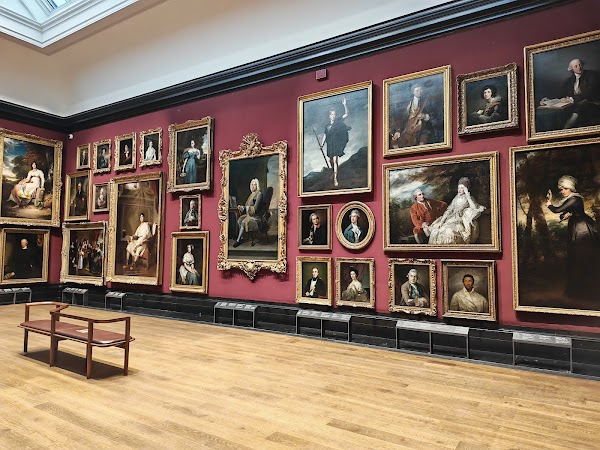
The collection covers Western European painting from the medieval period to about 1900. That means roughly six centuries of art under one roof: gold-ground altarpieces, Renaissance masterpieces, Dutch interiors, grand Baroque canvases, and the bright light of the Impressionists, arranged so you can walk forward through time as you move through the rooms.
Certain pictures draw the crowds. A Van Gogh painting of sunflowers, a Leonardo, the sharp-eyed couple of Van Eyck's Arnolfini portrait, Turner's storms of light, and Constable's English skies are all here. Each room holds something a person might travel a long way to see, and admission still costs nothing.
Because it is free and central, the gallery rewards short, repeat visits as much as long ones. You can step in for half an hour to see a handful of pictures and leave again, rather than forcing a march through every room. Many Londoners treat it exactly that way, dropping in between other errands.
The building tells its own story. The original front, with its columns and dome, belongs to the first half of the nineteenth century, while the Sainsbury Wing at the western end is a thoughtful modern addition built to hold the earliest and most delicate paintings. Moving between the two is a quiet lesson in changing taste.
The setting adds to the appeal. Trafalgar Square, with its tall column, fountains, and lions, is one of the city's great gathering places, used for celebrations, protests, and simply sitting in the sun. The gallery looks out over all of it from the top of its broad steps.
Inside, the layout runs broadly by date and region, with the most famous works well signposted. If your time is short, the gallery suggests routes to its highlights, and free maps at the entrance mark where the best-known pictures hang, so you need not wander at random hoping to stumble on them.
Step away from the headline names and the rooms grow calm. Smaller portraits, landscapes, and religious panels often hang in near-empty galleries only a few steps from the crowds, and they reward the visitor willing to slow down and look closely at less famous, quieter work.
A few practical notes. The permanent collection is free; special exhibitions are ticketed and often busy. The gallery stays open late one evening each week, which is among the calmest and most atmospheric times to visit. Bags are checked at the door, so it helps to travel light.
Its position links it to much of central London. The square sits between the theatres of the West End, the government buildings down Whitehall, and the river a short walk to the south, so the gallery folds easily into a wider day spent on foot in the centre.
The gallery works hard to be more than a store of old pictures. Free talks, family activities, and changing displays draw the paintings into the present, and copyists can sometimes be seen at their easels in the rooms, learning from the masters exactly as students have for generations.
Its position on the square also makes it a refuge. On a cold or wet day, the warm galleries a few steps from the open square are one of the easiest free shelters in central London, which is part of why the same visitors return again and again.
Before you go, pick one painting and give it five unhurried minutes rather than a passing glance. In a collection this rich it is easy to see everything and remember nothing. Choose a single picture to carry away with you, and the National Gallery becomes not a checklist but a place you will want to return to.
Key facts
What to look for
Practical tips
Common questions
How long do you need at National Gallery?
Plan 1–3 hours. That is the time most visitors spend at National Gallery. The free Lokali audio guide adds about 5 minutes of narration you can listen to as you walk, so it fits inside your visit rather than adding to it.
Is there a free audio guide to National Gallery?
Yes — the Lokali app narrates National Gallery free of charge in 50+ languages. It covers the history, what to look for on site and practical tips, and it works offline once downloaded.
Where is National Gallery?
National Gallery is in Westminster, United Kingdom, at 51.5087, -0.1283. Tap the map link on this page for directions from where you are.
What should you know before visiting National Gallery?
Visit free; special exhibitions need tickets.
What is National Gallery known for?
Founded in 1824 as a collection for the nation.
What is the best time to visit National Gallery?
The Sainsbury Wing's Italian Renaissance rooms are luminous in afternoon light.
On the map
Opens directions to National Gallery from your location.
More to see in Westminster


Hear National Gallery in your language
The full story, narrated, in 50+ languages. Download it before you go and it plays offline, at your own pace, with no ticket and no tour group.