National Portrait Gallery
51.5091° N · 0.1276° W · Museum
National Portrait Gallery is a museum in Westminster, United Kingdom. Specialised museum of portraiture from the 16th century onward, with over 195,000 works. Most visitors spend 1–2 hours here. The free Lokali audio guide runs 9 minutes.
✓ Verified August 2026 · how we write these guides
Visitor facts
| Time needed | 1–2 hours |
|---|---|
| Lokali audio guide | 9 min · free |
| Type | Museum |
| Best for | Editors' pick |
| Location | Westminster, United Kingdom |
| Coordinates | 51.5091, -0.1276 |
| Languages | 45, in the Lokali app |
The story
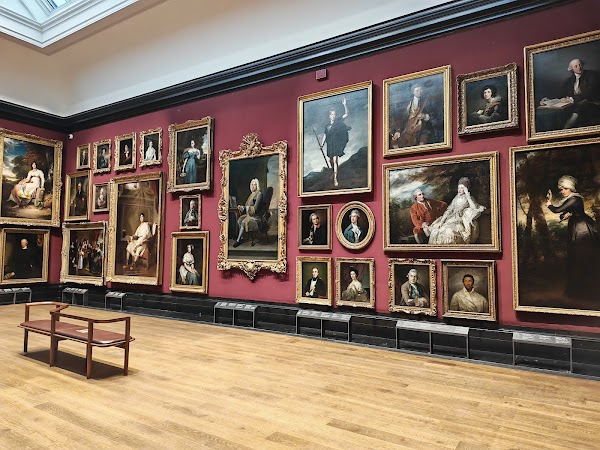
Stand in the entrance hall and look up. The light pours down through glass panels overhead, washing the white stone walls in a soft, even glow. The air smells faintly of polished wood and old varnish. This is the National Portrait Gallery, home to faces that shaped Britain — monarchs, poets, scientists, rebels — captured in paint, marble, and silver gelatin.
The gallery opened in 1856, the first of its kind anywhere in the world. Its mission was radical for the time: collect portraits not for their artistic merit alone, but for the significance of the sitter. A rough sketch of Shakespeare mattered more than a polished canvas of an unknown aristocrat. The founders wanted a visual archive of national memory, a place where history wore a human face.
Start on the top floor, where the Tudor galleries begin. The portraits here are small, dark, jewel-like panels. Elizabeth the First stares out from beneath a crown of pearls, her face a mask of white lead paint. The Tudors understood that a portrait was a tool of power — a way to project authority across a kingdom that could never see the monarch in person. Every detail was controlled: the tilt of the head, the fall of light, the symbols tucked into the background.
Move down a floor and the faces multiply. The eighteenth century loved conversation pieces — group portraits where sitters lounged in libraries or gardens, books open, dogs at their feet. Look for the portrait of the Brontë sisters, painted by their brother Branwell. He originally included himself in the composition, standing between Charlotte and Emily, but later painted himself out. You can still see the ghost of his figure, a pale column rising behind Anne's shoulder.
The Victorian galleries feel different. Photography arrived in the eighteen-forties, and suddenly a portrait could be made in seconds rather than weeks. The painted portrait had to justify itself, to offer something a camera could not. Artists pushed toward psychology, toward the inner life. Look for the portrait of Charles Darwin in old age, his eyes tired, his beard wild. The painter caught the weight of a man who had rewritten humanity's place in nature.
The twentieth century exploded the genre. Portraits became experiments in form, color, and identity. A canvas might fracture a face into geometric planes, or dissolve it into washes of pure pigment. The sitters changed too — not just prime ministers and poets, but footballers, activists, musicians, people who shaped culture from outside the old corridors of power. The gallery collected them all, building a portrait of Britain that was messier, louder, more honest than the official story.
Pause in front of the contemporary galleries. These portraits are often photographs now, large-scale prints that fill entire walls. The faces are close enough to meet your gaze, close enough to feel like an encounter rather than an observation. Some are celebrities you recognize. Others are strangers, their significance still unfolding. The gallery keeps collecting, keeps arguing about who belongs in the national story.
The building itself reopened in 2023 after a major renovation. The architects stripped away decades of additions, opened up sightlines, and carved a new entrance on the north side. The galleries flow more easily now, the light is better, and the cafe overlooks Trafalgar Square. But the core mission has not changed: this is still a place where you come face to face with history, where the past looks back.
Before you leave, find the self-portraits. Artists painting themselves, alone in the studio, deciding how they want to be remembered. Some are vain, some are brutal, some are playful. They remind you that every portrait is a negotiation between sitter and artist, between how we see ourselves and how we want to be seen. Walk slowly. Let the faces accumulate. By the time you reach the exit, you will have crossed five centuries of ambition, doubt, power, and vulnerability — all of it written on human skin.
Key facts
What to look for
Practical tips
Common questions
How long do you need at National Portrait Gallery?
Plan 1–2 hours. That is the time most visitors spend at National Portrait Gallery. The free Lokali audio guide adds about 9 minutes of narration you can listen to as you walk, so it fits inside your visit rather than adding to it.
Is there a free audio guide to National Portrait Gallery?
Yes — the Lokali app narrates National Portrait Gallery free of charge in 50+ languages. It covers the history, what to look for on site and practical tips, and it works offline once downloaded.
Where is National Portrait Gallery?
National Portrait Gallery is in Westminster, United Kingdom, at 51.5091, -0.1276. Tap the map link on this page for directions from where you are.
What should you know before visiting National Portrait Gallery?
Start on the top floor and work downward chronologically.
What is National Portrait Gallery known for?
Opened in 1856, the world's first portrait gallery.
What is the best time to visit National Portrait Gallery?
The top-floor galleries overlook Trafalgar Square and are often quiet.
On the map
Opens directions to National Portrait Gallery from your location.
More to see in Westminster


Hear National Portrait Gallery in your language
The full story, narrated, in 50+ languages. Download it before you go and it plays offline, at your own pace, with no ticket and no tour group.