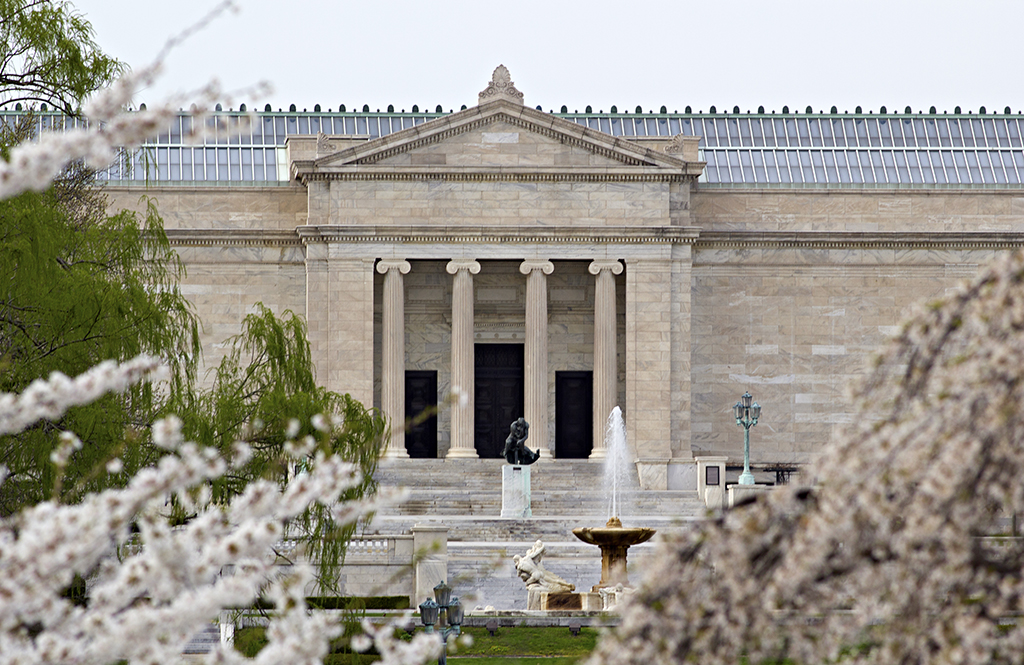
Cleveland Museum of Art
41.5089° N · 81.6117° W · Museum
Photo: zenbikescience · CC BY 2.0 · Wikimedia Commons
Cleveland Museum of Art is an art museum in Cleveland, Ohio. The museum first opened to the public in 1916. The free Lokali audio guide runs 7 minutes.
✓ Published October 2026 · how we write these guides
Visitor facts
| Lokali audio guide | 7 min · free |
|---|---|
| Type | Museum |
| Location | Cleveland, United States |
| Coordinates | 41.5089, -81.6117 |
| Official website | clevelandart.org |
| Languages | 50+, in the Lokali app |
The story
Stand at the edge of the lagoon for a moment. The water is still, and it holds a white reflection of marble columns. Behind you, the trees of Wade Park move in the wind off Lake Erie. Ahead, broad steps rise toward a building that looks like a Greek temple. It sits in Cleveland's University Circle, among universities, hospitals and concert halls. Take a breath here. It is a calm way to arrive at the Cleveland Museum of Art.
The museum opened its doors in 1916. In those years, Cleveland was one of the richest industrial cities in America. Steel, oil and shipping made fortunes along the lakefront. Several of those fortunes paid for this museum. The founders wanted more than a private treasure house. They wanted a place that belonged to the whole city. The museum still describes its mission as serving all the people, forever. Many visitors are surprised to learn how long that promise has lasted.
Look closely at the original building. It is faced with pale Georgian marble, from the state of Georgia in the American South. The style is Beaux-Arts, a grand classical manner taught at the famous art school in Paris. It uses columns, symmetry and carved stone to suggest permanence. The local architects Hubbell and Benes designed it. On a sunny afternoon the marble turns warm and almost golden. On a grey lake-effect morning it looks cool and silver. The same stone changes with the light.
Before you go inside, find the bronze figure near the south steps. It is a cast of Rodin's The Thinker, the seated man with his chin on his hand. Now look at his base and his legs. They are torn and blackened. In 1970, during a time of political unrest, a bomb exploded at the foot of the statue. The museum decided not to repair the damage. The sculpture stands today as Rodin made it, and as history changed it.
The building did not stay a simple temple. In the early 1970s, the Hungarian-born architect Marcel Breuer added a new wing. Breuer was a modernist, trained at the Bauhaus, the German design school that rejected ornament. His wing uses bands of dark and light granite in long horizontal stripes. For decades it stood in sharp contrast with the white marble. Some people loved the contrast. Others found it harsh. Either way, it shows how taste in architecture can change in one generation.
The largest change came in the early 2010s. The architect Rafael Viñoly designed a major expansion that joined the old and new parts together. At its centre is a huge glass-roofed atrium. Walk into it and the noise drops. Light falls from above onto a wide stone floor. Trees and benches make it feel like an indoor town square. The old marble walls are now inside the building. You can touch the outside of the 1916 museum while you stand indoors.
That atrium is a good place to plan your visit. The collection holds more than sixty thousand objects. It covers about six thousand years of human making. There is Egyptian sculpture, Chinese painting, Japanese screens, African masks, medieval gold and modern canvases. Nobody can see it all in one day. Pick two or three areas that interest you. Then let yourself get a little lost between them. The surprises often come in the rooms you did not plan to visit.
One room many people remember is the armour court. Suits of steel stand in rows, some of them on armoured horses. The metal is polished, and you can see your own face bent across a breastplate. Look at the hinges at the elbows and knees. These small joints let a knight bend, ride and fight. Children often stand here longest. But adults stay too, because the craft is so precise. Each plate was hammered and fitted by hand.
The medieval galleries hold another quiet surprise. The museum owns objects from the Guelph Treasure, a famous collection of church gold from medieval Germany. These are small things — crosses, reliquaries, portable altars. A reliquary is a decorated container made to hold the remains of a saint. The gold and enamel still shine after many centuries. Lean in close. You can see tiny figures and the marks of the goldsmith's tools.
Upstairs, the European paintings show the range of the collection. Caravaggio's Crucifixion of Saint Andrew is here, with its deep shadows and hard, bright light on the bodies. There is a large Water Lilies panel by Claude Monet, all soft violet and green. Turner's painting of the burning Houses of Parliament in London glows orange across the room. And Picasso's La Vie, from his Blue Period, hangs here too. It is a cold, sad painting, and people often stand before it in silence.
The museum is also known for its use of technology. In the ArtLens gallery, near the atrium, a long digital wall shows thousands of works from the collection. You can touch an image, learn about it, and save it to your phone. Then you can use the museum's app to find that object in the galleries. It is a playful way to explore. It also helps if you feel overwhelmed. You can build your own short tour before you walk away from the screen.
When you finish inside, return to the south steps. Below you lies the Fine Arts Garden, laid out by the Olmsted Brothers, the landscape firm founded by the family of Frederick Law Olmsted, who designed Central Park in New York. Paths lead down to the lagoon past sculptures, lawns and seasonal flowers. In spring the cherry trees bloom along the water. In autumn the leaves turn red and copper. In winter the lagoon may freeze, and the marble stands out white against grey sky.
Take a last look at the whole scene. The temple of marble. The striped granite of the modern wing. The glass roof shining between them. The broken Thinker, still thinking. Around you, students cross the park and joggers circle the water. This museum was built by a rich industrial city for its ordinary people. More than a century later, people still walk up these steps every day. As you walk down them, listen to the wind in the trees, and notice the light on the stone behind you.
Key facts
What to look for
Practical tips
Common questions
Is there a free audio guide to Cleveland Museum of Art?
Yes — the Lokali app narrates Cleveland Museum of Art free of charge in 50+ languages. The guide runs about 7 minutes, covers the history, what to look for on site and practical tips, and works offline once downloaded.
Where is Cleveland Museum of Art?
Cleveland Museum of Art is in Cleveland, United States, at 41.5089, -81.6117. Tap the map link on this page for directions from where you are.
What is Cleveland Museum of Art known for?
The museum first opened to the public in 1916. Original building is faced with white Georgian marble.
What should you look for at Cleveland Museum of Art?
The torn, blackened base and legs of the Thinker. Bands of dark and light granite on the Breuer wing. Original marble outer walls now standing inside the atrium.
What should you know before visiting Cleveland Museum of Art?
Pick two or three collection areas before you start walking. Use the ArtLens wall to build your own short tour.
When is the best time to visit Cleveland Museum of Art?
Visit the Fine Arts Garden in spring for cherry blossoms.
On the map
Opens directions to Cleveland Museum of Art from your location.
More to see near Cleveland Museum of Art

Hear Cleveland Museum of Art in your language
The full story, narrated, in 50+ languages. Download it before you go and it plays offline, at your own pace, with no ticket and no tour group.