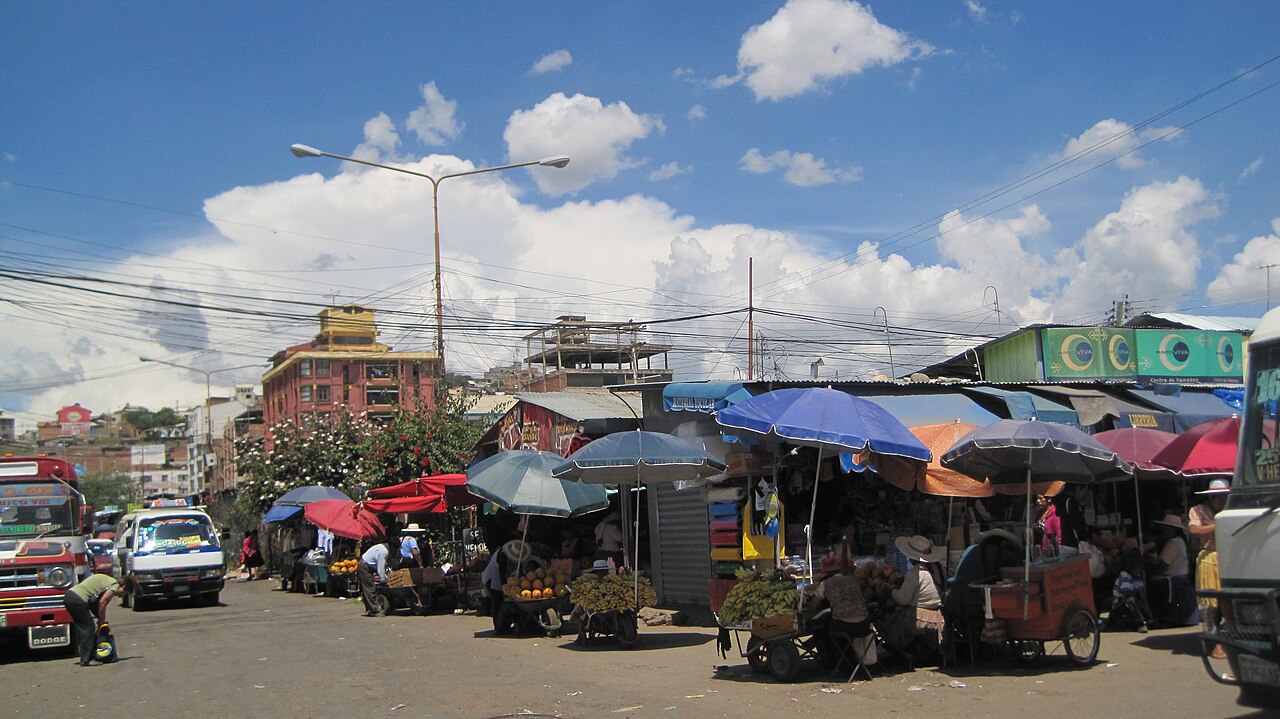
La Cancha Market is a market in Cochabamba, Bolivia. One of South America's largest open-air markets, sprawling across several blocks in central Cochabamba. Most visitors spend 1–2 hours here. The free Lokali audio guide runs 6 minutes.
✓ Verified August 2026 · how we write these guides
Visitor facts
| Time needed | 1–2 hours |
|---|---|
| Lokali audio guide | 6 min · free |
| Type | Market |
| Best for | Local life |
| Location | Cochabamba, Bolivia |
| Coordinates | -17.3980, -66.1450 |
| Languages | 45, in the Lokali app |
The story
The smell reaches you first. Ripe peaches, fried dough, fresh coriander, and the warm dust of the afternoon. You hear it next. Voices calling out prices in Spanish and Quechua. Wheels rolling over stone. A radio playing somewhere behind a wall of fruit. Then the color arrives all at once. You have walked into La Cancha, the great open market on the south side of Cochabamba, and the daily life of the city is spread out in front of you.
The name comes from a Quechua word for an open, enclosed space. That is a fair description. La Cancha is not a single building. It spreads across many blocks, a wide web of stalls, awnings, tarpaulins, and narrow lanes. There is no clear edge where it begins or ends. People call it the largest open-air market in South America. Once you are inside it, moving slowly through the crowd, you can easily believe the claim.
Trade here is older than the city itself. Long before Spanish settlers arrived in the sixteenth century, the communities of this valley met to exchange goods. Farmers brought maize and potatoes down from the highlands. They carried salt, cloth, and tools back up. That rhythm of exchange never really stopped. It only grew, slowly, over hundreds of years, until it became the sprawling market you walk through today.
La Cancha is open seven days a week. Wednesday and Saturday are the busiest. On those days the lanes fill so tightly that you move at the pace of the crowd around you. You do not really choose your direction. The crowd chooses it for you. The best thing you can do is relax your shoulders, slow your breathing, and let the current carry you wherever it happens to be going.
The market is loosely organized by what it sells. One area holds fruit and vegetables, stacked in bright pyramids that the sellers rebuild all day long. Another holds spices, dried herbs, and open sacks of grain. Walk a little further and you pass clothing, then shoes, then hardware, then phones and electronics. There is a section, somewhere in this maze, for almost everything a household could ever need.
Many of the vendors speak Quechua, the language of the surrounding valleys and the wider Andes. You will hear it threaded through the Spanish in every lane. The textiles, the herbs, and the produce come straight from the countryside around the city, carried in that same morning. The market is a meeting point, a place where the rural valleys and the growing city press up against each other every single day.
Food is a central part of the experience, not a break from it. Small kitchens cook from early morning. You smell grilled meat, fried pastries, and soup simmering in tall pots. Women in aprons ladle out steaming plates at low counters lined with plastic stools. Eating here is simple and direct. You sit, you point at what looks good, and you are served. The portions are large and the prices are small.
Cochabamba is known across Bolivia for its food. People often call it the gastronomic heart of the country, and they say it with real pride. La Cancha is where that reputation lives, day after day. The ingredients piled on these tables feed the kitchens of the whole city. Good cooks come early, before the worst of the crowds, to pick over the best of what the valleys sent down overnight.
Bargaining is normal here, and expected. Ask the price. Offer a little less. The vendor may smile, may refuse, may quietly meet you halfway. It is a soft conversation, not a fight, and it usually ends with both of you content. A few coins rarely matter much to either side. The small exchange itself is part of the visit, a brief human moment inside a vast sea of trade.
Keep your bag closed and your phone tucked away. Crowded markets attract pickpockets, and La Cancha is very crowded, especially on the busy days. This is not a reason to stay away. It is only a reason to stay aware. Carry small bills in a front pocket. Watch your belongings in the tightest lanes. The great majority of visitors pass through the whole place without any trouble at all.
Every now and then, look up. Above the awnings and the tangled wires you can see the dry hills that ring the valley. The light shifts through the afternoon, softening and turning gold as the day wears on. The noise, the color, and the constant movement can begin to feel like too much. When it does, step to the edge of a lane, stand still, breathe, and simply watch it all flow past you.
La Cancha is not arranged for visitors, and that is exactly its strength. It exists for the people who shop and sell here every single day of their lives. You are not watching a performance staged for tourists. You are walking straight through the living center of a working city. So stay a while. Let the market move around you instead of rushing through it. Then carry a little of its noise away with you when you finally go.
Key facts
What to look for
Practical tips
Common questions
How long do you need at La Cancha Market?
Plan 1–2 hours. That is the time most visitors spend at La Cancha Market. The free Lokali audio guide adds about 6 minutes of narration you can listen to as you walk, so it fits inside your visit rather than adding to it.
Is there a free audio guide to La Cancha Market?
Yes — the Lokali app narrates La Cancha Market free of charge in 50+ languages. It covers the history, what to look for on site and practical tips, and it works offline once downloaded.
Where is La Cancha Market?
La Cancha Market is in Cochabamba, Bolivia, at -17.3980, -66.1450. Tap the map link on this page for directions from where you are.
What should you know before visiting La Cancha Market?
Visit Wednesday or Saturday to see it at full scale.
What is La Cancha Market known for?
Called the largest open-air market in South America.
What is the best time to visit La Cancha Market?
Go early (before 9 am) when it's less crowded and vendors are arranging stock.
On the map
Opens directions to La Cancha Market from your location.
More to see in Cochabamba


Hear La Cancha Market in your language
The full story, narrated, in 50+ languages. Download it before you go and it plays offline, at your own pace, with no ticket and no tour group.