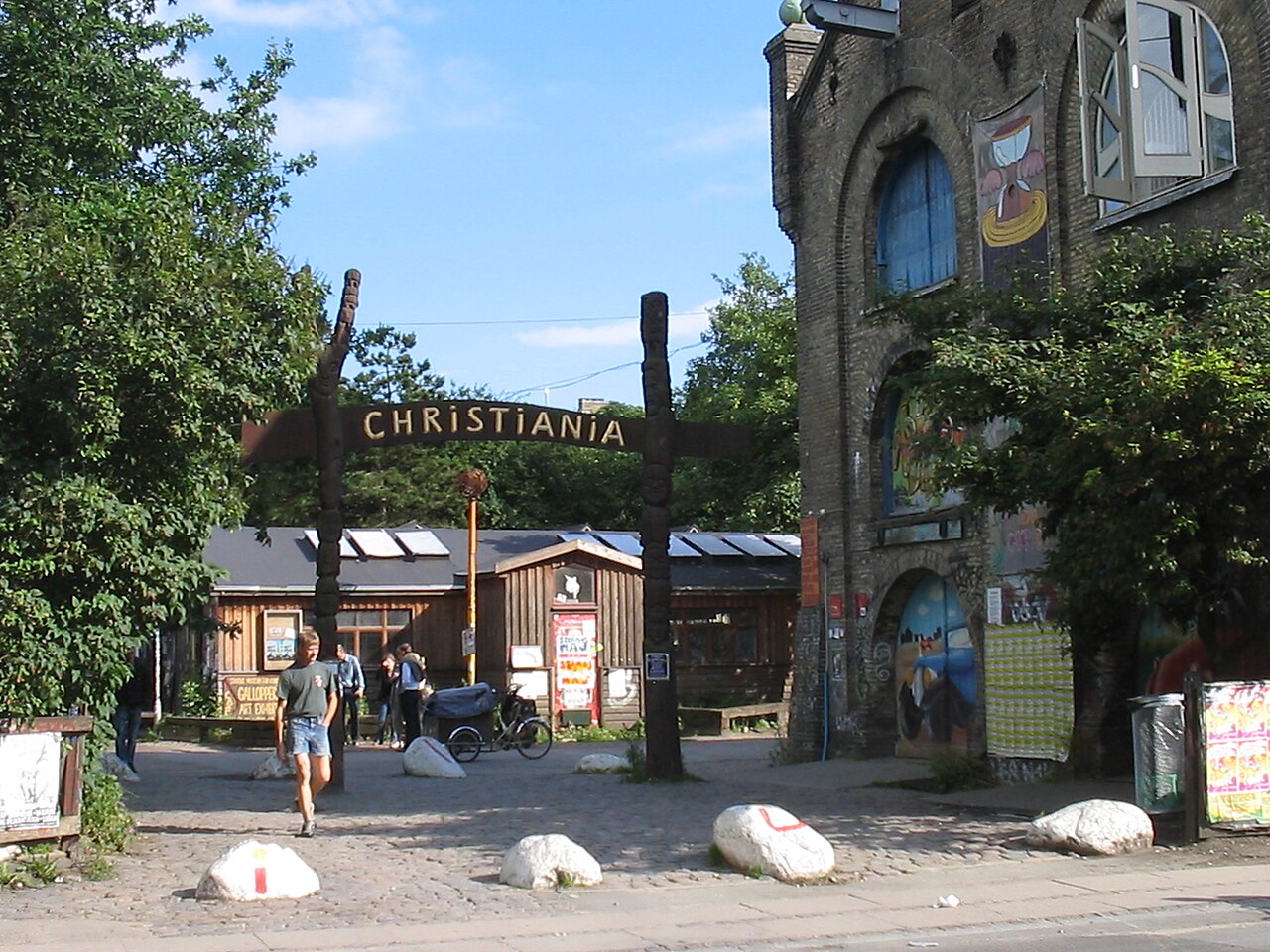
Christiania is a neighborhood in Copenhagen, Denmark. Self-governing community established in 1971 on a former military barracks. Most visitors spend 1–2 hours here. The free Lokali audio guide runs 6 minutes.
✓ Verified August 2026 · how we write these guides
Visitor facts
| Time needed | 1–2 hours |
|---|---|
| Lokali audio guide | 6 min · free |
| Type | Neighborhood |
| Best for | Local life |
| Location | Copenhagen, Denmark |
| Coordinates | 55.6754, 12.6451 |
| Languages | 45, in the Lokali app |
The story
You hear it before you see it. A guitar somewhere down a lane. The squeak of a bicycle wheel turning. Woodsmoke, fresh paint, and damp earth all hang in the air at once. The roar of the main road fades away behind you. You have stepped off the city grid and into Freetown Christiania, a corner of Copenhagen that long ago decided to live by its own clock.
This place sits in Christianshavn, a district of still canals and old earth fortifications. The land was once a closed military area, shut off from the public. Soldiers lived and trained here for many generations. Then, in time, the army moved out. The barracks stood empty, the heavy gates hung open, and slowly the wild grass began to grow over everything that was left behind.
In 1971, a group of people climbed over the fence. Some were young families with children. Some were artists and dreamers. Some simply had nowhere cheap to live in a crowded and expensive city. They walked into the empty buildings, lit the cold stoves, and stayed. Within a few weeks they had declared a free town, and they gave it a name: Christiania.
From the very start, the community made its own rules. Cars were not allowed inside the gates, and to this day they still are not. Big decisions were settled in open meetings, where people talked on until they reached agreement. A simple homemade flag soon appeared above the roofs: red cloth marked with three yellow dots. People say the dots stand for the three letters in the name.
Walk the narrow lanes now and you see homes that were built entirely by hand. No two of them are alike. Some lean gently to one side. Some wrap themselves around the trunk of a tree. Roofs are patched with tiles, tin, and salvaged old windows, whatever happened to be near at the time. The walls carry murals, bright and strange, layered over fifty years of patient painting.
The old ramparts run along the water at the eastern edge of the town. These broad earth walls once defended the city from attack by sea. Now thick grass grows over their slopes. People walk along the top in a slow, unhurried line, past small reed-fringed lakes and under tall leaning trees. It is green out here, and quiet, in a way the rest of the busy city simply is not.
Christiania has also known real trouble. For many years, one short lane was used for the open sale of cannabis. This drew large crowds, easy money, and with them came danger, conflict, and the police. The community has argued bitterly over that single lane for decades. The story is genuinely difficult, it has no simple ending, and even now it is still not finished.
But the place is much more than that one troubled lane. There are workshops, music venues, and small smoky cafes. A large old hall regularly hosts concerts. Blacksmiths still shape hot metal, and bicycle makers still bend and weld frames. The famous Christiania cargo bike, with its deep wooden box at the front, was first built here in these very sheds. Today you see it carrying children all across Copenhagen.
Photography has long been a sensitive matter in certain parts of the town. Out of plain respect, watch closely for the painted signs, and put your camera away wherever you are asked to. The people who live here are not a display set out for visitors. They are simply living their own ordinary days, and here that quietly comes first.
Children are born and grow up in these lanes. Some of the older residents have lived here for fifty years, since the very first day of the free town. To them, this is not a sight to be visited once and ticked off a long list. It is simply home, with every bit of the mess, the noise, and the warmth that the small word home can hold.
The town has always lived under a question mark. Over the years the city has tried to clear it, to tax it, and to make it normal, many times over. Agreements have been signed, then broken, then carefully signed again. Yet somehow the place keeps on going, slowly changing its shape while holding on, never fully wild and never fully tamed.
Take a moment to simply stand still and watch. A dog sleeps in the middle of a lane. Someone repairs a bicycle wheel upside down on a bench. Smoke rises from a tin chimney. The light comes down green through the leaves. None of it is arranged for you, and that is exactly why it holds your attention.
So move slowly while you are here. Buy a coffee from an open window. Sit on the grassy rampart and watch the still, dark water. Listen again for that guitar you first heard when you arrived. Whatever you finally decide about this long and stubborn experiment, it has lasted far longer than anyone ever expected, and it is still, every day, trying.
Key facts
What to look for
Practical tips
Common questions
How long do you need at Christiania?
Plan 1–2 hours. That is the time most visitors spend at Christiania. The free Lokali audio guide adds about 6 minutes of narration you can listen to as you walk, so it fits inside your visit rather than adding to it.
Is there a free audio guide to Christiania?
Yes — the Lokali app narrates Christiania free of charge in 50+ languages. It covers the history, what to look for on site and practical tips, and it works offline once downloaded.
Where is Christiania?
Christiania is in Copenhagen, Denmark, at 55.6754, 12.6451. Tap the map link on this page for directions from where you are.
What should you know before visiting Christiania?
Put your camera away where signs request no photos.
What is Christiania known for?
Founded in 1971 in former military barracks.
What is the best time to visit Christiania?
Photography is restricted in certain areas—respect posted signs.
On the map
Opens directions to Christiania from your location.
More to see in Copenhagen


Hear Christiania in your language
The full story, narrated, in 50+ languages. Download it before you go and it plays offline, at your own pace, with no ticket and no tour group.