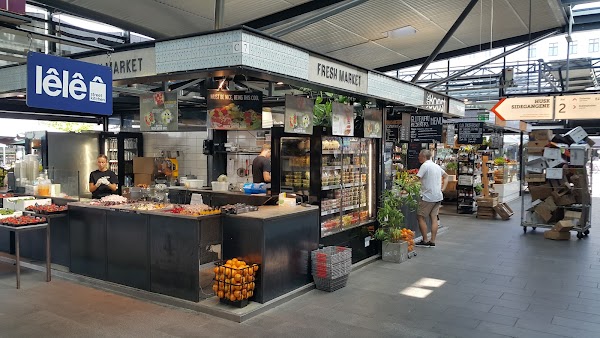
Torvehallerne Market
55.6829° N · 12.5703° E · Food Market
Torvehallerne Market is a food market in Copenhagen, Denmark. Modern covered food market opened in 2011, housing artisanal producers, organic vendors, and prepared-food stalls. Most visitors spend 1–2 hours here. The free Lokali audio guide runs 5 minutes.
✓ Verified August 2026 · how we write these guides
Visitor facts
| Time needed | 1–2 hours |
|---|---|
| Lokali audio guide | 5 min · free |
| Type | Food Market |
| Best for | Local life |
| Location | Copenhagen, Denmark |
| Coordinates | 55.6829, 12.5703 |
| Languages | 45, in the Lokali app |
The story
The smell of the place reaches you well before anything else does. Fresh warm bread. Newly ground coffee. Ripe, sharp cheese. The clean cold salt of fish laid out across the ice. You step in through the open doors of Torvehallerne, and the whole city of Copenhagen greets you, first of all, through your nose.
This is a food market, set down right in the center of the city. It stands very close to Norreport station, the busy point where the trains, the buses, and many thousands of bicycles all cross paths each day. The market fills an open public square called Israels Plads. For a very long time, markets of one kind or another have come and gone on this same patch of ground.
The market that you walk through today first opened in 2011. It is built as two long parallel halls, made mostly of glass and steel. Clear daylight pours straight in through the walls and fills the whole space. The architect was Hans Peter Hagens, who wanted a market that felt open, clean, and full of light, rather than dark and closed in.
Between the two long halls runs a wide outdoor lane. Out here the stalls sell cut flowers, fresh fruit, and vegetables in the open air. On a fine and dry day the tall doors are folded right back along the sides, and the line between the inside and the outside almost completely disappears.
Step now into the first of the two halls. Around sixty separate stalls stand close together, side by side. Each one is fairly small, and each one tends to do a single thing very well indeed. A fishmonger stands here. A baker works just there. The next seller offers nothing at all but cheese, or coffee, or fresh-made pasta.
Stop at the long fish counter for a moment. Whole fish lie out across the crushed ice, their eyes still clear and bright, their silver skin shining under the lights. The seller can tell you exactly where each one of them was caught. Point at one and ask, and you will often get a quick, friendly suggestion for how best to cook it.
The Danes have a dish that they call smorrebrod. It is an open-faced sandwich, a single slice of dark, dense rye bread piled high with toppings. You might see pickled herring, thin slices of roast beef, or tiny pink shrimp stacked carefully by hand. Each finished one looks less like a quick lunch and more like a small work of art.
Coffee is taken very seriously throughout this market. Watch the slow, steady drip, the careful weighing out of the beans, the thin steam rising up off the cup. People stand at the narrow counters in no real hurry at all, sipping and talking quietly with the very person who has just made their drink for them.
The smells keep on changing as you walk slowly along. Warm cinnamon rolls drifting from a bakery. Sharp, dry spice from a stall of loose teas and bright colored powders. The plain sweetness of cut fruit. Then the cool green scent of fresh herbs, and the flowers waiting out in the open lane just outside.
This is above all a place for the senses, yet it is also a place for ordinary daily life. Local people come here to shop for their evening dinner. Office workers step in for a quick bite at lunch. The market was not built only for visitors. It is a real and working part of how this whole neighborhood eats.
So eat as you move slowly through it all. Buy one small thing at one stall, then something quite different a few steps further on. Stand and rest at a tall shared table. Try a food whose name you cannot yet even pronounce. Watch how the people around you order their own, and simply follow their easy lead.
It is busy here, but it is rarely ever unpleasant. At lunchtime the narrow lanes fill up and the lines grow long. The mid-morning and the late afternoon are far calmer, much better times to look around slowly and to talk with the sellers. Take a basket if you mean to shop, and bring along some cash just in case.
So take your time moving between the two glass halls. Let the shifting smells pull you gently along from one stall to the next. Carry your hot coffee out into the open lane and stand a while in the daylight. Torvehallerne is a very simple idea, carried out with real and obvious care, and it tastes like the city itself.
Key facts
What to look for
Practical tips
Common questions
How long do you need at Torvehallerne Market?
Plan 1–2 hours. That is the time most visitors spend at Torvehallerne Market. The free Lokali audio guide adds about 5 minutes of narration you can listen to as you walk, so it fits inside your visit rather than adding to it.
Is there a free audio guide to Torvehallerne Market?
Yes — the Lokali app narrates Torvehallerne Market free of charge in 50+ languages. It covers the history, what to look for on site and practical tips, and it works offline once downloaded.
Where is Torvehallerne Market?
Torvehallerne Market is in Copenhagen, Denmark, at 55.6829, 12.5703. Tap the map link on this page for directions from where you are.
What should you know before visiting Torvehallerne Market?
Come hungry and eat small bites between stalls.
What is Torvehallerne Market known for?
Opened in 2011 on the Israels Plads square.
What is the best time to visit Torvehallerne Market?
Arrive mid-morning for the best selection and fewer crowds.
On the map
Opens directions to Torvehallerne Market from your location.
More to see in Copenhagen


Hear Torvehallerne Market in your language
The full story, narrated, in 50+ languages. Download it before you go and it plays offline, at your own pace, with no ticket and no tour group.