
Church of Our Saviour
55.6728° N · 12.5939° E · Church
Photo: Avda · CC BY-SA 3.0 · Wikimedia Commons
Church of Our Saviour is a church in Copenhagen. Main church built between 1682 and 1696. The free Lokali audio guide runs 8 minutes.
✓ Published October 2026 · how we write these guides
Visitor facts
| Lokali audio guide | 8 min · free |
|---|---|
| Type | Church |
| Location | Copenhagen, Denmark |
| Coordinates | 55.6728, 12.5939 |
| Official website | vorfrelserskirke.dk |
| Languages | 50+, in the Lokali app |
The story
Listen first. Somewhere above you, wind moves across copper and gold. Gulls call over the canals of Christianshavn. The pavement here is cool and uneven, and the brick in front of you is a deep, earthy red. Now tilt your head back. A dark spire twists into the sky like a corkscrew, and a golden staircase winds around its outside. Tiny figures are climbing it. That is not a trick of the light. That is the Church of Our Saviour, and those people are walking on the outside of the tower.
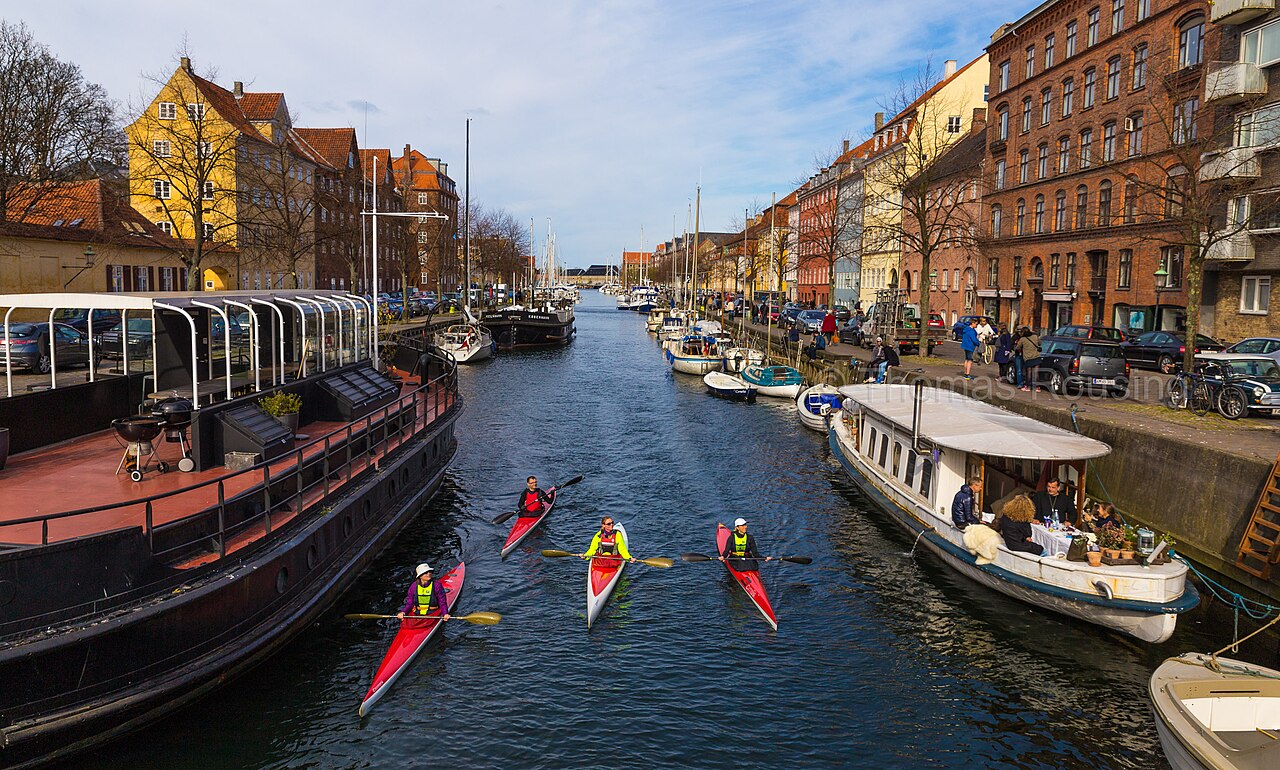
In Danish, the church is called Vor Frelsers Kirke. It stands in Christianshavn, a district of canals, houseboats and old merchant houses across the harbour from the medieval centre of Copenhagen. This part of the city was planned in the seventeenth century, partly as a fortified extension of the capital and partly as a home for traders and naval workers. A new district needed a large church. The building you see was raised to serve it, and it became one of the clearest landmarks on the whole Copenhagen skyline.
The main body of the church was built in the late seventeenth century, between 1682 and 1696. Its architect was Lambert van Haven, a Danish architect who had travelled and studied abroad. He brought home the language of Dutch and Italian Baroque. Baroque, for anyone unfamiliar with the word, is a European style of the period that loves drama, curves, and rich ornament. Here, though, the outside is fairly restrained. Look at the plain red brick and the sandstone details. The drama was saved for later... and for the top.
For several decades, the church had no finished spire. The tower stood waiting. Then, in the middle of the eighteenth century, the architect Lauridz de Thurah took on the job. His spire was completed in 1752. Many writers point out that his design echoes a famous church in Rome, Sant'Ivo alla Sapienza, by the Italian Baroque master Borromini. That Roman church also has a spiralling top. But de Thurah did something bolder. He put a staircase on the outside, so that people could climb the spiral itself.
Here is the story almost every visitor hears. Legend has it that the staircase twists the wrong way. According to the tale, the architect realised his mistake too late, climbed to the top in despair, and threw himself off. It is a dramatic story. It is also not true. De Thurah did not die at the church, and he lived for several more years after the spire was finished. Locals still enjoy telling the tale, so you may hear it from a passing tour group. Now you know the real ending.
There is another tradition linked to the opening of the spire. According to an often-repeated account, the king of Denmark at the time, Frederick the Fifth, climbed the tower when it was inaugurated. Whether he went all the way to the very top is hard to confirm. What is certain is that the spire was a royal-era statement. It showed that this young district across the water had a church worthy of a capital city.
Raise your eyes to the very peak. At the top sits a gilded globe, and on the globe stands a figure of Christ holding a banner. This is the Saviour who gives the church its name. From the street, the figure looks small. Up close, it is much larger than most people expect. On a bright day, the gold catches the sun and you can follow it from many parts of the city. On a grey day, it is often the only warm colour in the sky.
If you decide to climb, prepare your legs. The route has around 400 steps in total. The first part runs inside the tower, past heavy timber beams and the church bells. Near the top, you step outside onto the external staircase. The steps become narrower and narrower as the spiral tightens. Near the summit, there is barely space for one person. The wind is stronger up there, and the railing feels very welcome. People who are nervous about heights often go slowly, and that is completely fine.
The reward is a wide view across Copenhagen. Below you lie the canals of Christianshavn, lined with boats. Beyond them are the copper-green roofs and spires of the old city. Look the other way, and you will see the harbour, the modern waterfront, and on a clear day, the bridge towards Sweden. Close by is the free town of Christiania, a self-governing community founded in an old military area in the 1970s. From the tower, you can see how tightly old and new sit together here.
Now let us go inside. The interior surprises many visitors because it is so bright. The walls are white, the light is clear, and the space feels open and calm. This is a Lutheran church, and Danish Lutheran churches are often simpler than Catholic churches in southern Europe. But simple does not mean plain. Walk towards the front, and you will see an elaborate Baroque altar. It was designed by the Swedish architect Nicodemus Tessin the Younger, and it is full of sculpted figures, clouds and rays of light.
Then turn around and look up at the organ. This is the detail that most people miss. The great organ case, made around 1700, rests on carved elephants. Why elephants, in a church in Denmark? The elephant is a symbol connected with the Order of the Elephant, Denmark's highest royal honour. So the animals are not decoration by chance. They carry a quiet message about the crown. The organ is still played, and if you are lucky enough to hear it, the sound fills the whole white room.
The tower also holds a carillon, a set of tuned bells played to produce melodies. At certain moments, you may hear tunes drifting down over the rooftops of Christianshavn. It is one of those sounds that ties a neighbourhood together. Residents hear it while cycling along the canal or sitting outside a café. For them, this church is not only a viewpoint. It is part of daily life, a place for services, concerts, weddings and funerals, as it has been for more than three centuries.
Before you leave, step back a little and look at the whole building again. Notice how the warm red brick holds the ground, while the dark spire and its golden stair pull your eye upward. Listen to the bicycles on the cobbles and the water moving in the canal nearby. As you walk away through Christianshavn, keep glancing back over your shoulder. That twisting spire will follow you for streets... and it will look slightly different from every corner.
Key facts
What to look for
Practical tips
Common questions
Is there a free audio guide to Church of Our Saviour?
Yes — the Lokali app narrates Church of Our Saviour free of charge in 50+ languages. The guide runs about 8 minutes, covers the history, what to look for on site and practical tips, and works offline once downloaded.
Where is Church of Our Saviour?
Church of Our Saviour is in Copenhagen, Denmark, at 55.6728, 12.5939. Tap the map link on this page for directions from where you are.
What is Church of Our Saviour known for?
Main church built between 1682 and 1696. Original architect was Lambert van Haven.
What should you look for at Church of Our Saviour?
Carved elephants supporting the great organ case. Golden figure of Christ standing on the gilded globe. External staircase narrowing to almost nothing at the summit.
What should you know before visiting Church of Our Saviour?
Check the weather first; the tower may close in strong wind. Wear shoes with good grip for the narrow outer stairs.
When is the best time to visit Church of Our Saviour?
Climb early to avoid queues on the tight spiral.
On the map
Opens directions to Church of Our Saviour from your location.
More to see in Copenhagen


Hear Church of Our Saviour in your language
The full story, narrated, in 50+ languages. Download it before you go and it plays offline, at your own pace, with no ticket and no tour group.