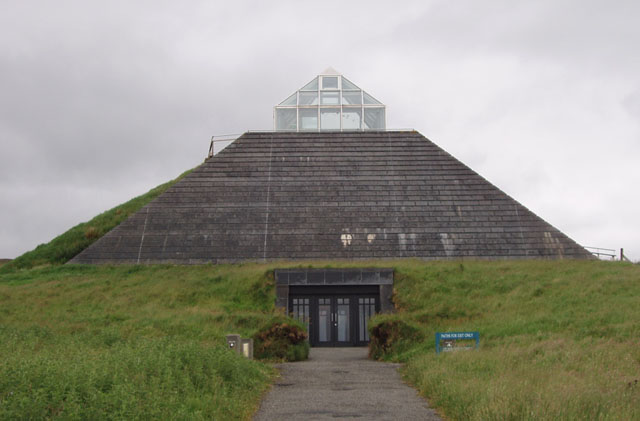
Céide Fields
54.3072° N · 9.4578° W · Archaeological Site
Photo: Liz McCabe · CC BY-SA 2.0 · Wikimedia Commons
Céide Fields is a neolithic site in the West of Ireland. Stone field walls are close to six thousand years old. The free Lokali audio guide runs 6 minutes.
✓ Published October 2026 · how we write these guides
Visitor facts
| Lokali audio guide | 6 min · free |
|---|---|
| Type | Archaeological Site |
| Location | County Mayo, Ireland |
| Coordinates | 54.3072, -9.4578 |
| Languages | 50+, in the Lokali app |
The story
Listen for a moment. The wind comes off the Atlantic with nothing to stop it, and it moves through the heather in a low, steady rush. Underfoot the ground gives slightly, soft and springy, like a mattress soaked in rain. Brown bog stretches in every direction, broken only by sky and sea. It looks empty. It is not. Beneath your feet, under several metres of peat, lies one of the oldest farmed landscapes ever found on Earth.
This is Céide Fields, on the north coast of County Mayo, a short drive west of the village of Ballycastle. The name comes from the Irish for a flat-topped hill. What lies here is a Neolithic field system, a network of stone walls built by some of Ireland's first farmers. The walls are close to six thousand years old. They are older than Stonehenge in its stone form. They are older than the pyramids of Egypt.
The story of how they were found begins with turf. For generations, families in north Mayo cut peat from the bog to burn as fuel. In the 1930s a local schoolteacher named Patrick Caulfield noticed something odd while cutting. His spade kept striking stones. They were not scattered at random. They sat in lines, deep below the surface, where no recent farmer could have placed them. A bog grows only a millimetre or so each year, so stones that deep had to be very old.
Patrick Caulfield understood that this mattered, but the full picture would take another generation. His son, Seamus Caulfield, grew up to become an archaeologist. From the 1970s he returned to the bog where his father had cut turf, and he began to trace those buried lines. It is a rare thing in archaeology — a discovery passed from father to son, across the same patch of ground.
Here is the first surprise. Most of these walls have never been dug up. Excavating a whole landscape under peat would be slow and destructive. Instead, the team used a simple tool: long iron probes. They pushed the rods down through the soft bog until they struck stone. They marked each hit with a small stake. Point by point, stake by stake, they drew a map of walls they could not see. You may still spot lines of these markers out on the bog.
What that map shows is remarkable. The walls run in long, parallel lines, often stretching for great distances, with cross-walls dividing the land into large rectangular fields. This was not a few scattered plots. It was a planned landscape, laid out across several square kilometres. Someone organised it. Many families must have cooperated. That suggests a settled, structured community, living here for a long time.
So what were the fields for? The size of the enclosures points mainly to cattle. Archaeologists think these early farmers kept herds and grazed them on open pasture, using the walls to manage the animals. Traces of houses and tombs have also been found within the system. Picture smoke rising from small homes, cattle lowing across the slope, and people working stone by hand to shape the land.
Now look again at the bog around you, and here is the second surprise. When those farmers arrived, this place was not a bog at all. It was dry land, with good soil and, before the clearing, woodland. Over many centuries the climate grew wetter. Heavy rain washed nutrients out of the soil. Water collected, plants stopped rotting fully, and peat began to build up. Slowly, the bog rose and covered the fields entirely.
That is the strange gift of this place. The same bog that drove the farmers away also preserved their work. Peat seals out oxygen and slows decay. Walls that would have been broken up and reused elsewhere stayed exactly where they were built. The bog acted like a blanket laid over the whole landscape, and it held its shape for thousands of years.
The visitor centre is hard to miss. It is a pyramid-shaped building that rises from the bog, clad in stone and designed to sit low in this exposed landscape. It opened in the early 1990s and drew attention for its architecture. Inside, one object stops many visitors. It is the stump of an ancient pine tree, pulled from the bog. These trees grew here after the fields were abandoned, before the peat finally swallowed them too. The wood is thousands of years old, yet it still looks like wood.
Walk out onto the paths and the setting opens up. Just beyond the fields, the land drops away into high sea cliffs. Below, the Atlantic breaks against dark rock. On a clear day you can look along the coast and see headlands folding into the distance, including Downpatrick Head to the east. The Neolithic farmers saw this same coastline. The cliffs are one of the few things here that look much as they did then.
The bog itself is worth your attention. Look closely and you will find a small world of plants adapted to wet, acidic ground. Mosses form the base of the peat. Heather, sedges and cotton grass grow on top. In season, the white tufts of bog cotton move in the wind like scraps of wool. Some of these plants are uncommon elsewhere. The whole surface is still slowly growing, still adding to the layer above those ancient walls.
Before you leave, stand still for one more minute. Feel the give of the peat beneath your boots. Listen to the wind and the distant sea. Somewhere below you, a line of stones runs on through the dark, placed by hands that worked here long before any written word in Ireland. As you walk back toward the road, notice the little stakes in the bog, and remember that each one marks a place where the past was touched with an iron rod.
Key facts
What to look for
Practical tips
Common questions
Is there a free audio guide to Céide Fields?
Yes — the Lokali app narrates Céide Fields free of charge in 50+ languages. The guide runs about 6 minutes, covers the history, what to look for on site and practical tips, and works offline once downloaded.
Where is Céide Fields?
Céide Fields is near County Mayo, Ireland, at 54.3072, -9.4578. Tap the map link on this page for directions from where you are.
What is Céide Fields known for?
Stone field walls are close to six thousand years old. Schoolteacher Patrick Caulfield found buried stones while cutting turf.
What should you look for at Céide Fields?
Small marker stakes tracing buried wall lines across the bog. The pyramid-shaped visitor centre rising from the open bog. An ancient bog pine stump displayed inside the centre.
What should you know before visiting Céide Fields?
Bring a waterproof jacket; Atlantic weather changes very quickly. Wear sturdy waterproof footwear for the soft, wet bog paths.
On the map
Opens directions to Céide Fields from your location.
More to see near Céide Fields

Hear Céide Fields in your language
The full story, narrated, in 50+ languages. Download it before you go and it plays offline, at your own pace, with no ticket and no tour group.