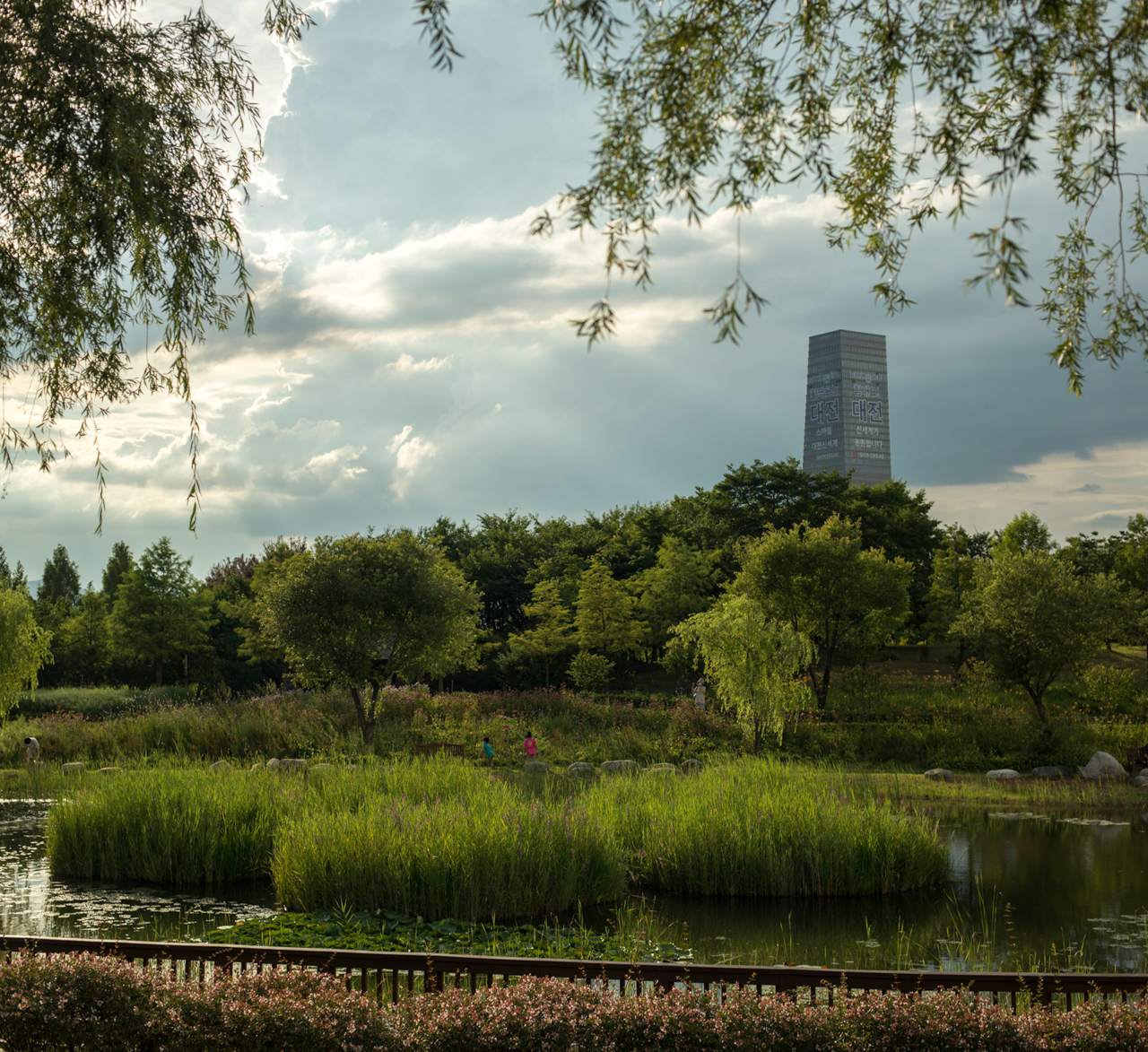
Hanbat Arboretum is a 82-hectare botanical garden featuring over 2,500 plant species arranged in themed zones. It is in Daejeon, South Korea. Most visitors spend 1–2 hours here. The free Lokali audio guide runs 6 minutes.
✓ Verified August 2026 · how we write these guides
Visitor facts
| Time needed | 1–2 hours |
|---|---|
| Lokali audio guide | 6 min · free |
| Type | Park |
| Best for | Photography |
| Location | Daejeon, South Korea |
| Coordinates | 36.3164, 127.3074 |
| Languages | 45, in the Lokali app |
The story
You step off the busy street and the noise of the city drops away behind you. Tall trees stand in long rows ahead. The air changes at once; it smells of leaves and damp soil and growing things. This is Hanbat Arboretum, a large green park set down in the middle of Daejeon. People made it here on purpose, planting a whole forest so that the city would have a place to breathe.
The name Hanbat is the old Korean word for Daejeon itself. It means large field. The arboretum sits in the Dunsan area, in Seo-gu, right beside the city government complex and close to the main art museums. Around its edges stand tall office towers and apartment blocks. But once you are inside, all of that falls back, and there are only trees, water, and quiet paths under the open sky.
This is not a wild forest that grew on its own. It was planted. Workers laid out every garden, dug the ponds by hand, and set each young tree carefully into place. It is one of the largest arboretums of its kind anywhere in Korea, built up patiently over several years. From the ground, though, none of that long effort shows. It feels settled and natural now, as if it had always stood here.
The park is divided into separate gardens. There is a west garden and an east garden, with a wide central path and open lawns lying between them. You can walk for a long time and pass through many smaller sections along the way, each one planted with its own trees and flowers. Take your time as you go. There is no single correct route, and no reason at all to hurry through it.
Entry to the arboretum is free, and that simple fact changes everything. It means this is not a special outing you save for once a year, but an ordinary daily place. In the early morning you see older residents walking slow, steady laps. At midday, office workers come and sit under the trees with their lunch. In the evening, families arrive and let their children run loose across the grass.
There is a greenhouse here too, a tall building of glass that holds plants from the warmer parts of the world. Step through its doors and the air changes again, turning humid and thick and green. Broad tropical leaves rise high overhead, and water drips somewhere just out of sight. In the cold months of winter, this warm glass room is one of the finest places in the whole park to stand a while.
Water runs all through the grounds. There are wide ponds with surfaces so still that they hold the full reflection of the trees above. Small wooden bridges cross over them here and there. In spring, the edges fill up with flowers. In autumn, the leaves turn red and gold and drift down to rest on the water. Each season hands the park a completely different face to wear.
Because the whole arboretum was carefully designed, the paths are wide, level, and smooth underfoot. They are easy for older visitors, and easy for parents pushing strollers. Benches are set at regular points along the way. You are never very far from somewhere to sit down and rest your legs. This quiet care in the planning is a large part of why so many people use the park every single day.
Around the arboretum stand several of Daejeon's main cultural buildings. An art museum and a large arts center are both close by, within an easy walk. Many people join a slow walk among the trees with a visit to an exhibition or a concert. The park forms the green and open center of this whole group of buildings, tying them together into one calm district.
Listen carefully as you walk. You hear birdsong, the wind moving in the leaves overhead, and water running somewhere nearby. The constant sound of city traffic is surprisingly far away and faint. The trees form a thick screen that softens the hard noise of the streets outside. This deep quiet, in the very middle of a large city, is exactly what the planners hoped to create when they built it.
Children have their own spaces here as well. There are wide open lawns where they can run freely, and small gardens shaped and planted to catch their interest. Parents sit nearby on the grass and watch, in no hurry to leave. The arboretum is one of those rare places where a whole city comes to relax together, across every age, on the same warm afternoon.
Find a bench beneath one of the wide trees and sit down for a moment. Watch the light come down through the moving leaves and slide slowly across the path in front of you. A whole busy city stands just beyond these trees, waiting. But here, for a little while at least, there is only the green, the water, and the quiet.
Key facts
What to look for
Practical tips
Common questions
How long do you need at Hanbat Arboretum?
Plan 1–2 hours. That is the time most visitors spend at Hanbat Arboretum. The free Lokali audio guide adds about 6 minutes of narration you can listen to as you walk, so it fits inside your visit rather than adding to it.
Is there a free audio guide to Hanbat Arboretum?
Yes — the Lokali app narrates Hanbat Arboretum free of charge in 50+ languages. It covers the history, what to look for on site and practical tips, and it works offline once downloaded.
Where is Hanbat Arboretum?
Hanbat Arboretum is in Daejeon, South Korea, at 36.3164, 127.3074. Tap the map link on this page for directions from where you are.
What should you know before visiting Hanbat Arboretum?
Arrive early to walk before the midday crowds.
What is Hanbat Arboretum known for?
Hanbat is the old Korean name for Daejeon.
What is the best time to visit Hanbat Arboretum?
The Japanese garden section feels transported from Kyoto.
On the map
Opens directions to Hanbat Arboretum from your location.
More to see in Daejeon


Hear Hanbat Arboretum in your language
The full story, narrated, in 50+ languages. Download it before you go and it plays offline, at your own pace, with no ticket and no tour group.