
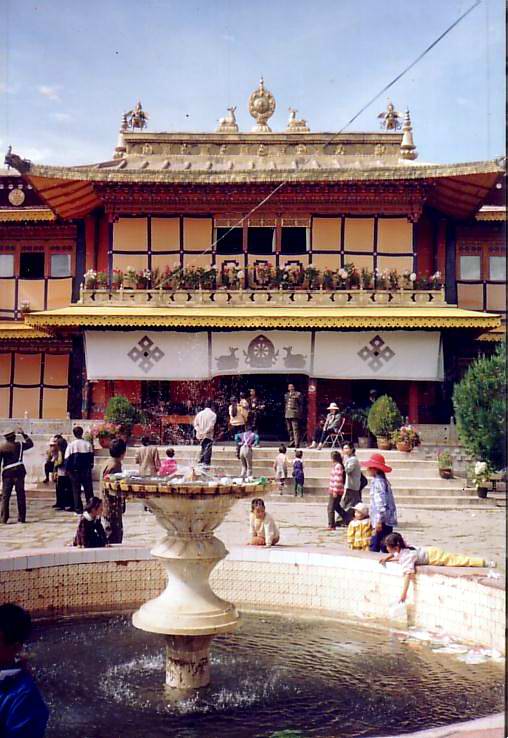
Photo: Wikimedia Commons contributor · CC BY-SA 3.0 · Wikimedia Commons
Ganden Monastery is a monastery in Dagzê District, Lhasa, Tibet, China. Founded in 1409 by the scholar Je Tsongkhapa. The free Lokali audio guide runs 6 minutes.
✓ Published October 2026 · how we write these guides
Visitor facts
| Lokali audio guide | 6 min · free |
|---|---|
| Type | Monastery |
| Location | Dagzê, China |
| Coordinates | 29.7585, 91.4763 |
| Languages | 50+, in the Lokali app |
The story
The air up here is thin, and you feel it in your chest before you see anything at all. The road climbs in long switchbacks above the valley floor. Then the white walls appear, stacked across a hollow in the mountain like a crescent of stone. Prayer flags snap in the wind. Somewhere a door creaks, and the smell of butter lamps drifts out. This is Ganden Monastery, one of the highest great monasteries in Tibet.
Ganden sits on a mountain east of Lhasa, a drive of an hour or more from the city. The site stands at well over four thousand metres above sea level. That height shapes everything here. The light is sharp and clear. Shadows are deep and cold. Even a short flight of steps can leave you breathless. Take it slowly. The monks who live here climb these paths every day, but they were not born in the city below.
The story begins with one man. His name was Je Tsongkhapa, a scholar and teacher from the far northeast of the Tibetan plateau. In 1409, he founded this monastery. Tsongkhapa wanted a return to strict monastic discipline and careful study of Buddhist philosophy. His followers became known as the Gelug school. Outsiders often call them the Yellow Hats, after the colour of the ceremonial hats their monks wear. Ganden was the first great home of this movement.
The name itself carries meaning. Ganden is the Tibetan word for Tushita, a heaven in Buddhist teaching. Tushita is the realm where the future Buddha, called Maitreya, waits before his final birth on earth. So the founders gave this mountain the name of a joyful heaven. Look around at the wide sky and the empty ridges. It is not hard to understand why they chose it.
Ganden soon became one of the three great Gelug monasteries of central Tibet. The other two are Sera and Drepung, both on the edges of Lhasa itself. Together they formed the intellectual heart of the Gelug tradition for centuries. At their height, these monasteries held thousands of monks. Young men came from across the Tibetan world to study here. Many spent decades in debate, memorisation, and meditation before they completed their training.
Here is a detail many visitors miss. The leader of the Gelug school is not the Dalai Lama. The formal head of the tradition is the Ganden Tripa, which means the Holder of the Ganden Throne. Unlike many Tibetan lineages, this position does not pass by reincarnation. A Ganden Tripa earns the role through long scholarship and senior office. In principle, any monk of great learning could one day sit on that throne.
Tsongkhapa died here in 1419, ten years after the founding. His remains were placed in a tomb inside the monastery. For centuries, that tomb was the spiritual centre of Ganden. Pilgrims travelled great distances to bow before it. Today you will find a golden reliquary in the main assembly area, and devotees still press their foreheads against the glass and the metal. Watch quietly. For many people around you, this is the reason they came.
Now look closely at the walls. Many of the buildings around you are not old. In the twentieth century, Ganden suffered terrible damage. During the Cultural Revolution, in the late 1960s, the monastery was largely destroyed. Halls were pulled down. Much of the site was reduced to ruins. Tsongkhapa's tomb was broken open. Accounts say that some relics were rescued by people who risked a great deal to save them.
Rebuilding began in the 1980s, and it has continued in stages since then. That is why you see a mix of textures here. Some walls show older stone and weathered timber. Others carry fresh whitewash and bright new paint. Ganden today is a monastery rebuilt on the bones of an older one. Every restored hall is a quiet statement that the community returned. The second surprise is how much of what you see is recent work.
Ganden also continues far from Tibet. After 1959, many monks went into exile in India. They re-established their colleges in the south of that country, in the state of Karnataka. The original Ganden had two main colleges, called Jangtse and Shartse. Both names now exist in two places at once. One set sits here on this mountain. The other sits thousands of kilometres away, in a warm Indian landscape very unlike these cold ridges.
Inside the halls, let your eyes adjust to the dim light. Butter lamps flicker in rows. Their smell is rich and slightly smoky. Painted columns rise in deep reds, and silk banners hang from the ceilings. Monks may be chanting in a low, steady drone. In the courtyards, you might hear the sharp clap of hands. That clap belongs to monastic debate, where one monk challenges another with each point of argument.
If you have the energy, walk the kora. This is a pilgrimage path that circles the monastery and the mountain. Pilgrims always walk it clockwise, keeping the sacred site on their right. The path runs along the hillside with long views over the river valley below. Along the way, you will pass prayer flags, piles of carved stones, and small shrines. Pilgrims touch certain rocks and walk on. Follow their rhythm, not your own.
Before you leave, stop for a moment in the open air. Look back at the white buildings curving across the slope. Listen for the wind in the flags, and for a bell or a voice from inside the halls. Feel the cold edge of the air on your face. Six centuries ago, a teacher chose this mountain for its distance from the world. As you walk back down, notice how that distance still holds.
Key facts
What to look for
Practical tips
Common questions
Is there a free audio guide to Ganden Monastery?
Yes — the Lokali app narrates Ganden Monastery free of charge in 50+ languages. The guide runs about 6 minutes, covers the history, what to look for on site and practical tips, and works offline once downloaded.
Where is Ganden Monastery?
Ganden Monastery is in Dagzê, China, at 29.7585, 91.4763. Tap the map link on this page for directions from where you are.
What is Ganden Monastery known for?
Founded in 1409 by the scholar Je Tsongkhapa. First great monastery of the Gelug, or Yellow Hat, school.
What should you look for at Ganden Monastery?
Golden reliquary linked to Tsongkhapa in the main hall. Contrast between weathered older walls and fresh whitewash. Monks clapping hands sharply during courtyard debate.
What should you know before visiting Ganden Monastery?
Spend a few days in Lhasa first to adjust to altitude. Foreign visitors need a Tibet permit and an arranged guide.
When is the best time to visit Ganden Monastery?
Bring warm layers; mountain wind is cold even in summer.
On the map
Opens directions to Ganden Monastery from your location.
More to see near Ganden Monastery

Hear Ganden Monastery in your language
The full story, narrated, in 50+ languages. Download it before you go and it plays offline, at your own pace, with no ticket and no tour group.