Photo: John Hill at English Wikipedia · CC BY-SA 3.0 · Wikimedia Commons
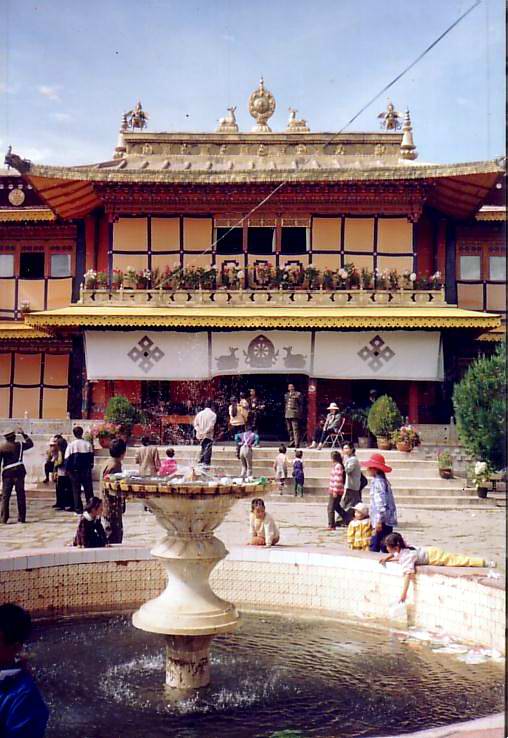
Norbulingka is a palace in Lhasa, Tibet. Name means Jewel Park or Treasure Garden in Tibetan. The free Lokali audio guide runs 6 minutes.
✓ Published October 2026 · how we write these guides
Visitor facts
| Lokali audio guide | 6 min · free |
|---|---|
| Type | Palace |
| Location | Lhasa, China |
| Coordinates | 29.6523, 91.0953 |
| Languages | 50+, in the Lokali app |
The story
Listen for a moment. Beneath the voices at the gate, there is the sound of leaves moving, and of water somewhere out of sight. The air here feels softer than on the open streets of Lhasa. Underfoot, the paths are shaded, and the light comes down in broken patches through tall trees. In a high, dry city, a garden this green feels almost surprising, and that feeling is the reason this place exists.
You are standing in Norbulingka. In Tibetan, the name means something close to Jewel Park or Treasure Garden. For roughly two centuries, this was the summer residence of the Dalai Lamas, the spiritual leaders of Tibetan Buddhism. In winter, they lived and worked in the Potala Palace, high on its hill a few kilometres to the east. In the warm months, they moved here, to a world of trees, pavilions, and quiet courtyards.
That yearly move was not a small affair. Accounts describe a formal procession from the Potala to the garden, with monks, officials, and townspeople along the route. Think about what that meant. The Potala is a fortress of stone, built upward, dense with corridors and chapels. Norbulingka spreads outward instead. It is low and green, and open to the sky. The two places together show two sides of the same life, one of ceremony and one of rest.
The story of the garden begins in the eighteenth century, with the Seventh Dalai Lama. Tradition says he came to this spot partly for its springs and its healing waters, as his health was poor. The first palace built here carries his name, Kelsang Phodrang. In Tibetan, phodrang simply means palace. Over the following generations, later Dalai Lamas added their own buildings, so the garden grew slowly, one palace at a time.
That slow growth is one of the quiet surprises of Norbulingka. It was never designed as a single plan. Instead, it is a collection of buildings from different reigns, scattered among the trees. As you walk, you move between centuries without any sign telling you so. A heavy, older roof may stand only a short walk from a building that is far more recent. The garden holds its history in layers, like rings in a tree.
Notice the buildings themselves. Tibetan architecture uses thick walls that lean slightly inward as they rise, which gives a feeling of great stability. Windows are framed in black, a broad band that widens toward the bottom. Above them, you will often see short pleated curtains, which move gently in the wind. Look up at the roofs and the gilded details catching the sun. These are the same design ideas you see at the Potala, but here they sit at a human scale, among flowers.
The Thirteenth Dalai Lama, who led Tibet in the early twentieth century, added several structures of his own. He was a reforming leader who lived through a time of great change in Asia. Then, in the 1950s, a new palace was completed for the young Fourteenth Dalai Lama. It is called Takten Migyur Phodrang, often described simply as the New Summer Palace. It is the building many visitors remember most clearly.
Inside the New Palace, the rooms feel surprisingly personal. Visitors usually see living quarters and an audience hall, with painted murals covering the walls. These murals show scenes of Tibetan history and Buddhist teaching, in deep reds, blues, and gold. Here is a detail many people miss. Alongside traditional Tibetan furnishings, there are signs of the modern world of the 1950s, such as objects that came from far beyond the Himalaya. The mix shows a young leader living between two eras.
And that leads to the most dramatic moment in the garden's story. In March 1959, during a time of crisis and uprising in Lhasa, the Fourteenth Dalai Lama was living here. Large crowds gathered around the walls of Norbulingka. One night, he left the palace in secret, disguised as an ordinary soldier, and began the long journey south toward India. He has lived in exile ever since. These quiet paths were the last part of his home that he walked through.
Today, the garden plays a different role in the life of the city. For local families, it is a place to sit in the shade, to eat, and to talk. The most lively time is the Shoton Festival, often called the Yogurt Festival, in late summer. During those days, Tibetan opera is performed here. This opera, called Ache Lhamo, mixes singing, dance, masks, and bright costumes, and performances can run for many hours.
In 2001, Norbulingka was added to the UNESCO World Heritage List. It joined the Potala Palace and the Jokhang Temple as part of one listing, the Historic Ensemble of the Potala Palace. This tells you something important. Norbulingka is not a side attraction. It is understood as one part of a single story, the story of how Tibetan religious and political life was shaped across the city of Lhasa.
A few practical thoughts as you explore. Lhasa sits at a very high altitude, well over three thousand metres, so walk slowly and drink water often. The grounds are large, and the buildings are spread out, so give yourself unhurried time. In many interior rooms, photography is restricted, so watch for signs and follow staff guidance. Take your time in the shade between buildings, too. The garden is meant to be felt as much as seen.
Before you leave, stop for one more moment under the trees. Look at the thick, whitewashed walls, the black window frames, the pleated curtains moving in the breeze. Listen again for water and leaves. For two hundred years, people came here to rest from the weight of ceremony and duty. As you walk back toward the gate and the city beyond, notice how the air changes. The garden stays behind you, quiet and green, just as it has for generations.
Key facts
What to look for
Practical tips
Common questions
Is there a free audio guide to Norbulingka?
Yes — the Lokali app narrates Norbulingka free of charge in 50+ languages. The guide runs about 6 minutes, covers the history, what to look for on site and practical tips, and works offline once downloaded.
Where is Norbulingka?
Norbulingka is in Lhasa, China, at 29.6523, 91.0953. Tap the map link on this page for directions from where you are.
What is Norbulingka known for?
Name means Jewel Park or Treasure Garden in Tibetan. Summer residence of the Dalai Lamas for about two centuries.
What should you look for at Norbulingka?
Black window frames widening toward the bottom on palace walls. Pleated fabric curtains moving above windows in the breeze. Walls that lean slightly inward as they rise.
What should you know before visiting Norbulingka?
Walk slowly and drink water often at Lhasa's high altitude. Visit during the Shoton Festival to see Tibetan opera performances.
On the map
Opens directions to Norbulingka from your location.
More to see near Norbulingka


Hear Norbulingka in your language
The full story, narrated, in 50+ languages. Download it before you go and it plays offline, at your own pace, with no ticket and no tour group.