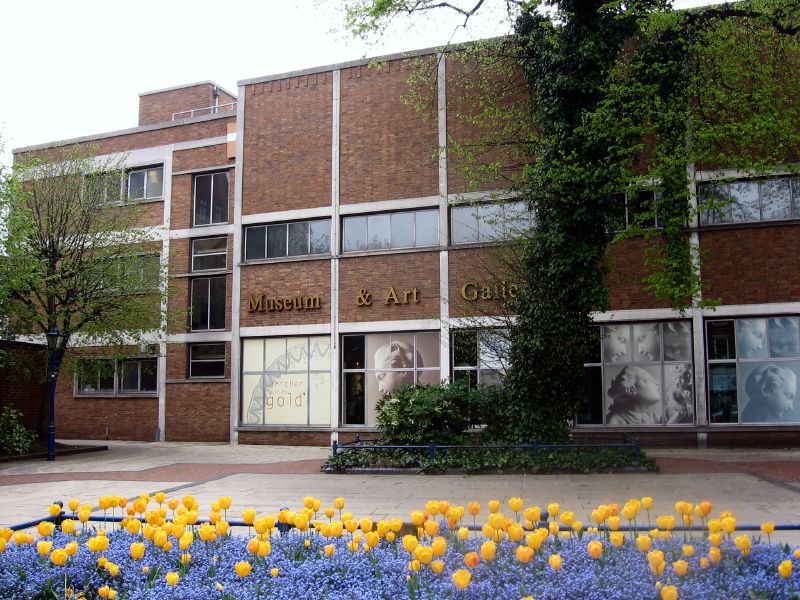
Derby Museum and Art Gallery
52.9229° N · 1.4800° W · Museum
Photo: Janet Roberts from UK · CC BY-SA 2.0 · Wikimedia Commons
Derby Museum and Art Gallery is a museum and art gallery in Derby, England, United Kingdom. The museum building opened to the public in 1879. The free Lokali audio guide runs 7 minutes.
✓ Published October 2026 · how we write these guides
Visitor facts
| Lokali audio guide | 7 min · free |
|---|---|
| Type | Museum |
| Location | Derby, United Kingdom |
| Coordinates | 52.9229, -1.4800 |
| Official website | derbymuseums.org |
| Languages | 50+, in the Lokali app |
The story
Push through the doors on the Strand and the sound of the street drops away. Traffic and footsteps give way to a softer hush. Polished floors carry the squeak of a child's trainers and the murmur of a school group further down a corridor. The air smells faintly of old timber and warm radiators. Somewhere ahead, in a gallery lit low and golden, a row of painted faces glows in candlelight that was mixed from pigment more than two centuries ago.
This is Derby Museum and Art Gallery. It is one of the oldest public museums in this part of England, and it is still very much a town's museum. Families come here on rainy Saturdays. Local schoolchildren meet their first Egyptian mummy here. Older visitors return to rooms they first walked through decades ago. Before the paintings and the porcelain, it helps to know that this place grew out of a civic idea: that ordinary working people in an industrial town deserved art and learning on their doorstep.
The building opened in 1879. Much of the money came from Michael Thomas Bass, a wealthy brewer and Member of Parliament for Derby. His family's beer had made Burton upon Trent famous, and he chose to spend part of that fortune on a free library and museum for the town. Look up at the exterior as you arrive or leave. You will see warm red brick, carved stone details and tall gables in a style that looks back to Flemish and Dutch town halls. It was built to feel generous and civic.
Now to the reason many people travel here from far beyond Derbyshire. Joseph Wright was born in this town in 1734. He became known simply as Wright of Derby, and the museum holds the largest collection of his work anywhere in the world. Wright painted portraits, landscapes and moonlit scenes. But he is best remembered for something stranger — science, lit by a single flame, in a darkened room full of astonished faces.
Find A Philosopher Lecturing on the Orrery. An orrery is a clockwork model of the solar system, with small brass planets turning around a central lamp that stands in for the Sun. In the painting, a group of adults and children lean in around the machine. The lamp itself is hidden from view. You only see its light, falling on cheeks, on a lace collar, on a boy's open mouth. Spend a moment with the children. Wright gives them the brightest faces in the room.
Here is something many visitors miss. When Wright painted these scenes, science was not yet a respectable subject for serious art. Grand paintings were supposed to show gods, kings and battles. Wright chose instead to show ordinary people watching an experiment. He lived among the engineers, inventors and mill owners of the Midlands, in the years when nearby river valleys were filling with early factories. His canvases show that excitement from the inside — the feeling of a new age arriving.
Nearby, look for The Alchemist, sometimes titled The Alchymist. An old man kneels in a gothic chamber beside a glowing flask, his arms raised in wonder. The painting is often linked to the discovery of phosphorus, a substance that gives off a ghostly light. Notice how Wright makes the glass vessel the brightest point in the whole composition. Everything else — the arches, the assistants, the moon at the window — falls away into shadow around it.
From painting, move to porcelain. Derby has made fine china since the eighteenth century, and the museum holds a large collection of it. Cases are filled with delicate figurines, painted plates and cups decorated with flowers, birds and landscapes. Look closely at the gilding and the deep blues. Derby porcelain was a luxury product, made by skilled local hands. Many families in the town have a grandmother or great-grandfather who worked in the ceramics trade, and you may overhear visitors pointing out patterns they own at home.
Next comes one of the most surprising rooms in the building. In December 1745, Charles Edward Stuart — known as Bonnie Prince Charlie — marched south from Scotland with a Jacobite army. Jacobites were supporters of the exiled Stuart family, who wanted their claim to the British throne restored. The army reached Derby, roughly halfway to London. Here, after tense discussions, the Prince's commanders decided to turn back. That retreat ended the rising's advance south. The museum's Bonnie Prince Charlie Room tells this story, and it is lined with wooden panelling linked to the house where the Prince stayed.
The collections then reach much further back in time. In the archaeology galleries, look for the Hanson Logboat. It is a boat carved from a single tree trunk, found in gravel workings in the Trent Valley and dated to the Bronze Age, roughly three and a half thousand years ago. Stand at one end and follow the length of the hollowed wood. Someone shaped this with simple tools, then paddled it on the rivers that still run through Derbyshire today.
The museum is a place of many rooms rather than one grand story. There are Egyptian mummies and coffins, which tend to draw the biggest crowds of children. There are natural history displays of Derbyshire wildlife, rocks and fossils from the Peak District. There are also military galleries for the county's regiments, with uniforms, medals and letters home. It is worth moving slowly. Some of the most personal objects sit in small cases you could easily walk past.
The museum is run by Derby Museums, a charitable trust that also looks after Pickford's House, a Georgian townhouse, and the Museum of Making at the old Silk Mill by the River Derwent. If you have time, those places complete the picture. The Silk Mill site is often described as one of England's earliest factories. Together, the three sites tell one connected story — how a market town became a place of makers, thinkers and machines.
Before you leave, go back to one of Wright's candlelit paintings. Stand still for a moment and let your eyes adjust. The light in the picture seems to come from inside the canvas, while the gallery around you stays soft and dim. Then step out onto the Strand. Notice the brick, the traffic, the ordinary afternoon light on Derby's streets. Wright walked these same streets. He looked at the people of his own town and decided they were worth painting.
Key facts
What to look for
Practical tips
Common questions
Is there a free audio guide to Derby Museum and Art Gallery?
Yes — the Lokali app narrates Derby Museum and Art Gallery free of charge in 50+ languages. The guide runs about 7 minutes, covers the history, what to look for on site and practical tips, and works offline once downloaded.
Where is Derby Museum and Art Gallery?
Derby Museum and Art Gallery is in Derby, United Kingdom, at 52.9229, -1.4800. Tap the map link on this page for directions from where you are.
What is Derby Museum and Art Gallery known for?
The museum building opened to the public in 1879. Brewer Michael Thomas Bass funded the original building.
What should you look for at Derby Museum and Art Gallery?
The hidden lamp lighting faces in the Orrery painting. The glowing glass flask in Wright's The Alchemist. Panelled walls inside the Bonnie Prince Charlie Room.
What should you know before visiting Derby Museum and Art Gallery?
Start with the Joseph Wright galleries before school groups arrive. Let your eyes adjust in the dim Wright rooms.
On the map
Opens directions to Derby Museum and Art Gallery from your location.
More to see in Derby


Hear Derby Museum and Art Gallery in your language
The full story, narrated, in 50+ languages. Download it before you go and it plays offline, at your own pace, with no ticket and no tour group.