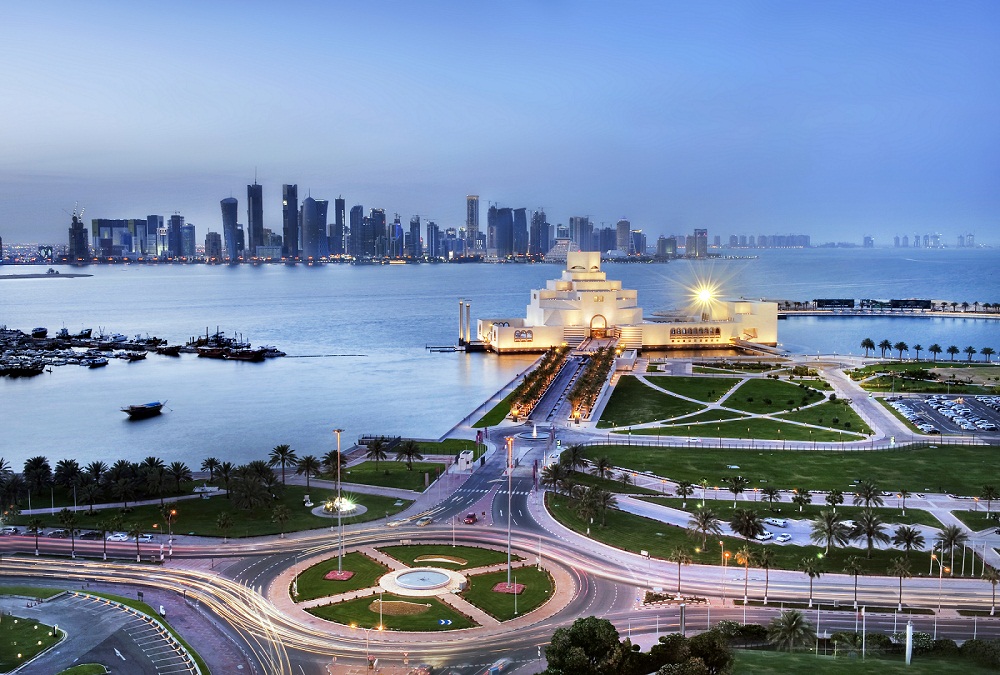
Museum of Islamic Art, Doha
25.2950° N · 51.5393° E · Museum
Photo: Mohamod Fasil · CC BY 2.0 · Wikimedia Commons
Museum of Islamic Art, Doha is an art museum in Doha, Qatar. Opened to the public in 2008 on Doha's Corniche. The free Lokali audio guide runs 6 minutes.
✓ Published October 2026 · how we write these guides
Visitor facts
| Lokali audio guide | 6 min · free |
|---|---|
| Type | Museum |
| Location | Doha, Qatar |
| Coordinates | 25.2950, 51.5393 |
| Official website | mia.org.qa |
| Languages | 50+, in the Lokali app |
The story
Listen for a moment. Behind you, the traffic on the Corniche hums like a distant engine. In front of you, water laps softly against the stone edge of the promenade. The air carries salt from the Gulf. And rising from that water is a building of pale cream limestone, stacked in clean geometric blocks. It almost seems to float. In the heat of midday it glows white. In the evening it turns honey and rose.
This is the Museum of Islamic Art. It opened in 2008, and it was one of the first great signals of Doha's ambition as a cultural city. It holds art from across the Islamic world, from Spain in the west to Central Asia and India in the east. The objects span more than a thousand years. Many visitors come for the collection. Many others come first for the building itself.
The architect was I. M. Pei, the Chinese-American designer behind the glass pyramid at the Louvre in Paris. When he accepted this commission, he was already in his late eighties and largely retired. He later said the project was one of the hardest of his career. The reason was simple. He felt he did not yet understand Islamic architecture well enough. So before drawing anything, he went looking for its essence.
Pei travelled widely. He visited mosques, palaces and fortresses across several countries. He studied the Great Mosque of Córdoba in Spain, and he looked at sites in North Africa and the Middle East. None of them gave him the answer. Then, in Cairo, he found it. At the Mosque of Ibn Tulun, a ninth-century mosque, there is a small domed fountain for ritual washing, added in the thirteenth century. Its simple shapes moved from square, to octagon, to circle.
That fountain is the seed of the building in front of you. Look at the central tower. You can see the same idea at work — a square base, then angled cuts, then a smaller form stepping upward. Pei described it as an architecture of light and shadow. Under the strong Gulf sun, every face of the stone takes a different shade. As the day moves, the building changes its appearance without moving at all.
Here is the first detail most visitors miss. The museum stands on its own island. Pei asked for it to be built on reclaimed land, just off the shore. He worried that future towers might crowd around the building and block it from view. Water, he reasoned, would protect it forever. So the museum sits apart, joined to the city by a road and surrounded by the bay on most sides.
Now think about the approach. Visitors usually walk up a long, straight path lined with palms and channels of water. It is a slow, deliberate entrance, and it is no accident. Many traditional Islamic gardens use running water and strong axes to calm the visitor before arrival. By the time you reach the doors, the noise of the road has faded. Your eye has had time to adjust to the stone.
Step inside, and the scale changes. The central atrium rises high above you, and at its top is a faceted dome. Its many angled surfaces gather and break the light. At the very centre, a small opening called an oculus lets daylight fall into the hall. Twin staircases curve up from the floor. The space feels both open and calm, with very little decoration on the walls.
And then there is the window. At the far end of the atrium, a huge wall of glass faces the bay. Through it you see the water and, across it, the towers of West Bay. It is the second surprise of this place. Pei designed a museum of the past, but he framed it with a view of the modern city. Old and new sit in the same glance.
The galleries themselves are darker and quieter, so that fragile objects stay safe from too much light. The collection includes ceramics, metalwork, glass, textiles, carpets, jewellery and manuscripts. You can see delicate lustreware, which is pottery with a metallic shine. You can see pages of the Qur'an written in elegant calligraphy, and intricate scientific instruments like astrolabes, which once helped people measure the stars. Each object shows a different craft, and a different region.
What ties these objects together is not one country or one empire. It is a shared visual language. Geometric patterns repeat across tiles and doors. Arabic script appears on bowls, on weapons and on fabric, as both text and ornament. Plant forms twist into endless scrolls. As you walk through the rooms, try to notice how the same patterns travel across centuries and across thousands of kilometres. The galleries were refreshed and reopened in 2022, with new displays.
When you leave, the museum has one more space to offer. Around it lies MIA Park, a long green stretch along the water. On weekends and cool evenings, families spread out on the grass, children run along the paths, and people fish from the edge. At the far tip stands a tall steel sculpture by the American artist Richard Serra. Its plates rise from the shore, and from there you can look back across the bay.
So take a last look at the building before you go. Notice how the stone has shifted colour since you arrived. Notice the small windows near the top of the tower, cut like narrow eyes in the limestone. Somewhere behind those walls are bowls, carpets and manuscripts that crossed deserts and seas to reach this room. And out here, the water still laps at the stone, the call to prayer may rise from the city, and the light keeps moving.
Key facts
What to look for
Practical tips
Common questions
Is there a free audio guide to Museum of Islamic Art, Doha?
Yes — the Lokali app narrates Museum of Islamic Art, Doha free of charge in 50+ languages. The guide runs about 6 minutes, covers the history, what to look for on site and practical tips, and works offline once downloaded.
Where is Museum of Islamic Art, Doha?
Museum of Islamic Art, Doha is in Doha, Qatar, at 25.2950, 51.5393. Tap the map link on this page for directions from where you are.
What is Museum of Islamic Art, Doha known for?
Opened to the public in 2008 on Doha's Corniche. Designed by I. M. Pei, architect of the Louvre pyramid.
What should you look for at Museum of Islamic Art, Doha?
The oculus at the centre of the faceted atrium dome. The giant glass window framing the West Bay towers. Square-to-octagon geometry stepping up the central tower.
What should you know before visiting Museum of Islamic Art, Doha?
Arrive late afternoon to see the limestone change colour. Walk the full palm-lined approach rather than taking a shortcut.
When is the best time to visit Museum of Islamic Art, Doha?
Arrive late afternoon to see the limestone change colour.
On the map
Opens directions to Museum of Islamic Art, Doha from your location.
More to see near Museum of Islamic Art, Doha

Hear Museum of Islamic Art, Doha in your language
The full story, narrated, in 50+ languages. Download it before you go and it plays offline, at your own pace, with no ticket and no tour group.